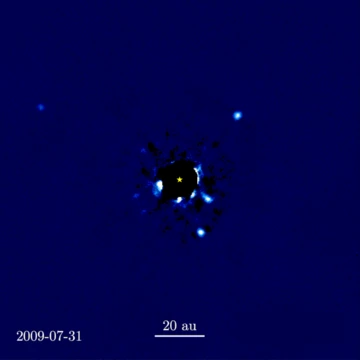
51 Pegasi b
First exoplanet found orbiting a Sun-like star.

51 Pegasi b, officially named Dimidium, is an exoplanet located about 50 light-years away in the constellation Pegasus. It was the first planet found orbiting a main-sequence star—the Sun-like 51 Pegasi—making it a landmark discovery and the original example of a class of worlds known as hot Jupiters.
The planet’s host star, 51 Pegasi, carries its Flamsteed designation. The planet itself was originally designated 51 Pegasi b by Michel Mayor and Didier Queloz, who discovered it in 1995 using the radial velocity method with the ELODIE spectrograph at the Observatoire de Haute-Provence in France. Their findings, published in the journal *Nature* on October 6, 1995, made global headlines. The following year, astronomer Geoffrey Marcy unofficially dubbed it “Bellerophon,” following the convention of naming planets after figures from Greek and Roman mythology (Bellerophon rode the winged horse Pegasus). In July 2014, the International Astronomical Union launched the NameExoWorlds process, allowing public nomination and voting for official names. In December 2015, the IAU announced the winning name: Dimidium, submitted by the Astronomische Gesellschaft Luzern in Switzerland. Latin for “half,” Dimidium refers to the planet’s mass, which is roughly half that of Jupiter.
The discovery was confirmed within a week by a team using the Lick Observatory in California. For this work, Mayor and Queloz were awarded the 2019 Nobel Prize in Physics. The planet was detected by a sensitive spectroscope that measured regular velocity changes in the star’s spectral lines of about 70 meters per second, caused by the planet’s gravitational pull from a distance of just 7 million kilometers.
After its discovery, further observations revealed that 51 Pegasi b orbits its star every four days, much closer than Mercury is to the Sun, at an orbital speed of 136 km/s (300,000 mph). Its minimum mass is about half that of Jupiter (roughly 150 times Earth’s mass). At the time, a massive world so close to its star contradicted existing theories of planet formation and was considered an anomaly. Since then, many other hot Jupiters have been found (such as those around 55 Cancri and τ Boötis), leading astronomers to revise formation theories to include orbital migration.
Assuming a perfectly grey planet with no greenhouse or tidal effects and a Bond albedo of 0.1, its temperature would be 1,265 K (992 °C; 1,817 °F), falling between the predicted temperatures of HD 189733 b and HD 209458 b. Initially, the discoverers speculated that 51 Pegasi b might be the stripped core of a brown dwarf or decomposed star, composed of heavy elements, but it is now considered a gas giant. Its mass is sufficient that its thick atmosphere is not blown away by the star’s solar wind. Despite its lower mass, the planet likely has a larger radius than Jupiter because its superheated atmosphere is puffed up into a thick, tenuous layer. Beneath this, the gases would be so hot that the planet would glow red, and silicate clouds may exist in its atmosphere. The planet is tidally locked, always showing the same face to its star. It was also considered a candidate for aperture polarimetry by Planetpol and for near-infrared characterization with the VLTI Spectro-Imager.
A 2015 study claimed to have detected 51 Pegasi b in visible light using the HARPS instrument at the European Southern Observatory’s La Silla Observatory in Chile. If confirmed, this would imply a true mass of 0.46 Jupiter masses, a high albedo, and a large radius of up to 1.9±0.3 Jupiter radii, suggesting an inflated hot Jupiter. However, the optical detection could not be replicated in 2021, implying an albedo below 0.15. Measurements in 2021 marginally detected a polarized reflected light signal, which, while not placing limits on albedo without assumptions about scattering, could suggest a high albedo. A 2022 study found no evidence of reflected light, ruling out previous radius and albedo estimates; instead, 51 Pegasi b is likely a low-albedo planet with a radius around 1.2±0.1 Jupiter radii.
- mass
- minimum mass of 0.47 Jupiter masses (actual mass unknown due to unknown orbital inclination)
Quick Facts
- Discoverer
- Michel Mayor and / Didier Queloz
- Discovery Site
- OHP, France
- Discovered
- 6 October 1995
- Discovery Method
- Radial velocity (ELODIE)
- Semimajor
- 0.052344942 · (2) · ul=au (0.052344942 AU)
- Eccentricity
- <0.0063
- Inclination
- 49.8 · 5.8 · 5.7 · u=deg
- Period
- 4.2307966 · 0.0000027 days
- Semi-Amplitude
- 55.77 · 0.15 · u=km/s
- Star
- 51 Pegasi
- Mean Radius
- 1.07 · 0.14 · ul=Jupiter radius
- Mass
- 0.61 · 0.06 · 0.05 · ul=Jupiter mass
Facts from the source article.
Lore & Background
The exoplanet's discovery was announced at a conference on October 6, 1995, and published in the journal Nature on November 23, 1995, by Michel Mayor and Didier Queloz of the University of Geneva. They used the radial velocity method with the ELODIE spectrograph on the Observatoire de Haute-Provence telescope in France, detecting slight velocity changes in the star's spectral lines of 59 ± 3 m/s. The planet was later confirmed by another team using the Lick Observatory in California, though not within a week of the original announcement. After discovery, many teams confirmed the planet's existence and obtained more observations. It was discovered that the planet orbits its star in around four days, much closer than Mercury is to the Sun, with a minimum mass about half that of Jupiter. At the time, the presence of a huge world so close to its star was not compatible with theories of planet formation and was considered an anomaly. Since then, numerous other hot Jupiters have been discovered, leading astronomers to revise their theories by studying orbital migration. The planet was originally designated 51 Pegasi b by Mayor and Queloz. In December 2015, the International Astronomical Union announced the winning name Dimidium, submitted by the Astronomische Gesellschaft Luzern, Switzerland; 'Dimidium' is Latin for 'half', referring to the planet's minimum mass of approximately half the mass of Jupiter.
Reader's Guide
51 Pegasi b holds immense significance as the first exoplanet discovered orbiting a main-sequence star, fundamentally changing astronomy and planetary science. Its discovery by Michel Mayor and Didier Queloz, awarded the 2019 Nobel Prize in Physics, opened the door to the study of exoplanets and revealed a new class of worlds: hot Jupiters. These gas giants orbiting extremely close to their stars challenged existing theories of planet formation, prompting the development of orbital migration models. The planet's physical characteristics—such as its likely inflated radius due to intense heating, tidal locking, and potential silicate clouds—have made it a key target for atmospheric studies, including the 2017 detection of water traces. Its legacy endures as a benchmark for understanding planetary systems beyond our own.
Did You Know?
- 51 Pegasi b was the first planet discovered orbiting a main-sequence star.
- The planet orbits its star in around four days, much closer than Mercury is to the Sun.
- In 2019, the Nobel Prize in Physics was awarded in part for the discovery of 51 Pegasi b.
- The official name Dimidium is Latin for 'half', referring to the planet's minimum mass of approximately half that of Jupiter.
The Discovery That Rewrote Astronomy
On October 6, 1995, Michel Mayor and Didier Queloz of the University of Geneva published a landmark announcement in the journal Nature, revealing a planet orbiting 51 Pegasi — a Sun-like main-sequence star roughly 50 light-years away in the constellation Pegasus. Their detection relied on the radial velocity technique: the ELODIE spectrograph mounted on the Observatoire de Haute-Provence telescope in France measured tiny, periodic shifts of about 70 metres per second in the star's spectral lines, produced by the gravitational tug of a world sitting only seven million kilometres from its host. The result made world headlines almost immediately, and within a single week an independent team at California's Lick Observatory confirmed the signal. The finding was extraordinary because no planet had previously been identified around a star of the Sun's type. Twenty-four years later, in 2019, the Nobel Prize in Physics was awarded in part to Mayor and Queloz for this breakthrough, cementing the discovery's place as a watershed moment in the history of astronomy.
A World That Defied Expectation
When the discovery first broke, such a configuration was flatly incompatible with prevailing models of how planets form, and the object was widely regarded as an anomaly. Over the years, however, astronomers have identified numerous similar worlds, including those around 55 Cancri and τ Boötis, and the field has shifted toward explaining their presence through orbital migration. The planet is now understood to be a gas giant rather than the stripped brown-dwarf core once hypothesised. The interior gases are so hot the planet would glow red, and silicate clouds may drift through the upper atmosphere. It is tidally locked, forever showing the same face to its star, and in 2017 traces of water were detected in its atmosphere.
From Designation to Dimidium
When Michel Mayor and Didier Queloz first reported the planet in 1995, it carried the straightforward catalogue label 51 Pegasi b, derived from the Flamsteed designation of its host star. The following year, astronomer Geoffrey Marcy gave it an informal mythological nickname — Bellerophon, the Greek hero who tamed the winged horse Pegasus — following a tradition of drawing on classical figures for planetary names. For nearly two decades that was as far as the naming went. In July 2014 the International Astronomical Union launched NameExoWorlds, a public campaign inviting nominations and votes for official names of select exoplanets and their stars. The Astronomische Gesellschaft Luzern, the Astronomical Society of Lucerne in Switzerland, submitted the entry that ultimately won. In December 2015 the IAU announced the result: Dimidium. The word is Latin for 'half,' a direct nod to the planet's mass of approximately half a Jupiter. The name thus encodes both a cultural choice and a physical fact, linking the object's identity to one of its most defining characteristics.
The Albedo Puzzle and the Search for Reflected Light
Since its discovery, 51 Pegasi b has been a target for direct-detection efforts that have produced conflicting results. A 2015 study using the HARPS instrument at the European Southern Observatory's La Silla site in Chile claimed to detect the planet in visible light, which would have implied a true mass of 0.46 Jupiter masses, a high albedo, and a radius as large as 1.9 ± 0.3 Jupiter radii — painting the picture of a dramatically inflated hot Jupiter. By 2021, however, that optical detection could not be replicated, pointing instead to an albedo below 0.15. The same year, a marginally detected polarised reflected-light signal appeared, though without firm assumptions about scattering mechanisms it could not constrain the albedo. The current consensus favours a low-albedo world with a radius around 1.2 ± 0.1 Jupiter radii. The planet also remains a candidate for aperture polarimetry with Planetpol and for near-infrared characterisation using the VLTI Spectro-Imager, keeping it in the queue for future observational campaigns.
More in Exoplanets 1-21
Spotted an error? Know more?
This is a living reference — every entry is fact-audited, and reader corrections feed straight into our audit queue. Suggest an edit · See this site's audit record