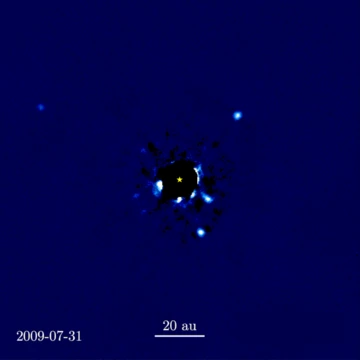
WASP-12b
A hot Jupiter being consumed by its star.

WASP-12b is a hot Jupiter—a type of exoplanet—that orbits the star WASP-12. It was discovered in April 2008 by the SuperWASP survey, which looks for planets as they cross in front of their stars. The planet completes one orbit in just over one Earth day, compared to Earth’s 365.25 days. It sits about 3.5 million kilometers (2.2 million miles, or 0.023 astronomical units) from its star, which is 1/43 of the distance between Earth and the Sun. Its orbital eccentricity matches Jupiter’s. Because it is so close to its star, the planet’s atmosphere is puffed up by stellar energy, giving it one of the lowest densities known among exoplanets. On December 3, 2013, scientists using the Hubble Space Telescope reported detecting water in its atmosphere. In July 2014, NASA announced that WASP-12b, along with HD 189733b and HD 209458b, has a very dry atmosphere.
Like other hot Jupiters, WASP-12b is tidally locked, meaning one side always faces its star (permanent day) and the other always faces away (permanent night). This setup drives strong winds that carry heat from the scorching day side to the cooler night side. Researchers Taylor Bell and Nicolas Cowan have noted that hydrogen on the day side becomes ionized, then flows to the night side, where it recombines into neutral atoms, boosting heat transport. The planet’s extreme proximity to its star creates tidal forces that stretch it into a prolate spheroid and strip away its atmosphere at a rate of about 10⁻⁷ Jupiter masses (roughly 189 quadrillion tons) per year, or 6 billion tons per second. Tidal heating and the star’s heat push the surface temperature above 2,500 K (2,200 °C, or 4,000 °F).
On May 20, 2010, the Hubble Space Telescope observed WASP-12b being consumed by its star—the first clear observation of such an event. Scientists estimate the planet has between 3 and 10 million years left before it is destroyed. Hubble’s Cosmic Origins Spectrograph (COS) confirmed predictions published in Nature in February 2009 by Peking University’s Shu-lin Li. The planet’s atmosphere has ballooned to nearly three times Jupiter’s radius, while its mass is 40% greater than Jupiter’s.
A 2012 study using the Rossiter–McLaughlin effect found that WASP-12b’s orbit is strongly misaligned with its star’s equator, tilted by 59⁺¹⁵₋₂₀ degrees. A 2019 study showed that the time between transits has been shrinking by 29 ± 2 milliseconds per year since 2008. This was updated in 2020 to 32.53 ± 1.62 milliseconds per year, giving the planet an estimated lifetime of 2.90 ± 0.14 million years. The orbital decay is due to tidal interactions with the star, and it is much faster than the decay seen in WASP-19b. In 2022, the decay rate was refined to 29.81 ± 0.94 milliseconds per year, corresponding to a lifetime of 3.16 ± 0.10 million years.
Evidence from a 2010 study suggests WASP-12b has a carbon-to-oxygen ratio of about 1, much higher than the Sun’s 0.54, making it a carbon-rich gas giant. One researcher noted that with more carbon than oxygen, rocks could be pure carbon, like diamond or graphite. The study, published in Nature, states that while carbon-rich giant planets like WASP-12b had not been observed before, theory predicts carbon-dominated solid planets with interiors of graphite or diamond. The carbon in WASP-12b’s atmosphere exists as carbon monoxide and methane. This finding led some media to call it a “diamond planet.”
Russian astronomers studying the planet’s light curve have observed regular variations that could come from a plasma torus surrounding at least one exomoon orbiting WASP-12b. This is unexpected, since hot Jupiters typically lose large moons quickly. The object might instead be a Trojan body.
- type
- Hot Jupiter exoplanet
- orbital_period
- ~1 Earth day
- distance_from_star
- ~3.5 million km (0.023 AU)
- mass
- 40% more than Jupiter
- radius
- ~3 times Jupiter's radius
Verified Timeline
Lore & Background
WASP-12b orbits its star at a distance of about 3.5 million kilometers, just 1/43 of Earth's distance from the Sun. Its proximity causes tidal forces to distort it into a prolate spheroid and pull away its atmosphere at a rate of about 189 quadrillion tons per year (6 billion tons per second). In December 2013, the Hubble Space Telescope detected water in its atmosphere, and in July 2014, NASA reported very dry atmospheres on WASP-12b and two other exoplanets. In September 2017, researchers working on the HST announced that WASP-12b reflects just 6% of the light that shines on its surface, described as "black as asphalt" and as "pitch black", although it is so hot that it emits a reddish glow. On May 20, 2010, the Hubble Space Telescope spotted WASP-12b being "consumed" by its star; scientists had been aware that stars could consume planets, but this was the first time such an event had been observed so clearly. It has been estimated that the planet has between 3 and 10 million years left of its life.
Reader's Guide
WASP-12b is significant as one of the most extreme hot Jupiters known, demonstrating the effects of tidal heating and atmospheric stripping. Its low albedo (6% reflectivity) and carbon-rich atmosphere challenge models of planetary formation and composition. The detection of water and carbon monoxide in its atmosphere, along with evidence of a possible plasma torus from a candidate exomoon, make WASP-12b a key object for studying exoplanetary atmospheres and orbital dynamics. A study from 2019 found that the time interval between two transits has decreased by 29 ± 2 msec/year since the discovery in 2008. The value was updated in 2020 to 32.53±1.62 msec/year, giving WASP-12b an estimated lifetime of 2.90±0.14 million years. In 2022, the decay rate was further refined to 29.81±0.94 msec/year, which corresponds to an estimated lifetime of 3.16±0.10 Ma.
Did You Know?
- WASP-12b reflects just 6% of the light that shines on its surface, described as 'black as asphalt' and 'pitch black', though it emits a reddish glow due to its heat.
- On May 20, 2010, the Hubble Space Telescope spotted WASP-12b being 'consumed' by its star, the first time such an event had been observed so clearly.
- The planet's atmosphere is being pulled away at a rate of about 189 quadrillion tons per year (6 billion tons per second).
- A 2012 study determined WASP-12b's orbit is strongly misaligned with its star's equatorial plane by 59+15−20°.
- Evidence from a 2010 study indicates WASP-12b has an enhanced carbon-to-oxygen ratio of about 1, significantly higher than the Sun's value of 0.54.
Discovery & Orbital Profile
Its orbital radius of roughly 3.5 million kilometres—about one forty-third of the Earth-Sun gap—places it in an extremely tight embrace around WASP-12, with an eccentricity comparable to Jupiter's own orbit. Despite carrying 40 percent more mass than Jupiter, the planet's atmosphere has swelled to nearly three times Jupiter's radius, giving it one of the lowest known densities among all exoplanets. This pronounced inflation is attributed to the relentless flood of stellar energy it receives. The combination of a bloated envelope and a compact orbit makes WASP-12b a textbook example of how close-in giant planets can be puffed up by their host star's radiation.
Atmospheric Chemistry & the Carbon Question
The chemical makeup of WASP-12b's atmosphere has generated both excitement and confusion among astronomers. In December 2013, a team using the Hubble Space Telescope reported the detection of water vapour in the planet's upper atmosphere. Yet just seven months later, in July 2014, NASA announced that WASP-12b—alongside HD 189733b and HD 209458b—possessed a remarkably dry atmosphere, a finding that seemed to complicate the earlier water detection. The excess carbon resides in the atmosphere primarily as carbon monoxide and methane. One of the researchers behind that study commented that "with more carbon than oxygen, you would get rocks of pure carbon, such as diamond or graphite". The published study states, "Although carbon-rich giant planets like WASP-12b have not been observed, theory predicts myriad compositions for carbon-dominated solid planets. Terrestrial-sized carbon planets, for instance, could be dominated by graphite or diamond interiors, as opposed to the silicate composition of Earth." These remarks have led the media to pick up on the story, some even calling WASP-12b a "diamond planet". The carbon content of the planet is located within its atmosphere, in the form of carbon monoxide and methane. The study appears in the journal Nature.
A Dying Orbit and Stellar Consumption
WASP-12b is on a slow but irreversible path toward destruction. A 2012 analysis of the Rossiter-McLaughlin effect showed its orbit is tilted roughly 59 degrees relative to the star's equatorial plane. This steady decay, driven by tidal interactions between planet and star, implies an orbital lifetime of only about 3.16 million years. Earlier estimates placed the planet's remaining lifespan at three to ten million years, a window that is now steadily closing.
A Black, Blazing, Tidally Warped World
Despite its enormous size, WASP-12b is almost impossibly dark. In September 2017, Hubble-based researchers measured its albedo at just six percent, meaning it bounces back only a tiny fraction of the starlight that strikes it. Descriptions in the literature have called its surface "black as asphalt" and "pitch black." Yet the planet is simultaneously so scorching hot that it radiates its own reddish glow, a direct consequence of tidal heating and its blistering proximity to WASP-12. Because it is tidally locked—much like the Moon always showing Earth the same face—one hemisphere is locked in perpetual daylight while the other endures endless night. This extreme temperature gradient drives ferocious winds that sweep heat from the irradiated day side toward the cooler night side. Physicists Taylor Bell and Nicolas Cowan have further argued that hydrogen atoms become ionised on the blazing day face and then recombine into neutral atoms as they travel to the cooler hemisphere, amplifying the planet's internal heat transport. The relentless tidal pull also stretches the planet into a visibly elongated, prolate spheroid shape.
More in Exoplanets 1-21
Spotted an error? Know more?
This is a living reference — every entry is fact-audited, and reader corrections feed straight into our audit queue. Suggest an edit · See this site's audit record