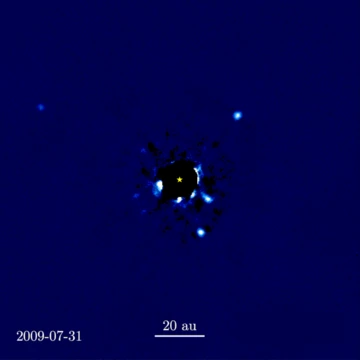
Kepler-186f
First Earth-sized exoplanet found in another star's habitable zone.

As the first planet with a radius similar to Earth's to be discovered in the habitable zone of another star, Kepler-186f became a key target in the search for potentially habitable worlds. Detected by NASA's Kepler space telescope using the transit method, its signal required three years of data analysis. The discovery, along with four other planets orbiting much closer to the star, was presented at a conference in March 2014 and formally announced in April 2014 alongside a publication in *Science*. Some follow-up studies have questioned its confirmation status, with false positive probabilities estimated at 4% in 2019 and 20% in 2025, meaning it may still be considered a candidate. The planet orbits the red dwarf star Kepler-186, which has about half the mass and radius of the Sun and is roughly 4 billion years old. Kepler-186f has a radius about 1.17 times that of Earth and orbits its star every 130 days at a distance of about 0.4 times Earth's orbital radius. The star's low luminosity means the planet receives only about 32% of the illumination Earth gets, placing it near the outer edge of the conservative habitable zone, similar to Mars's position in our solar system. Its mass is unknown but could range from a low-density water world to a dense iron-rich body; an Earth-like composition would yield a mass about 1.44 times Earth's, with surface gravity 17% higher. The planet's equilibrium temperature without an atmosphere is colder than Mars's, and its actual habitability depends entirely on unknown atmospheric properties. A simple climate model suggests surface temperatures above freezing would require at least 0.5 to 5 bars of carbon dioxide, depending on nitrogen levels. The star's four inner planets are too hot for liquid water, and while they are likely tidally locked, Kepler-186f's more distant orbit may have spared it from this fate.
- discovery_announcement
- 17 April 2014
- radius
- 1.17 ± 0.08 times Earth's radius
- constellation
- Cygnus
Lore & Background
Kepler-186f is a candidate Earth-sized exoplanet orbiting within the habitable zone of the red dwarf star Kepler-186, located in the constellation Cygnus. It is the outermost of five known planets in the system and was the first planet with a radius similar to Earth’s discovered in another star’s habitable zone. Its radius is about 1.17 times that of Earth, giving it a volume roughly 1.37 times Earth’s. The planet orbits its star at a distance of about 0.40 times Earth’s orbital radius, completing an orbit every 129.9 days. The host star is an M-type red dwarf with about half the Sun’s mass and radius, a temperature of 3755 K, and an age of roughly 4 billion years. Kepler-186f receives about 32% of the illumination Earth gets from the Sun, placing it near the outer edge of the conservative habitable zone, similar to Mars’s position in our solar system. Its mass is uncertain, with estimates ranging from 0.32 Earth masses for a pure water-ice composition to 3.77 Earth masses for pure iron; a composition similar to Earth yields a mass of about 1.44 Earth masses and a surface gravity 17% higher than Earth’s. The planet’s equilibrium temperature—without an atmosphere—is somewhat colder than Mars’s. Its atmosphere is unknown, but climate models suggest that with at least 0.5 to 5 bars of carbon dioxide, surface temperatures could rise above freezing. The four inner planets orbit much closer to the star and are considered too hot for liquid water. Kepler-186f was detected via the transit method after three years of data analysis; its false positive probability has been estimated at 4% by a 2019 study and 20% by a 2025 study, meaning it remains a candidate rather than a confirmed planet.
Reader's Guide
Kepler-186f holds significance as the first Earth-sized exoplanet discovered within the habitable zone of another star, demonstrating that planets of similar size to Earth can exist in regions where liquid water might be possible. Its discovery marked a milestone in exoplanet science, shifting the search for potentially habitable worlds from gas giants to rocky planets. However, key components needed to determine its habitability—such as its atmosphere, composition, and whether liquid water can exist on its surface—remain unknown. The planet is too distant for its atmosphere to be analyzed by current or next-generation instruments like the James Webb Space Telescope. Climate models suggest that surface temperatures above freezing could be possible if sufficient carbon dioxide is present in its atmosphere. The planet's axial tilt is likely very small, and its orbit is probably close to circular, so it would lack Earth-like seasons. One review essay in 2015 concluded that Kepler-186f, along with Kepler-442b and Kepler-62f, were likely the best candidates for being potentially habitable planets. Studies in June 2018 suggested that Kepler-186f may have seasons and a climate similar to those on Earth. The SETI Institute's Allen Telescope Array listened for radio emissions from the system for about a month as of 17 April 2014, finding no signals attributable to extraterrestrial technology.
Did You Know?
- Kepler-186f was the first Earth-sized planet discovered in the habitable zone of another star.
- The planet receives about 32% of the illumination Earth gets from the Sun, similar to Mars's position in the Solar System.
Discovery and the Ongoing Debate Over Confirmation
Finding Kepler-186f required sifting through three full years of photometric data collected by NASA's Kepler space telescope. The planet revealed itself through the transit method—tiny, periodic dips in stellar brightness as it passed in front of its host star. Alongside it, four smaller inner planets were identified, all modestly larger than Earth. The team first presented their findings at a conference in mid-March 2014, with media coverage following shortly after. The formal announcement came on April 17, 2014, timed with a peer-reviewed paper in Science. The discovery carried historic weight: it marked the first time a planet with a radius close to Earth's was found orbiting within another star's habitable zone. Yet the story has not reached a clean conclusion. Subsequent statistical analyses have raised the possibility that the signal still sits below the conventional threshold for full planetary confirmation, leaving it technically a candidate.
Size, Mass, and the Puzzle of Composition
From the transit depth, astronomers can derive the planet's radius relative to its star. For Kepler-186f that ratio is roughly 0.021, yielding a radius of about 1.17 times Earth's, with an uncertainty of 0.08 Earth radii. In volume the planet is roughly 1.37 times Earth's, though the error band stretches from 0.87 to 2.03. Mass remains a wide-open question. Depending on assumed composition, estimates swing from 0.32 Earth masses for a hypothetical pure water-ice body to 3.77 for an all-iron sphere—both implausible extremes. A realistic Earth-like mix of iron and silicate rock points to around 1.44 Earth masses and surface gravity roughly 17 percent stronger than our own. A thick hydrogen-helium envelope is considered unlikely: planets below 1.5 Earth radii tend not to retain such atmospheres, and the intense extreme-ultraviolet radiation a young red dwarf emits would have stripped any primordial H/He through hydrodynamic escape.
A Red Dwarf's Crowded Neighborhood
From Earth it appears at an apparent magnitude of 14.62, far too faint for unaided human eyes, which top out around magnitude 6.5 to 7. The system hosts five known planets in total. The four inner worlds—designated b, c, d, and e in order of increasing orbital distance—circle so close to their star that they are considered too hot to sustain liquid water and are probably tidally locked. It receives approximately 32 percent of the illumination Earth gets from the Sun. The conservative habitable zone for this system spans from 0.23 to 0.46 AU, meaning Kepler-186f sits comfortably inside but near the outer boundary—a position analogous to Mars in our own Solar System.
The Habitability Question: Promise and Limits
Being in the habitable zone is necessary but nowhere near sufficient for a world to support life, and Kepler-186f's atmospheric properties remain entirely unknown. What can be done is modeling. A simplified climate simulation—restricting volatile inventory to nitrogen, carbon dioxide, and water, and ignoring cloud effects—suggests surface temperatures would climb above the freezing point of water if the atmosphere carries anywhere from 0.5 to 5 bars of CO₂, across a range of assumed nitrogen partial pressures from 10 bars down to zero. Tidal locking presents another wildcard: the four inner planets are almost certainly locked, but Kepler-186f orbits high enough that the star's tidal torque is much weaker, and the system's roughly four-billion-year age may not have been long enough to fully synchronize its rotation. Current estimates put the probability of tidal locking at about fifty percent. Until an atmosphere is detected and characterized, the question of whether liquid water can persist on this world's surface remains firmly open.
More in Exoplanets 1-21
Spotted an error? Know more?
This is a living reference — every entry is fact-audited, and reader corrections feed straight into our audit queue. Suggest an edit · See this site's audit record