The transit method
Detects exoplanets by measuring starlight dimming during transit.

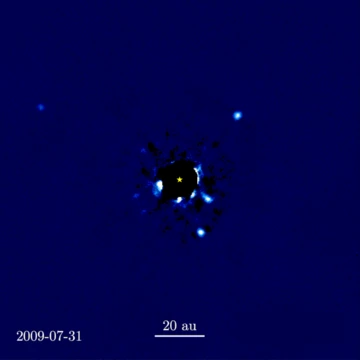
The transit method detects exoplanets by observing the periodic, slight decrease in a star's brightness that occurs when a planet crosses in front of it, blocking a fraction of the star's light. This technique is one of several indirect detection strategies, which are necessary because planets are extremely faint compared to their parent stars—a star like the Sun is roughly a billion times brighter than the reflected light from any of its orbiting planets, and the star's glare overwhelms the planet's signal. As a result, very few exoplanets have been directly imaged or resolved from their host star. The transit method itself can determine a planet's radius from the depth of the dimming. When combined with radial velocity measurements, which track the star's wobble due to the planet's gravitational pull, the planet's true mass can be calculated. The radial velocity method, also known as Doppler spectroscopy, was the most productive technique for discovering planets until around 2012, when the transit method, particularly from the Kepler space telescope, surpassed it in number of discoveries. Radial velocity works by detecting variations in a star's speed toward or away from Earth, revealed by shifts in its spectral lines via the Doppler effect. Modern spectrometers like HARPS, HIRES, and EXPRES can detect velocity changes as small as a few meters per second, though Earth-mass planets are only detectable in very small orbits around low-mass stars. The radial velocity method is distance-independent but requires high signal-to-noise spectra, limiting it mostly to nearby stars for lower-mass planets. It can directly measure a planet's orbital eccentricity but only provides a minimum mass estimate unless the planet's own spectral lines can be distinguished. False signals can arise from stellar activity, magnetic fields, or insufficient data in multi-planet systems, though techniques like Gaussian Process modeling can help disentangle planetary signals from stellar noise.
- field
- Astronomy
- known_for
- Detecting exoplanets via periodic dimming of a star's light
- first_successful_use
- HD 209458 (star dims by 1.7%)
- key_observables
- Transit depth, transit duration, ingress/egress duration, period
Lore & Background
The transit method relies on photometry, measuring the drop in a star's brightness when a planet crosses its disk. The method assumes the planet and star are spherical, the stellar disk is uniform, and the orbit is circular for simplified calculations. From the light curve, astronomers derive the transit depth (δ), which reveals the planet's radius relative to the star; the transit duration (T), which depends on orbital speed; and the ingress/egress duration (τ), which varies with the transit path across the star. These observed parameters allow calculation of physical properties such as semi-major axis, star mass and radius, planet radius, eccentricity, and orbital inclination. After 2012, the transit method from the Kepler space telescope became the most productive technique for discovering exoplanets, surpassing radial velocity. The method can confirm findings from radial velocity, and when both methods are used together, the planet's true mass can be estimated.
Reader's Guide
The transit method is significant because it provides a direct measurement of a planet's radius, complementing the mass estimates from radial velocity. This combination allows astronomers to determine a planet's density and infer its composition. The method's productivity surged after 2012, largely due to the Kepler space telescope, which monitored many stars simultaneously. The method also assumes idealized conditions (spherical bodies, uniform stellar disk, circular orbit) for basic calculations, though real systems may deviate. Despite these challenges, transit photometry has become a cornerstone of exoplanet detection, enabling the discovery of thousands of planets and providing key data for characterizing their sizes and orbits.
Did You Know?
- The transit method can determine a planet's radius from the depth of the starlight dimming.
- After 2012, the transit method from the Kepler space telescope became the most productive exoplanet detection technique.
- When combined with radial velocity data, the transit method allows estimation of a planet's true mass.
More in Exoplanets 1-21
Spotted an error? Know more?
This is a living reference — every entry is fact-audited, and reader corrections feed straight into our audit queue. Suggest an edit · See this site's audit record