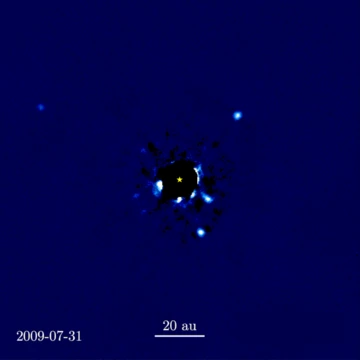
PSR B1257+12 planets
First confirmed exoplanets, orbiting a pulsar.

The PSR B1257+12 planets, named Draugr, Poltergeist, and Phobetor, are the first confirmed extrasolar planets ever discovered, revolutionizing astronomy by proving that planets can exist outside the Solar System and around a stellar remnant. Their host star, PSR B1257+12 (also known as Lich), is a millisecond pulsar located in the constellation Virgo, rotating at 160.8 times per second. This neutron star was discovered in 1990 by Aleksander Wolszczan using the Arecibo radio telescope. Anomalies in its pulsation period led to the 1992 discovery of two planets by Wolszczan and Dale Frail, with a third found in 1994. The planets are believed to have formed from a disk of material resulting from the merger of two white dwarfs, which collapsed into the pulsar. Poltergeist and Phobetor were detected first, followed by Draugr, which remains the lowest-mass planet ever detected by any observational technique, having less than twice the mass of Earth’s moon. The planets are named after undead beings: Draugr from Norse mythology, Poltergeist from German folklore, and Phobetor, a son of Somnus in Ovid’s *Metamorphoses*. The system may also host an asteroid or Kuiper belt. A later claim of a fourth body, first a Saturn-like gas giant and then a dwarf planet, was retracted after further observations.
- discovered
- 1992 (Poltergeist, Phobetor); 1994 (Draugr)
- host_star
- PSR B1257+12 (Lich)
- type
- Pulsar planets
- number_confirmed
- 3
- lowest_mass_planet
- Draugr (less than twice the mass of Earth's moon)
- first_extrasolar_planets
- True
- first_pulsar_planets
- True
Lore & Background
The three planets orbiting the millisecond pulsar PSR B1257+12 were the first confirmed extrasolar planets ever discovered, a finding that surprised astronomers who had expected planets only around ordinary stars. The two outer planets, Poltergeist and Phobetor, were announced in 1992 by Aleksander Wolszczan and Dale Frail, with the innermost planet, Draugr, found in 1994. Draugr remains the lowest-mass planet detected by any observational technique, having somewhat less than twice the mass of Earth’s Moon. The planets are believed to have formed from a disk of material left over after two white dwarfs merged to create the pulsar, rather than from a typical stellar nebula. They were originally designated PSR 1257+12 A, B, and C in order of increasing distance, but later received the proper names Draugr, Poltergeist, and Phobetor through the IAU’s NameExoWorlds campaign in December 2015. The host star, a millisecond pulsar rotating 160.8 times per second, is also called Lich, after a powerful undead creature.
Reader's Guide
The PSR B1257+12 planets are historically significant as the first confirmed exoplanets, proving that planetary systems can exist beyond the Solar System. Their discovery around a pulsar—a rapidly spinning neutron star—was unexpected, as astronomers had assumed planets only form around main-sequence stars. The planets are believed to have formed from a disk of material resulting from the merger of two white dwarfs, which created the pulsar. This system also sparked a search for other pulsar planets, though only a handful have been confirmed. The planets' naming convention—using lower-case Roman letters from 'b'—became the standard for exoplanets. Draugr remains the lowest-mass planet discovered by any observational technique, with less than twice the mass of Earth's moon.
Did You Know?
- The planets were the first extrasolar planets and first pulsar planets ever discovered.
- Draugr has less than twice the mass of Earth's moon, making it the lowest-mass planet discovered by any observational technique.
Frequently Asked Questions
Why are the PSR B1257+12 planets so important to astronomy?
Because they were the very first exoplanets ever confirmed to exist, their detection shattered the assumption that planets could only form around ordinary stars and launched the entire field of exoplanet science.
How many planets orbit PSR B1257+12 and what are their names?
Three worlds have been confirmed: Draugr, Poltergeist, and Phobetor, with Draugr being the lightest at under twice the mass of Earth's Moon.
When were the PSR B1257+12 planets discovered?
Poltergeist and Phobetor were identified in 1992, while the innermost planet Draugr was confirmed two years later in 1994.
What kind of star do the PSR B1257+12 planets orbit?
Their host, PSR B1257+12 (Lich), is a millisecond pulsar—a rapidly spinning stellar remnant—making these the first known planets to survive around a dead star rather than a living one.
More in Exoplanets 1-21
Spotted an error? Know more?
This is a living reference — every entry is fact-audited, and reader corrections feed straight into our audit queue. Suggest an edit · See this site's audit record