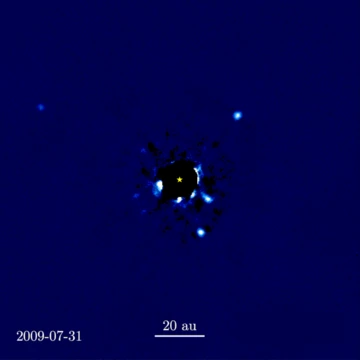
Rogue planets
Interstellar planetary-mass objects not bound to any star.

A rogue planet—also called a free-floating planet (FFP) or an isolated planetary-mass object (iPMO)—is a body with a mass similar to a planet that travels through interstellar space without being gravitationally tied to any star or brown dwarf. Such objects can come from two different origins: they may form within a planetary system and later get flung out, or they can form independently, outside any system. In the Milky Way, the total number of rogue planets could range from billions to trillions; the upcoming Nancy Grace Roman Space Telescope is expected to narrow down that estimate.
The terms used to describe these objects vary. The first two discovery papers introduced the names "isolated planetary-mass objects" (iPMOs) and "free-floating planets" (FFPs), and most astronomical studies adopt one of these. "Rogue planet" appears more often in microlensing research, which also frequently uses "FFP." For public-facing announcements, alternative names are sometimes chosen. For instance, press releases about the 2021 discoveries of at least 70 FFPs referred to them as rogue planets, starless planets, wandering planets, and free-floating planets.
The first iPMOs were found in 2000. The UK team of P. W. Lucas and P. F. Roche, using UKIRT, detected them in the Orion Nebula. That same year, a Spanish team led by María Rosa Zapatero Osorio identified iPMOs via Keck spectroscopy in the σ Orionis cluster. The spectroscopy of the Orion Nebula objects was published in 2001. Both European groups are now credited with the quasi-simultaneous discoveries. In 1999, a Japanese team headed by Yumiko Oasa spotted objects in Chamaeleon I, but spectroscopic confirmation did not come until 2004, from the US team of Kevin Luhman and colleagues.
Two main techniques are used to detect free-floating planets: direct imaging and microlensing.
In microlensing, a 2011 study by Takahiro Sumi of Osaka University and collaborators from the Microlensing Observations in Astrophysics and the Optical Gravitational Lensing Experiment collaborations monitored 50 million stars in the Milky Way. They used the 1.8-meter MOA-II telescope at New Zealand's Mount John Observatory and the 1.3-meter University of Warsaw telescope in Chile. Out of 474 microlensing events detected, ten were brief enough to indicate planets roughly Jupiter's size with no nearby star. From these data, the researchers estimated that nearly two Jupiter-mass rogue planets exist for every star in the Milky Way. Another study suggested a far higher number—up to 100,000 times more rogue planets than stars—but that work included hypothetical objects much smaller than Jupiter. A 2017 analysis by Przemek Mróz of Warsaw University Observatory and colleagues, using six times more statistics than the 2011 study, found an upper limit of 0.25 Jupiter-mass free-floating or wide-orbit planets per main-sequence star. In September 2020, astronomers using microlensing reported the first detection of an Earth-mass rogue planet, designated OGLE-2016-BLG-1928, floating unbound in the Milky Way.
Direct imaging offers a way to characterize these objects, since microlensing planets can only be studied during lensing events. To determine the mass of a brown dwarf or iPMO, astronomers need its luminosity and age—but age is notoriously hard to pin down for low-mass objects. Most known iPMOs are found in young, nearby star-forming regions whose ages are known; these objects are under 200 million years old, more massive than 5 Jupiter masses, and belong to the L and T dwarf classes. A small but growing sample of cold, old Y-dwarfs have estimated masses between 8 and 20 Jupiter masses. One nearby candidate, WISE 0855−0714, lies about 7.27 light-years away. If more accurate measurements or better age estimates become available for these Y-dwarfs, the count of old, cold iPMOs is expected to rise significantly.
The first iPMOs, discovered in the early 2000s via direct imaging in young star-forming regions, likely formed like stars (sometimes called sub-brown dwarfs). There may also be iPMOs that formed as planets and were later ejected. Such objects would differ kinematically from their natal star-forming region, would lack a circumstellar disk, and would have high metallicity. None of the iPMOs found in young star-forming regions show a high velocity relative to their region. For older iPMOs, WISE J0830+2837 has a tangential velocity of about 100 km/s—high, but still consistent with formation within the galaxy. WISE 1534–1043 has a tangential velocity of roughly 200 km/s, leading some to suggest it is an ejected exoplanet, though its color indicates it is an old, metal-poor brown dwarf. Most astronomers studying massive iPMOs consider them to be the low-mass end of the star-formation process.
- discovery teams
- UK team P. W. Lucas & P. F. Roche (Orion Nebula); Spanish team María Rosa Zapatero Osorio et al. (σ Orionis cluster)
- detection methods
- direct imaging and microlensing
- estimated abundance
- nearly two Jupiter-mass rogue planets per star (2011 study); upper limit 0.25 per main-sequence star (2017 study)
- largest known group
- at least 70, up to 170, discovered as of December 2021
Lore & Background
Rogue planets, also called free-floating planets or isolated planetary-mass objects, are interstellar bodies of planetary mass that are not gravitationally bound to any star or brown dwarf. They can originate from planetary systems, being formed and later ejected, or they may form independently outside a planetary system. The Milky Way alone may contain billions to trillions of such objects, a range the upcoming Nancy Grace Roman Space Telescope is expected to refine. The odds of a rogue planet entering the solar system in the next 1,000 years are estimated at one in a billion. Some planetary-mass objects may have formed similarly to stars; the International Astronomical Union has proposed calling these sub-brown dwarfs. A possible example is Cha 110913−773444, which may have been ejected or formed on its own. The first discoveries were made in 2000 by P. W. Lucas and P. F. Roche using UKIRT in the Orion Nebula, and by María Rosa Zapatero Osorio et al. using Keck spectroscopy in the σ Orionis cluster. In 1999, Yumiko Oasa et al. discovered objects in Chamaeleon I, spectroscopically confirmed in 2004 by Kevin Luhman et al. Two main detection techniques exist: direct imaging and microlensing. Microlensing studies in 2011 estimated nearly two Jupiter-mass rogue planets per star in the Milky Way, while a 2017 study with larger statistics gave an upper limit of 0.25 such planets per main-sequence star. In September 2020, microlensing detected the first Earth-mass rogue planet, OGLE-2016-BLG-1928. Direct imaging has found iPMOs in young star-forming regions, typically younger than 200 million years and more massive than 5 Jupiter masses, belonging to L and T spectral types. A small sample of cold, old Y-dwarfs, such as WISE 0855−0714 at a distance of 7.2 parsecs, have estimated masses of 8–20 Jupiter masses. The cold WISE J0830+2837 shows a tangential velocity of about 100 km/s, consistent with formation in our galaxy.
Reader's Guide
Rogue planets are significant because they challenge traditional definitions of planets and star formation. They may form either like stars (via gravitational collapse) or like planets (in protoplanetary disks, later ejected). The discovery of Jupiter-mass binary objects (JuMBOs) in the Orion Nebula, making up at least 9% of iPMOs, raises questions about formation mechanisms—whether they formed in situ like stars or were ejected as binaries without breaking apart. Microlensing studies, such as the 2011 survey of 50 million stars, estimated nearly two Jupiter-mass rogue planets per star, though a 2017 study with larger statistics reduced that upper limit to 0.25 per main-sequence star.
Did You Know?
- The largest group of rogue planets discovered as of December 2021 numbers at least 70, found in the OB association between Upper Scorpius and Ophiuchus.
More in Exoplanets 1-21
Spotted an error? Know more?
This is a living reference — every entry is fact-audited, and reader corrections feed straight into our audit queue. Suggest an edit · See this site's audit record