Batten disease
Fatal childhood nervous system disorder, first described in 1903.

Batten disease is a fatal nervous system disorder that usually starts in childhood, with symptoms first appearing between ages five and ten. It is the common name for a group of conditions known as neuronal ceroid lipofuscinoses (NCLs), and it can occur in as many as one in every 12,500 births. While the term often refers specifically to the juvenile form of NCL (type 3), some doctors use it for all NCL types. The disease was first documented in 1903.
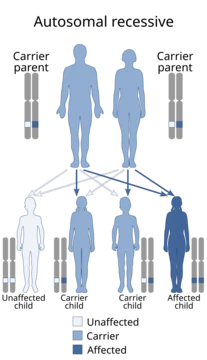
Inheritance is typically autosomal recessive. At least 20 genes are linked to Batten disease, but the most common form—juvenile NCL—is tied to mutations in the CLN3 gene, which produces a protein called Battenin. The CLN3 gene sits on the short arm of chromosome 16 at position 12.1. About 73% of cases involve a specific 1.02-kb deletion that causes a frameshift, resulting in a shortened protein of 181 amino acids instead of the normal 438. The normal CLN3 protein is a hydrophobic transmembrane protein found mainly in the lysosome, but the mutant version ends up in the endoplasmic reticulum and Golgi apparatus. Its exact function remains unknown.
Signs and symptoms usually emerge around ages five to ten, starting with gradual vision problems or seizures. Early clues can be subtle, like personality shifts, behavioral changes, slow learning or regression, repetitive speech (echolalia), clumsiness, or stumbling. Other possible signs include slowing head growth in the infantile form, poor circulation in the legs and feet, reduced body fat and muscle mass, spinal curvature, hyperventilation or breath-holding spells, teeth grinding, and constipation. Over time, affected children experience mental decline, worsening seizures, and progressive loss of sight, speech, and motor skills. The disease is terminal, and life expectancy varies by type. Notably, girls with juvenile Batten disease show symptoms about a year later than boys but die about a year sooner.
Diagnosis can be tricky because the disease is rare, and misdiagnosis can lead to unnecessary costs, family stress, and ineffective treatments. Vision loss is the most common symptom in childhood forms, while adult-onset cases often preserve sight. A fundus eye exam can reveal retinal pigment epithelium granularity in the central macula, though this also appears in other conditions. If Batten disease is suspected, several tests help confirm it: blood or urine tests
- First described
- 1903
- Named after
- British pediatrician Frederick Batten
- Common onset age
- 5–10 years
- Incidence
- Up to 1 in 12,500 live births
- Most prevalent form
- Juvenile NCL (CLN3 mutation)
- Life expectancy
- Varies by type; late infantile NCL: 8–12 years
Lore & Background
Batten disease is named after the British pediatrician Frederick Batten, who first described it in 1903. It is also known as Spielmeyer–Vogt–Sjögren–Batten disease and is the most common form of a group of disorders called neuronal ceroid lipofuscinosis (NCL). Historically, the NCLs were classified by age of disease onset as infantile NCL (INCL), late infantile NCL (LINCL), juvenile NCL (JNCL), or adult NCL (ANCL). At least 20 genes have been identified in association with Batten disease, but juvenile NCL, the most prevalent form, has been linked to mutations in Battenin, the protein encoded by the CLN3 gene.
Reader's Guide
Batten disease is a terminal illness with no cure, though the FDA has approved Brineura (cerliponase alfa) for a specific form (CLN2). Human clinical trials of a gene therapy for the CLN5 variant began in 2022. A custom antisense oligonucleotide, milasen, described in The New England Journal of Medicine, is believed to be the first 'custom' treatment for a genetic disease. Diagnosis involves blood or urine tests, skin or tissue sampling, EEG, eye studies, CT or MRI, enzyme activity measurement, and DNA analysis. Misdiagnosis may lead to increased medical expenses and incorrect treatment. The disease causes progressive loss of sight, speech, and motor skills, with life expectancy varying by type.
Did You Know?
- 73% of Batten disease cases are due to a 1.02-kb deletion in the CLN3 gene.
- Females with juvenile Batten disease show first symptoms a year later than males but die a year sooner on average.
- The CLN3 gene is located on the short arm of chromosome 16 at position 16p12.1.
- Brineura is the first FDA-approved treatment to slow loss of walking ability in symptomatic pediatric patients with CLN2 disease.
More in Diseases named after discoverers 1-24
Spotted an error? Know more?
This is a living reference — every entry is fact-audited, and reader corrections feed straight into our audit queue. Suggest an edit · See this site's audit record