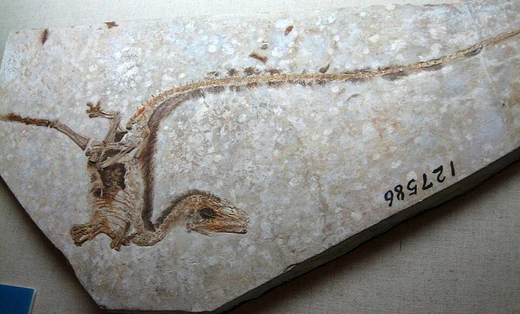
Yulong mini
A chicken-sized oviraptorid dinosaur from Late Cretaceous China.

Jonathan Chen · via Wikipedia: Yulong mini · CC BY 4.0
Yulong is a genus of oviraptorid theropod dinosaur from the Late Cretaceous Qiupa Formation in Henan Province, central China. Its only species is *Yulong mini*. The genus is known primarily from many juvenile fossils, which rank among the smallest oviraptorids ever found, plus one subadult specimen.
The first fossils were collected near Qiupa Town in Luanchuan County. The Qiupa Formation’s exact age is uncertain, but it is probably Late Cretaceous because it also contains other derived dinosaurs like dromaeosaurids, ornithomimids, and alvarezsaurs. Junchang Lü, Philip J. Currie, Li Xu, Xingliao Zhang, Hanyong Pu, and Songhai Jia named and described *Yulong mini* in 2013. The genus name combines *Yu* (the one-character abbreviation for Henan Province) with *long* (Chinese for “dragon”), a common suffix in Chinese dinosaur names. The species name *mini* refers to the small size of the specimens.
The type series consists of five syntypes: HGM 41HIII-0107 (a well-preserved skeleton with skull and jaws, missing only the skull base and neck); HGM 41HIII-0108 (a skull without lower jaws); HGM 41HIII-0109 (a partial skeleton with skull and jaws); HGM 41HIII-0110 (a partial skull with jaws and some neck vertebrae); and HGM 41HIII-0111 (a left ilium). Additional finds were mentioned in the original paper, including one exceptionally preserved embryo (HGM 41HIII-0301) inside an egg from a nest of 26 eggs. The first non-juvenile specimen was described by Wei et al. in 2022, consisting of three dorsal and 29 caudal vertebrae, partial pectoral girdles, and forelimbs.
Most oviraptorids range from one to eight meters in body length, but *Yulong* was described as “chicken-sized.” Most individuals measured between a quarter and half a meter long, making them among the smallest oviraptorids known.
Quick Facts
- Taxon
- Yulong
- Type Species
- Yulong mini
- Type Species Authority
- Lü et al., 2013
Facts from the source article.
Lore & Background
Yulong was first described and named by Junchang Lü, Philip J. Currie, Li Xu, Xingliao Zhang, Hanyong Pu and Songhai Jia in 2013. The generic name derives from Chinese 豫 (Yù), the one-character abbreviation of Henan Province, and 龙/龍 lóng meaning 'dragon'. The specific name mini refers to the small size of the specimens. The syntype series includes five specimens housed in the Henan Geological Museum, including an exceptionally well-preserved skeleton with skull and lower jaws, a skull lacking lower jaws, a partial skeleton with skull and lower jaws, a partial skull with lower jaws and neck vertebrae, and a left ilium. An exceptionally preserved embryo within an egg (HGM 41HIII-0301) came from a nest of 26 eggs. The first non-juvenile specimen was described by Wei et al. (2022), consisting of three dorsal and 29 caudal vertebrae, partial pectoral girdles, and forelimbs.
Reader's Guide
Yulong mini is significant as one of the smallest known oviraptorids, with most individuals having a total body length of a quarter to half a meter, described as 'chicken-sized' by its describers. Its discovery in the Qiupa Formation adds to the diversity of Late Cretaceous dinosaurs from central China, alongside dromaeosaurids, ornithomimids, and alvarezsaurs. The describers noted that hindlimb proportions of oviraptorids do not essentially change during growth, suggesting a more sedentary lifestyle and probable herbivory. Phylogenetic analysis initially placed Yulong as more derived than Gigantoraptor erlianensis but less derived than the clade formed by Oviraptorinae and 'Ingeniinae', though the describers cautioned that its position is uncertain because younger specimens tend to display more basal traits. Later work by Wei et al. (2022) found Yulong to be a basal oviraptorid outside Citipatiinae and Heyuanninae. The presence of an embryo within an egg from a nest of 26 eggs provides rare insight into oviraptorid reproduction.
Did You Know?
- Yulong is known from many juvenile specimens that represent some of the smallest known oviraptorids.
- An exceptionally preserved embryo (HGM 41HIII-0301) was found within an egg from a nest of 26 eggs.
- The generic name Yulong combines the Chinese abbreviation for Henan Province (Yù) with the word for 'dragon' (lóng).
- The describers cautioned that the phylogenetic position of Yulong is uncertain because younger specimens tend to display more basal traits than unknown adult specimens.
More in Dinosaur species 1-24
Spotted an error? Know more?
Reader corrections go straight into our review queue. Suggest an edit · How this site is sourced