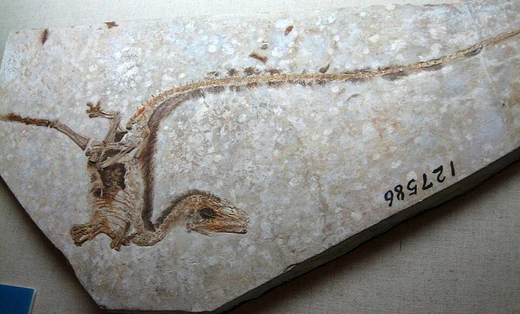
"Dryosaurus" grandis
A disputed ornithomimosaur from Maryland's Arundel Formation.

"Dryosaurus" grandis is a dubious species of ornithomimosaur dinosaur known from remains found in the Arundel Formation of Maryland. The species was originally erected by Richard Swann Lull for foot elements, including a phalanx and astragalus previously assigned to "Allosaurus" medius by Marsh in 1890. Its classification has been disputed, with various researchers assigning it to different genera over time.
- Classification
- Dubious species of ornithomimosaur dinosaur
Lore & Background
Richard Swann Lull erected the species Dryosaurus grandis for foot elements from the Arundel Formation, including a phalanx and astragalus that had been previously assigned to "Allosaurus" medius by Marsh, 1890. Due to Gilmore's 1920 classification of Dryosaurus grandis as a member of the genus Ornithomimus, Marsh's 1890 name Ornithomimus grandis became secondarily preoccupied with Lull's term, necessitating the use of Ornithomimus affinis as a substitute. However, the holotype specimen of Ornithomimus grandis comes from the Eagle Sandstone of Montana and is presumed lost, rendering Gilmore's action unnecessary. Matthew and Brown (1922) assigned the species to Coelosaurus, as C. affinis.
Reader's Guide
The significance of "Dryosaurus" grandis lies in its long history of taxonomic uncertainty, reflecting broader challenges in classifying fragmentary dinosaur fossils. In his 1972 review of North American ornithomimosaurs, Russell noticed that "Dryosaurus" grandis was similar to the Asian Archaeornithomimus in having curved pedal unguals, so referred to it as Archaeornithomimus affinis. Smith and Galton (1990), however, claimed that the Arundel taxon could not be assigned beyond the level of Theropoda. A 2016 paper by Chase Brownstein confirmed Gilmore's assignment of "Dryosaurus" grandis to Ornithomimosauria, noting that the Arundel material is similar to Kinnareemimus and Nedcolbertia in the characteristics of the feet. This ongoing debate illustrates how limited material can lead to multiple reclassifications, and the species remains a dubious name in dinosaur paleontology.
Discovery and Initial Recognition
The story of "Dryosaurus" grandis begins in the Arundel Formation of Maryland, where a small collection of foot bones — specifically a phalanx and an astragalus — was recovered. These elements had initially been lumped in with the much larger theropod "Allosaurus" medius by Othniel Charles Marsh back in 1888. It was not until Richard Swann Lull examined the material that he recognized it as something distinct, erecting the new species Dryosaurus grandis. The fact that the entire known record of this animal consists of just a couple of foot elements makes it one of the most fragmentary dinosaur taxa described from North America. Despite its modest remains, the species has generated decades of taxonomic debate, with paleontists repeatedly reconsidering where it fits in the theropod tree. Its dubious status reflects the difficulty of assigning identity to such limited material, yet it has nonetheless served as a persistent touchstone for understanding ornithomimosaur diversity in eastern North America.
A Nomenclatural Tangle
The naming history of this taxon is a textbook example of how taxonomic decisions can create cascading complications. When Gilmore classified Dryosaurus grandis within the genus Ornithomimus in 1920, he inadvertently triggered a nomenclatural problem: Marsh's 1890 name Ornithomimus grandis became secondarily preoccupied by Lull's earlier combination. This forced the use of Ornithomimus affinis as a replacement name. However, the situation was rendered moot by the fact that the actual holotype of Ornithomimus grandis — a specimen from the Eagle Sandstone of Montana — is presumed lost, meaning Gilmore's reassignment was arguably unnecessary from the start. Adding to the confusion, Matthew and Brown in 1922 went further and placed the species under yet another genus, Coelosaurus, as C. affinis. Each of these decisions reflected the best available information at the time, but together they illustrate how a single pair of foot bones could generate multiple competing names and affiliations across different decades.
Decades of Re-evaluation
From the 1970s through the 2010s, paleontists continued to wrestle with the proper placement of the Arundel Formation foot material. In 1972, Dale Russell, conducting a comprehensive review of North American ornithomimosaurs, noticed that the curved pedal unguals of "Dryosaurus" grandis closely resembled those of the Asian genus Archaeornithomimus, prompting him to refer the specimen as Archaeornithomimus affinis. This was a bold move, linking a Maryland taxon to an Asian relative. However, Smith and Galton pushed back in 1990, arguing that the Arundel material was too fragmentary to be assigned beyond the broad order Theropoda. Their conservative stance effectively froze the taxon's identity for over two decades. It was not until 2016 that Chase Brownstein revisited the question, confirming Gilmore's original ornithomimosaurian assignment by demonstrating that the Arundel foot characteristics align with those seen in Kinnareemimus and Nedcolbertia. This brought the long debate full circle, vindicating a classification that had been proposed nearly a century earlier.
What the Bones Tell Us
Everything we know about "Dryosaurus" grandis comes from a remarkably small set of skeletal elements: a phalanx and an astragalus, both from the foot. These bones, recovered from the Arundel Formation in Maryland, are all that survive of this animal. Despite their modesty, they carry significant morphological information. The curved pedal unguals — the claw bones — were a key diagnostic feature that drew attention from multiple researchers over the decades. Russell's 1972 observation of these curved unguals was what led him to compare the specimen with Archaeornithomimus, while Brownstein's 2016 analysis focused on broader foot characteristics that matched Kinnareemimus and Nedcolbertia. The Arundel Formation itself provides the geological context for these remains in Maryland. The fact that such a limited assemblage could sustain so many competing interpretations underscores both the challenges and the enduring interest in understanding the ornithomimosaur fauna of eastern North America.
Frequently Asked Questions
What is "Dryosaurus" grandis?
It is a questionable ornithopod dinosaur species named from a handful of foot bones recovered in Maryland. Because the material is so limited and its placement in the tree of life has shifted repeatedly, most paleontologists treat it as a nomen dubium rather than a confirmed species.
What fossils are actually known for "Dryosaurus" grandis?
The entire species rests on just two elements: a phalanx and an astragalus, both from the foot. No skull, vertebrae, or limb bones have ever been attributed to it, which is a major reason its identity remains uncertain.
Who described "Dryosaurus" grandis and what was the naming history?
Richard Swann Lull formally erected the species name, working with bones that Oscar C. Marsh had originally lumped under "Allosaurus" medius back in 1890. Lull's reassignment was meant to separate those foot elements from the theropod, but the move has never been universally accepted.
Why do researchers keep reassigning "Dryosaurus" grandis to different genera?
With only two small foot bones to go on, the material is too fragmentary to diagnose a unique species with confidence. As a result, various authors over the decades have shuffled the bones into other ornithopod genera or left them as indeterminate material.
Where and when did "Dryosaurus" grandis live?
The remains come from the Arundel Formation in Maryland, a Late Jurassic to Early Cretaceous deposit. Beyond that geographic and broad time-frame detail, very little can be said about its ecology or behavior given the paucity of material.
More in Dinosaur species 1-24
Spotted an error? Know more?
Reader corrections go straight into our review queue. Suggest an edit · How this site is sourced