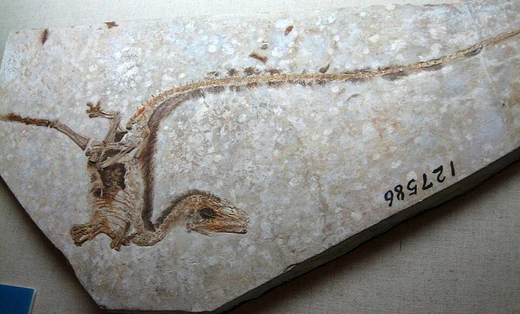
Anzu wyliei
First well-preserved North American oviraptorosaur, nicknamed 'chicken from hell'.

Anzu wyliei is a species of caenagnathid dinosaur from the Late Cretaceous (upper Maastrichtian stage, 67.2–66.0 Ma) of what is now the Hell Creek Formation in North Dakota, South Dakota, and Montana. Named in 2014 by Matthew C. Lamanna, Hans-Dieter Sues, Emma R. Schachner, and Tyler R. Lyson, it is notable as the first well-preserved example of a North American oviraptorosaur, providing fossil evidence for the appearance and biology of this group in the continent.
Quick Facts
- Taxon
- Anzu
- Type Species
- Anzu wyliei
- Type Species Authority
- Lamanna et al., 2014
Facts from the source article.
Lore & Background
The first two partial skeletons of Anzu wyliei, including the holotype CM 78000, were discovered in 1998 by Fred Nuss of Nuss Fossils on a private South Dakota ranch; both were mostly disarticulated and appeared to have been transported by water. A third referred specimen, MRF 319, was found by Scott Haire at his uncle's ranch in Marmarth, North Dakota, and studied by Tyler Lyson. A fourth specimen, a rear lower jaw fragment (FMNH PR 2296), was first reported in 1993. Together, these four fossils comprise about 75 to 80 percent of the whole skeleton.
In 2006, researchers Emma Schachner, Matthew Lamanna, and Tyler Lyson realized they each held partial skeletons of the same species and began collaborating, assisted by Hans-Dieter Sues. The genus name Anzu evokes the bird-like daemon Anzû from Ancient Mesopotamian religion, roughly translating to 'heavenly eagle'; the specific name wyliei honors Wylie J. Tuttle, grandson of museum donor Lee B. Foster. The creature's appearance—a toothless beak, prominent crest, long arms with large curved claws, long legs, and a short tail—led to its nickname 'chicken from hell'.
Reader's Guide
Anzu wyliei is significant as the first well-preserved North American oviraptorosaur, ending nearly a century of fragmentary knowledge about this group in the continent. Its discovery in the Hell Creek Formation, alongside Asian oviraptorosaurs, confirmed that North American forms were more closely related to each other than to their Asian counterparts, despite a Cretaceous land connection. The species was listed among 2014's 'Top 10 New Species' and acknowledged in 2015 by the International Institute for Species Exploration as an unprecedented discovery.
Its fossils, found in mudstone from ancient floodplains, suggest a lifestyle different from Asian oviraptorosaurs that lived in arid conditions. Anzu was likely an omnivore or herbivore, with a jaw morphology suited to a variety of foods. Its bird-like features, such as a crest possibly used for display, are examples of convergent evolution rather than direct avian ancestry. The species died out in the Cretaceous–Paleogene extinction event 66 million years ago, along with all other known non-avian dinosaurs.
Did You Know?
- Anzu wyliei was named after Anzû, a bird-like daemon from Ancient Mesopotamian religion, roughly translating to 'heavenly eagle'.
- The species was nicknamed the 'chicken from hell' due to its bird-like skeleton and discovery in the Hell Creek Formation.
- The holotype and other partial skeletons were discovered by fossil collectors Fred Nuss and Scott Haire on private ranches in South Dakota and North Dakota.
- Anzu wyliei was among the largest North American oviraptorosaurs, measuring up to 1.5 m tall at the hips and weighing 200–300 kg.
A Decade of Piecing Together a Missing Piece
For nearly a century, North American oviraptorosaurs existed only as scattered fragments, their true form a mystery. That changed through a remarkable convergence of finds spanning two decades. In 1998, Fred Nuss uncovered two disarticulated partial skeletons on a private South Dakota ranch, their bones apparently shifted by ancient water currents. A third fragmentary skeleton, MRF 319, had been spotted by Scott Haire at his uncle's property near Marmarth, North Dakota, and was later examined by Tyler Lyson. A fourth piece, a rear lower jaw fragment first reported back in 1993, rounded out the collection. By 2006, Emma Schachner, Matthew Lamanna, and Lyson independently recognized that their separate specimens belonged to a single unknown species. With Hans-Dieter Sues joining the effort, the team assembled what amounted to seventy-five to eighty percent of a complete skeleton. In 2014 they formally named the animal Anzu wyliei, drawing the genus name from Anzû, a bird-like daemon in ancient Mesopotamian mythology, while the species epithet honored Wylie J. Tuttle, grandson of a museum donor. Though informally dubbed the 'chicken from hell,' Lamanna found the phrase resisted translation into Latin or Greek and chose the mythological reference instead.
Anatomy of a Bird-Like Giant
Standing roughly 1.5 metres tall at the hips and stretching 3.5 to 3.75 metres in length, Anzu wyliei was one of the largest oviraptorosaurs known from North America, with an estimated body mass between 200 and 300 kilograms. Its silhouette was strikingly avian: a toothless beak crowned by a high crescent-shaped crest formed from the upper branches of the praemaxillae, long arms tipped with large curved claws, powerful legs ending in slender toes, and a comparatively short tail. The skull and jaw carried several unique derived traits. The occipital condyle exceeded the width of the foramen magnum, the fused front of the lower jaw bore a prominent outer flange, and the retroarticular process was elongated to roughly match the jaw joint surface. The lower radius split into two rounded processes, and the first phalanx of the second finger carried a trough along its inner lower edge. Additional features seen in referred specimens included an elongated, inverted-L shaped nasal branch of the maxilla, a vertically deep jugal branch, and a forked rear end on that same branch. Together these details paint a picture of a robust, crested, beaked animal well adapted to its floodplain environment.
Rewriting the Map of Oviraptorosaur Evolution
Before Anzu, North American oviraptorosaurs were known only from a handful of skeletal bits, leaving their appearance and biology largely speculative for nearly a hundred years. The 2014 description of Anzu wyliei changed that, providing the first well-preserved North American representative of the group. Cladistic analysis placed it within Caenagnathidae and suggested it may have been a sister species to Caenagnathus. The biogeographic implications were significant: although Asia and North America had been connected by land during the Cretaceous, making the presence of oviraptorosaurs on both continents unsurprising, the anatomical details of Anzu revealed that North American forms were more closely related to one another than to their Asian counterparts. This pointed to a distinct evolutionary trajectory on the western side of the ancient land bridge. The discovery was recognized as one of 2014's Top Ten New Species and was further acknowledged in 2015 by the International Institute for Species Exploration as an unprecedented find of major scientific worth. Notably, another unnamed oviraptorosaur species has since been documented in Carter County, Montana, within the same Hell Creek Formation, hinting that Anzu may not have been the only large member of this family in Late Cretaceous North America.
Life on the Floodplain
Anzu wyliei inhabited the mudstone floodplains of what is now the Hell Creek Formation, spanning parts of North Dakota, South Dakota, and Montana during the upper Maastrichtian stage, roughly 67.2 to 66 million years ago. Its ecological niche differed markedly from that of its Asian Oviraptoridae relatives, which occupied arid or semi-arid environments and were generally smaller. Anzu's beak, while toothless, was not as heavily built as those of its Asian cousins, and its legs were thicker with a differently structured lower jaw. Stephen Brusatte of the University of Edinburgh described it as a fast-running ecological generalist that defied easy categorization as either meat-eater or plant-eater. Jaw morphology suggests a flexible diet encompassing vegetation, small animals, and possibly eggs. Despite its bird-like skeleton, Anzu was not an avian dinosaur; it belonged to a lineage that perished in the Cretaceous–Paleogene extinction event 66 million years ago, leaving no direct descendants in the modern world.
Frequently Asked Questions
What is Anzu wyliei?
Anzu wyliei is a bird-like theropod dinosaur belonging to the oviraptorosaur group, living in North America during the very end of the Cretaceous period roughly 67 to 66 million years ago. It was formally described in 2014 by a team led by Matthew Lamanna along with Sues, Schachner, and Lyson.
Why is Anzu wyliei significant to paleontology?
It represents the first well-preserved oviraptorosaur skeleton ever recovered from North America, giving scientists their clearest look at how this bird-like group appeared on the continent before the mass extinction. Before its discovery, the group was known there only from fragmentary remains.
How large was Anzu wyliei?
The animal measured roughly 3.5 to 3.75 meters in body length and stood about 1.5 meters tall at the hip, placing it in the size range of a large turkey or small ostrich in overall build.
Where were Anzu wyliei fossils found?
Remains have been recovered from the Hell Creek Formation spanning parts of North Dakota, South Dakota, and Montana. This rock unit is well known for preserving many of the last non-avian dinosaurs before the K-Pg extinction event.
Why is Anzu wyliei nicknamed the 'chicken from hell'?
The playful nickname blends its bird-like, oviraptorosaur body plan with its home range in the Hell Creek Formation. It is a fan and media shorthand rather than an official scientific designation.
More in Dinosaur species 1-24
Spotted an error? Know more?
Reader corrections go straight into our review queue. Suggest an edit · How this site is sourced