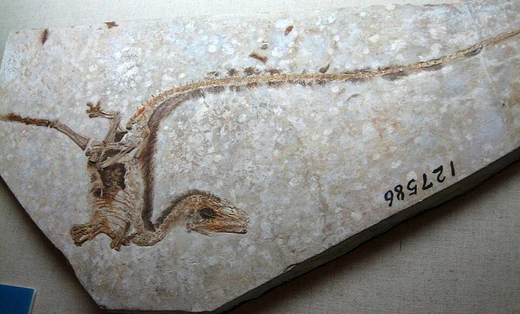
Almas ukhaa
A small troodontid dinosaur from Late Cretaceous Mongolia.

Almas ukhaa is a species of troodontid theropod dinosaur from the Late Cretaceous of Mongolia. It is the only species in the genus Almas, named in 2017 based on a partial articulated skeleton discovered in the Djadochta Formation. The species is known from a single subadult specimen, which provides insight into the anatomy and ecology of small, bird-like dinosaurs from arid Late Cretaceous environments.
Quick Facts
- Taxon
- Almas
- Type Species
- Almas ukhaa
- Type Species Authority
- Pei et al., 2017
Facts from the source article.
Lore & Background
The only known specimen of Almas ukhaa was discovered in 1993 during a joint expedition by the American Museum of Natural History and the Mongolian Academy of Sciences near Ukhaa Tolgod, the Flaming Cliffs. The fossil was prepared by Amy Davidson, but a formal description was not published until 2017, when Pei Rui and colleagues named the type species. The holotype, IGM 100/1323, consists of a partial skeleton with a skull found disarticulated from the postcrania but considered to belong to the same individual. The skull roof and lower jaws were disconnected from the rest of the head, and the postcranial skeleton includes three sacral vertebrae, eleven front tail vertebrae, belly ribs, parts of the pelvis, and parts of the hindlimbs lacking toes. The specimen represents a subadult individual.
Reader's Guide
Almas ukhaa is significant as a rare example of a troodontid dinosaur from the Djadochta Formation, adding to the known diversity of small theropods in Late Cretaceous Mongolia. Its anatomical features, such as slender hind limbs and a relatively large brain-to-body mass ratio, suggest it was an active, agile animal with developed sensory abilities, likely solitary and active during twilight or night. The species' inferred omnivorous or faunivorous diet, based on tooth and skull morphology, indicates dietary flexibility advantageous in arid, seasonal environments. The discovery of Prismatoolithidae eggshells near the skeleton, previously referred to Troodontidae, may hint at reproductive behavior. As a troodontid, Almas ukhaa contributes to understanding the evolution of bird-like dinosaurs and their adaptations to desert ecosystems. Its naming after the almas, a creature from Mongolian folklore, connects paleontology to local cultural heritage.
Did You Know?
- The generic name Almas refers to the 'wild man' from Mongolian folklore.
- The only known specimen was found near Ukhaa Tolgod, also known as the Flaming Cliffs.
- Eggshells of the Prismatoolithidae type were found near the skeleton, and such eggs have been referred to Troodontidae.
- The holotype represents a subadult individual.
From Folklore to Fossil: The Discovery and Naming of Almas
In 1993, a joint field expedition between the American Museum of Natural History and the Mongolian Academy of Sciences uncovered a small theropod skeleton near the famous Flaming Cliffs of Ukhaa Tolgod. The fossil was painstakingly prepared by Amy Davidson, and over the following years its anatomical traits were quietly incorporated into several phylogenetic data matrices. Yet no formal description ever appeared in the literature, leaving the specimen in a kind of paleontological limbo for more than two decades. That changed in 2017, when Pei Rui, Mark Norell, Daniel Barta, Gabriel Bever, Michael Pittman, and Xu Xing finally published the full account. They erected the new genus Almas, a name drawn from Mongolian folklore, where the almas is a wild, man-like creature roaming the steppe. The species epithet ukhaa simply anchors the animal to its type locality. The holotype, catalogued as IGM 100/1323, comes from a late Campanian layer of the Djadochta Formation and represents a subadult individual, making it the sole known member of its genus.
Life in the Arid Gobi: Habitat and Environmental Context
Almas ukhaa is known exclusively from the Gobi Desert region of present-day southern Mongolia. During the Upper Cretaceous, specifically the late Campanian interval recorded by the Djadochta Formation, this landscape bore little resemblance to the barren expanse seen today. The formation captures an arid to semi-arid world punctuated by shifting sandy dunes, broad seasonal alluvial plains, and patches of scattered vegetation. Almas shared this harsh, resource-limited setting with a rich assemblage of other dinosaurs and vertebrates documented from the same formation. The seasonal and arid character of the environment would have imposed strong selective pressures on any animal living there, favouring flexibility in foraging strategy and the ability to exploit a wide range of food sources. The fact that a subadult troodontid could thrive in such conditions speaks to the adaptability of this small, active predator within a competitive Late Cretaceous ecosystem.
A Swift, Solitary Hunter with an Omnivorous Edge
Anatomical evidence paints Almas ukhaa as a remarkably active and dynamic animal. Its slender hind limbs point to rapid locomotion, a trait that would have served both in pursuit of prey and in escaping larger predators. The high ratio of brain volume to body mass, a hallmark shared across troodontids, hints at well-developed sensory processing, fine motor coordination, and possibly behaviours of considerable complexity. The relatively large orbits of the skull suggest the animal was most active during twilight hours or at night, navigating its arid surroundings by sight in low-light conditions. Behavioural reconstructions also point toward a solitary existence. On the dietary front, no stomach contents have been directly attributed to Almas, but its tooth morphology, skull architecture, and close relationship to other well-studied troodontids all converge on an opportunistic, likely omnivorous or faunivorous feeding strategy. Small vertebrates such as lizards and primitive mammals, insects and other arthropods, and occasionally plant material or eggs would all have been within reach. This dietary flexibility would have been a significant advantage in the seasonal, resource-poor Gobi environment.
One Skeleton, One Story: The Holotype Specimen
The holotype of Almas ukhaa, designated IGM 100/1323, is a partial articulated skeleton that preserves a subadult individual. The skull, which is the better-preserved portion of the specimen, was found disarticulated from the postcranial elements, though the authors judged it to belong to the same animal. Within the skull itself, parts of the roof and the lower jaws lay disconnected from the rest of the head, a common occurrence in fossilised material. The postcranial skeleton is more fragmentary, yielding three sacral vertebrae, eleven anterior caudal vertebrae, a set of belly ribs, portions of the pelvis, and elements of the hindlimbs that notably lack the toes. Perhaps the most intriguing contextual detail is the presence of egg shells of the Prismatoolithidae type found in close proximity to the skeleton. These eggs had previously been referred to the Troodontidae, lending an intriguing ecological and possibly behavioural connection to the animal that lived nearby. As the only known representative of its genus, this single specimen carries the entire weight of our understanding of Almas.
Frequently Asked Questions
What is Almas ukhaa?
Almas ukhaa is a small troodontid theropod that lived in Mongolia during the Late Cretaceous. It is the sole species in the genus Almas and was formally described in 2017 from a partial articulated skeleton found in the Djadochta Formation.
Where and when was Almas ukhaa found?
The fossil was originally unearthed in 1993 from the Djadochta Formation in Mongolia, a deposit dating to the Late Campanian stage. It took more than two decades before the specimen was studied and given its official name in 2017.
What did Almas ukhaa eat?
Based on its troodontid anatomy, it is thought to have been either omnivorous or faunivorous, meaning it likely scavenged or hunted small prey while possibly supplementing its diet with plant matter. This flexible feeding strategy is typical of small, active theropods from that era.
How much do we actually know about Almas ukhaa?
All we have to work with is a single subadult specimen, so many details about its full growth, behavior, and ecology remain uncertain. Even so, the partial skeleton gives researchers a valuable snapshot of a small, bird-like theropod thriving in an arid Late Cretaceous landscape.
Why does Almas ukhaa matter to dinosaur fans and paleontologists?
As the only member of its genus, it broadens the known diversity of troodontids in Mongolian deposits and highlights how small theropods adapted to drier climates. Its existence reminds us that the Late Cretaceous of Mongolia supported a richer variety of small, agile dinosaurs than we once appreciated.
More in Dinosaur species 1-24
Spotted an error? Know more?
Reader corrections go straight into our review queue. Suggest an edit · How this site is sourced