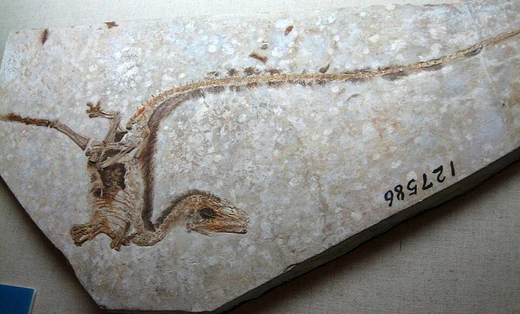
"Coelosaurus" antiquus
Dubious theropod dinosaur from the Navesink Formation of New Jersey.

"Coelosaurus" antiquus is a dubious species of theropod dinosaur, named by Joseph Leidy in 1865 for two tibiae found in the Navesink Formation of New Jersey. Its classification has been disputed, with some researchers assigning it to the genus Ornithomimus, while others consider it an indeterminate ornithomimosaur and thus a nomen dubium.
- Named by
- Joseph Leidy
- Year named
- 1865
- Type specimen
- two tibiae
- Formation
- Navesink Formation, New Jersey
- Current status
- nomen dubium
- Group
- theropod dinosaur (ornithomimosaur)
Lore & Background
Joseph Leidy named "Coelosaurus" antiquus in 1865 based on two tibiae discovered in the Navesink Formation of New Jersey. The species was later reclassified as Ornithomimus antiquus by Donald Baird and John R. Horner in 1979, a move followed by some later researchers. However, others have rejected this classification, noting that there is no justification for assigning New Jersey specimens to a genus known only from western North America. David Weishampel in 2004 considered "C." antiquus to be indeterminate among ornithomimosaurs, rendering it a nomen dubium. In 1979, Baird and Horner also discovered that the name "Coelosaurus" was preoccupied by another dubious taxon, named Coelosaurus by an anonymous author now known to be Richard Owen in 1854.
Reader's Guide
The significance of "Coelosaurus" antiquus lies in its contested taxonomic history, which illustrates the challenges of classifying fragmentary dinosaur fossils from eastern North America. Its status as a nomen dubium reflects the difficulty of assigning isolated limb bones to specific genera, especially when those genera are otherwise known from distant regions. The species has been used as a catch-all for ornithomimid material from the Severn Formation of Maryland and the Mooreville Chalk and Blufftown formations of Alabama and Georgia, though these assignments remain uncertain. A specimen once assigned to Coelosaurus from the Merchantville Formation of Delaware has since been reassigned to "Cryptotyrannus." The case highlights the importance of careful taxonomic revision and the pitfalls of preoccupied names in paleontology.
Did You Know?
- "Coelosaurus" antiquus was named by Joseph Leidy in 1865 for two tibiae from the Navesink Formation of New Jersey.
- The name "Coelosaurus" was found to be preoccupied by a taxon named by Richard Owen in 1854.
- A specimen from the Merchantville Formation of Delaware once assigned to Coelosaurus was later reassigned to "Cryptotyrannus."
Discovery & Naming
"Coelosaurus" antiquus, a name that translates to "antique hollow lizard," was formally described by the pioneering paleontologist Joseph Leidy back in 1865. The taxon was erected on the basis of a remarkably modest set of remains—just two tibiae, or lower leg bones—recovered from the Navesink Formation in New Jersey. Despite the limited nature of the material, Leidy's description placed this animal among the theropod dinosaurs, a group of meat-eating bipeds that would later become one of the most diverse lineages of the Mesozoic. The species epithet "antiquus" evokes the deep antiquity of the creature, while the genus name "Coelosaurus" references the hollow construction of its bones, a trait shared by many dinosaurs. Though the original material was sparse, the name stuck in the scientific literature for over a century, becoming a point of reference in discussions of Eastern North American theropods long before its taxonomic position was called into serious question.
Taxonomic Controversy & the Nomen Dubium Verdict
The taxonomic identity of "C." antiquus has been a source of ongoing disagreement among paleontologists. In 1979, Donald Baird and John R. Horner proposed that the New Jersey tibiae actually belonged to the genus Ornithomimus, renaming the species Ornithomimus antiquus. While some subsequent researchers accepted this reassignment, a significant portion of the scientific community pushed back. Critics pointed out a fundamental geographic problem: Ornithomimus was known exclusively from western North American deposits, making it difficult to justify placing a specimen from New Jersey into that genus without stronger evidence. The debate reached a kind of resolution—or perhaps a stalemate—when David Weishampel assessed the material in 2004 and concluded that the New Jersey bones could not be confidently assigned to any particular ornithomimosaur genus. He designated "C." antiquus as a nomen dubium, an indeterminate member of the ornithomimosaur group, effectively acknowledging that the original material was too fragmentary to support a definitive identification.
The Preoccupied Name
Adding to the taxonomic complications surrounding this species was a nomenclatural problem that Baird and Horner uncovered during their 1979 work. They determined that the genus name "Coelosaurus" had already been claimed, decades earlier, by a taxon erected in 1854. That earlier name had been assigned by an author who was anonymous at the time of publication but is now identified as the renowned British anatomist and paleontologist Richard Owen. Owen's original "Coelosaurus" was itself a dubious taxon, based on nothing more than a single vertebra. This meant that the name Leidy had used in 1865 was technically preoccupied, creating a layer of nomenclatural confusion on top of the already uncertain biological identity of the New Jersey specimens. The preoccupation meant that any future attempt to resurrect the name "Coelosaurus" for the theropod would require a new name entirely, further complicating an already tangled taxonomic history.
Broader Material and Shifting Assignments
Over the decades, various ornithomimid dinosaur remains from across the Mid-Atlantic and southeastern United States have been linked to "C." antiquus, broadening the geographic range of material associated with this name. Ornithomimid fossils recovered from the Severn Formation in Maryland, as well as from the Mooreville Chalk and Blufftown formations spanning Alabama and Georgia, have at various points been assigned to this species. However, not all material once connected to "Coelosaurus" has retained that association. A specimen discovered in the 1970s from the Merchantville Formation in Delaware was originally placed within Coelosaurus, but subsequent study led researchers to reassign it to a different taxon, "Cryptotyrannus." This shifting pattern of assignments underscores just how difficult it has been to sort out the ornithomimosaur fauna of eastern North America. With the type material reduced to two tibiae and the species status remaining in doubt, many of these broader associations remain provisional at best, reflecting the ongoing challenges of working with fragmentary Mesozoic vertebrate remains.
Frequently Asked Questions
What is "Coelosaurus" antiquus?
It is a theropod dinosaur from the ornithomimosaur group that was described in 1865 based on two shin bones. Because its identity has never been firmly established, it is generally regarded as a nomen dubium rather than a valid species.
Who named "Coelosaurus" antiquus and when?
Joseph Leidy gave the name in 1865 after examining two tibiae recovered from the Navesink Formation in New Jersey.
What evidence exists for "Coelosaurus" antiquus?
The entire case rests on just two tibiae (shin bones) from the Navesink Formation in New Jersey. No other skeletal material has ever been assigned to this name.
Why is "Coelosaurus" antiquus considered a nomen dubium?
Some paleontologists have argued the bones belong to Ornithomimus, while others see them as an unidentifiable ornithomimosaur. Because neither assignment is universally accepted, the name lacks a clear, unique referent and is treated as invalid.
Where were the "Coelosaurus" antiquus fossils discovered?
The two tibiae came from the Navesink Formation in New Jersey, a Cretaceous-age deposit.
More in Dinosaur species 1-24
Spotted an error? Know more?
Reader corrections go straight into our review queue. Suggest an edit · How this site is sourced