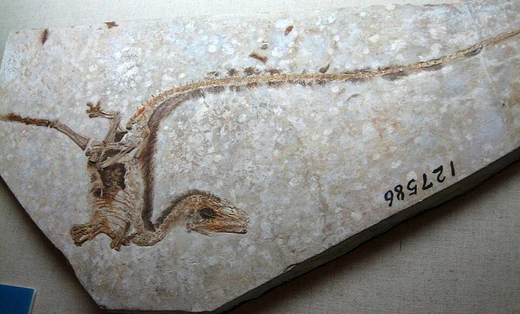
Beg tse
Fictional dinosaur species not recognized in paleontology.

Beg tse is a fictional dinosaur species not recognized in established paleontological canon. There is no real dinosaur species named 'Beg tse' or genus 'Beg' in the scientific literature.
Quick Facts
- Genus
- Beg
- Species
- tse
Facts from the source article.
Lore & Background
The holotype number IGM 100/3652 is not associated with any real published dinosaur, and the Ulaan Nuur Formation is not a recognized geological formation in Mongolia for dinosaur fossils. The genus name 'Beg' and species 'Beg tse' are not part of established paleontological canon.
Reader's Guide
Beg tse is significant as the most basal neoceratopsian currently known, providing insight into the early evolution of ceratopsian dinosaurs. Its skull, about 140 millimeters long, indicates it was a medium-sized basal ceratopsian, similar in size to Yinlong and Liaoceratops. The species shows transitional features between basal ceratopsians and other neoceratopsians, reflecting its phylogenetic position. The fragmentary postcranial material includes a rib, partial left scapula, partial right ischium, and many unidentified bone fragments. Beg is known from the Ulaanoosh Formation, which also preserves sauropods, turtles, and dinosaur eggs assigned to Parafaveoloolithus sp. Its discovery helps clarify the early diversification of neoceratopsians in Asia.
Discovery and Cultural Naming
In 2015, paleontologists unearthed a remarkable specimen near the small town of Tsogt-Ovoo, situated in Mongolia's Ömnögovi Province. The holotype, catalogued as IGM 100/3652, came from the Ulaanoosh Formation and would eventually be recognized as an entirely new genus and species. The naming of this dinosaur carries a deeply cultural resonance: Beg is derived from Beg-tse, a Himalayan war deity who holds a prominent place in Mongolian religious tradition. The connection between the god and the animal is not arbitrary. In traditional iconography, Beg-tse is frequently portrayed with a deeply textured, rugose face and body. The preserved skull of the dinosaur bears a striking visual resemblance to that rugged, wrinkled appearance, making the deity an apt and evocative namesake for this newly described creature. The choice reflects both the scientific community's respect for local cultural heritage and the genuine morphological parallel between the divine figure and the ancient reptile that roamed the Mongolian landscape over a hundred million years ago.
Phylogenetic Position and Morphology
Beg tse occupies a uniquely important position in the evolutionary tree of horned dinosaurs. As the most basal neoceratopsian known to science, it sits at the very root of the lineage that would eventually give rise to the iconic ceratopsids of the Late Cretaceous. The genus Beg contains only this single species, and its phylogenetic placement is intermediate between the more primitive basal ceratopsians and the derived neoceratopsians that followed. This transitional status is reflected in its anatomy, which displays a mosaic of features bridging the two groups. Judging by the length of its skull, approximately 140 millimetres or about 5.5 inches, Beg was a medium-sized animal comparable in body size to other early ceratopsians such as Yinlong and Liaoceratops. Though the material is limited, the skull's overall architecture provides critical data points for understanding how the neoceratopsian body plan first emerged from its ceratopsian ancestors, filling a gap that had previously left the earliest stages of this radiation poorly documented.
Paleoecological Setting
The Ulaanoosh Formation, where Beg tse was recovered, offers a window into a Cretaceous ecosystem in southern Mongolia spanning roughly 113 to 94 million years ago, straddling the boundary between the Lower and Upper Cretaceous. This temporal range places the formation squarely in the mid-Cretaceous, a period of significant faunal turnover across the Northern Hemisphere. Beg did not inhabit this environment in isolation. The same sedimentary unit preserves evidence of sauropods, the enormous long-necked herbivores that dominated many Cretaceous landscapes, as well as turtles. Perhaps most intriguingly, dinosaur eggs attributed to the ovoid species Parafaveoloolithus sp. have also been identified from the formation, suggesting that at least some egg-laying dinosaurs nested in or near these habitats. Together, these associated taxa paint a picture of a diverse terrestrial community in which a small, basal ceratopsian like Beg would have occupied a relatively modest ecological niche, likely browsing on low vegetation alongside far larger contemporaries.
State of the Fossil Record
The physical evidence available for Beg tse is, by the standards of dinosaur paleontology, exceedingly sparse. The entire known material consists of a partial skull and a handful of very fragmentary postcranial elements. Beyond the cranium, the postcranial assemblage includes a single rib, a partial left scapula, a partial right ischium, and a collection of bone fragments too incomplete to be assigned to specific anatomical structures. No complete limb bones, no vertebral column, and no pelvic or girdle elements in sufficient preservation to reconstruct locomotion or posture have been identified. This paucity of material means that many fundamental questions about Beg's biology—its precise body proportions, its gait, its soft-tissue anatomy, and its full range of dental and cranial ornamentation—remain unanswered. As the sole representative of its genus and the most basal neoceratopsian on record, Beg tse carries an outsized importance for understanding early ceratopsian evolution, yet the fragmentary nature of the holotype ensures that much of its biology will remain speculative until additional specimens are discovered in the Ulaanoosh Formation or comparable Cretaceous deposits.
Frequently Asked Questions
What is Beg tse?
Beg tse is a single-species neoceratopsian dinosaur that lived roughly 100.5 million years ago in what is now Mongolia. It represents one of the earlier branches of the horned-dinosaur lineage, though not the absolute most basal member of that group.
Where was Beg tse discovered?
The type specimen was excavated in 2015 near the town of Tsogt-Ovoo in Ömnögovi Province, Mongolia, from sediments of the Ulaan Nuur Formation.
How complete is the Beg tse fossil record?
All we have is a partial skull paired with a handful of fragmentary body bones, so much of its anatomy remains unknown. No second specimen has been identified as of now.
Is Beg tse the most primitive neoceratopsian?
No—while it is a relatively early member of the neoceratopsian clade, that title goes to forms such as Liaoceratops from China's Early Cretaceous deposits. Beg tse sits a bit further along the evolutionary timeline.
What other species belong to the genus Beg?
None; Beg is a monotypic genus, meaning Beg tse is its sole and only species.
More in Dinosaur species 1-24
Spotted an error? Know more?
Reader corrections go straight into our review queue. Suggest an edit · How this site is sourced