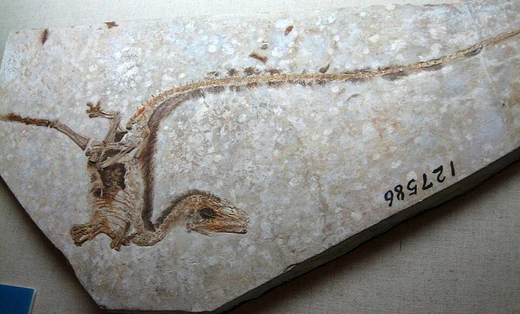
Talos sampsoni
A troodontid dinosaur with a life-damaged sickle claw.

Talos sampsoni is the only known species of the extinct genus Talos, a troodontid theropod dinosaur that lived during the late Cretaceous period (late Campanian, about 76 million years ago) in what is now Utah, United States. It is known from a single partial postcranial skeleton of a subadult individual, discovered in 2008 in the Kaiparowits Formation. The species is notable for its sickle claw, which was damaged during life, possibly from an attack on prey.
Quick Facts
- Taxon
- Talos sampsoni
Facts from the source article.
Lore & Background
Talos sampsoni is known only from the holotype specimen UMNH VP 19479, a partial postcranial skeleton of a subadult individual including hindlimbs, pelvis, vertebral fragments, chevrons, and the left ulna. It was discovered and collected in 2008 by M. J. Knell during the Kaiparowits Basin Project, initiated by the University of Utah in 2000, from the Kaiparowits Formation within the Grand Staircase–Escalante National Monument. The species was first named in 2011 by Lindsay E. Zanno, David J. Varricchio, Patrick M. O'Connor, Alan L. Titus, and Michael J. Knell.
The generic name Talos comes from a giant bronze automaton in Greek mythology and is intended as a pun on the English word talon. The specific name sampsoni honors television paleontologist Dr. Scott D. Sampson for his work during the Kaiparowits Basin Project. Talos is a troodontid, a group of small, bird-like, gracile maniraptorans with sickle-claws and raptorial hands, and some of the highest non-avian encephalization quotients. The sickle claw of the Talos specimen was damaged during life, possibly in an attack on prey.
Reader's Guide
Talos sampsoni contributes to the understanding of troodontid diversity and behavior in the late Cretaceous of Laramidia. Its damaged sickle claw provides rare direct evidence of possible predatory or defensive injuries in a small theropod. As a derived troodontid, Talos helps clarify evolutionary relationships within Troodontidae, forming a clade with Byronosaurus, Saurornithoides, Zanabazar, and Troodon. The species is part of the rich fossil record of the Kaiparowits Formation, which preserves one of the best and most continuous records of Late Cretaceous terrestrial life. Talos shared its environment with a diverse array of dinosaurs and other vertebrates, including tyrannosaurids, hadrosaurs, ceratopsians, and early mammals. Its discovery underscores the importance of ongoing fieldwork in the Grand Staircase–Escalante National Monument.
Did You Know?
- The generic name Talos is a pun on the English word talon.
- Talos lived about 76 million years ago in the Kaiparowits Formation of Utah.
More in Dinosaur species 1-24
Spotted an error? Know more?
Reader corrections go straight into our review queue. Suggest an edit · How this site is sourced