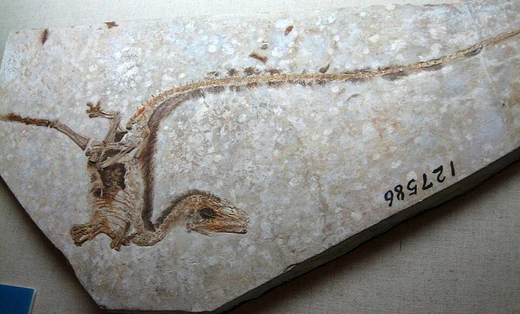
Saturnalia tupiniquim
Early Brazilian dinosaur from the Late Triassic.

Saturnalia is a genus of early sauropodomorph dinosaur from the Late Triassic period, found in the Santa Maria Formation of Rio Grande do Sul, southern Brazil. Its only known species is Saturnalia tupiniquim, and it ranks among the very oldest dinosaurs yet discovered.
The first fossils were gathered by the Museum of Science and Technology of the Pontifical Catholic University of Rio Grande do Sul during the austral summer of 1998, with some specimens collected during Carnival. They came from a site called Wald Sanga (or Sanga do Mato), one of several "sanga" locations near Santa Maria, where red, fossil-bearing mudstone is exposed. In 1999, Max Cardoso Langer, Fernando Abdala, Martha Richter, and Michael J. Benton named the genus and species based on three skeletons. The genus name references the Roman festival Saturnalia, because the fossils were found during Carnival; the species name, tupiniquim, is a Guarani-derived term used colloquially in Portuguese for things of Brazilian origin. Since then, numerous studies have made Saturnalia one of the best-studied Carnian sauropodomorphs.
The species is known from three well-preserved partial skeletons and disarticulated remains from at least three other individuals. The holotype, MCP 3844-PV, includes most presacral vertebrae and the sacrum, pectoral and pelvic girdles, the right humerus and part of the right ulna, the left femur, and most of the right hind limb. Paratypes are MCP 3845-PV (partial skull, trunk vertebrae, pectoral girdle, right pelvic girdle, right humerus, and most of the right hind limb) and MCP 3846-PV (trunk vertebrae, a tibia, and part of a foot). Referred material, cataloged as UFSM 11660, comprises disarticulated remains of at least three other individuals, including a partial skull and parts of the pelvis and hindlimb. Another specimen, LPRP/USP 0651 (a few vertebrae, ilium, and most of the right hind limb), was originally described as a distinct species, Nhandumirim waldsangae, but may be a juvenile of Saturnalia tupiniquim. All known fossils come from a single site in the Alemoa Member of the Santa Maria Formation, within the Hyperodapedon Assemblage Zone.
Quick Facts
- Genus
- Saturnalia
- Species
- tupiniquim
Facts from the source article.
Lore & Background
Fossils of Saturnalia were first collected by the Museum of Science and Technology of the Pontifical Catholic University of Rio Grande do Sul in the austral summer of 1998, with some specimens collected during Carnival. The specimens were found at a site called Wald Sanga or Sanga do Mato in the vicinity of Santa Maria, Rio Grande do Sul. In 1999, Max Cardoso Langer, Fernando Abdala, Martha Richter, and Michael J. Benton described the new genus and species Saturnalia tupiniquim based on three skeletons. The genus name derives from the Roman festival of Saturnalia, referencing the discovery during Carnival, and the species name tupiniquim is a Guarani-origin word used in Portuguese for things of Brazilian origin.
Saturnalia tupiniquim is known from three well-preserved partial skeletons and disarticulated remains from at least three other individuals. The holotype, MCP 3844-PV, includes most of the presacral vertebrae and sacrum, pectoral and pelvic girdles, and parts of the limbs. The paratypes include partial skulls and additional skeletal elements. Another specimen, LPRP/USP 0651, originally described as Nhandumirim waldsangae, may be a juvenile of Saturnalia tupiniquim. All known fossils come from a single site in the Alemoa Member of the Santa Maria Formation, part of the Hyperodapedon Assemblage Zone. A maximum age of 233.23 ± 0.61 million years was determined by uranium–lead dating of detrital zircons.
Saturnalia was a small, bipedal animal reaching about 1.5 metres in length and weighing between 4 and 11 kilograms. Its skull was only about 10 centimetres long, giving it a proportionally small head, and it had a moderately long neck composed of nine or ten vertebrae. The plesiomorphic nature of Saturnalia, with a mix of sauropodomorph and theropod characteristics, has made classification difficult. It has been assigned to Sauropodomorpha, placed in the family Guaibasauridae, and considered a member of the subfamily Saturnaliinae. Like many early dinosaurs, Saturnalia was likely carnivorous or omnivorous, feeding on insects or small vertebrates.
Reader's Guide
Saturnalia tupiniquim holds significant importance as one of the earliest known dinosaurs, providing crucial insight into the early evolution of sauropodomorphs and the diversification of dinosaurs in the Late Triassic. Its fossils, discovered in Brazil's Santa Maria Formation, help establish a timeline for early dinosaur evolution, with a maximum age of about 233 million years. The species exhibits a mix of sauropodomorph and theropod features, illustrating the transitional anatomy of basal dinosaurs and the difficulty of classifying early forms. Its small size, bipedal stance, and likely carnivorous or omnivorous diet contrast with later, larger herbivorous sauropodomorphs. The discovery during Carnival and the naming after the Roman festival Saturnalia highlight the cultural context of its collection. The possibility that specimen LPRP/USP 0651 represents a juvenile of Saturnalia underscores ongoing research into dinosaur growth and variation. Saturnalia's presence in the Hyperodapedon Assemblage Zone, alongside contemporaries like the herrerasaurid Staurikosaurus and the sauropodomorph Buriolestes, suggests a complex ecosystem with potential niche partitioning among early dinosaurs.
Did You Know?
- Saturnalia was named after the Roman festival Saturnalia because some fossils were collected during Carnival.
- Saturnalia is one of the earliest known dinosaurs, with a maximum age of 233.23 ± 0.61 million years.
More in Dinosaur species 1-24
Spotted an error? Know more?
Reader corrections go straight into our review queue. Suggest an edit · How this site is sourced