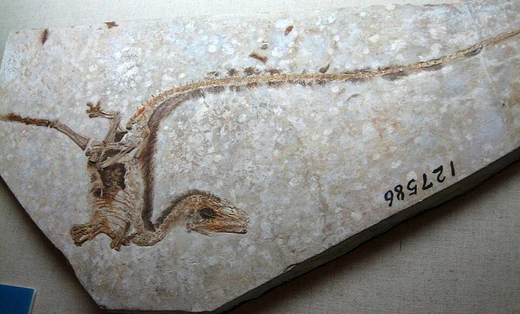
Qianlong shouhu
Early Jurassic sauropodomorph from China with eggs and embryos.

Qianlong shouhu, whose name translates to "Guizhou Province dragon," is a type of extinct basal sauropodomorph dinosaur. It lived during the Early Jurassic and its remains come from the Ziliujing Formation in China. The genus contains only this one species, known from three partial adult skeletons and several leathery eggs, some still holding embryos.
The fossils were unearthed in the Zhenzhuchong Member of the Ziliujing Formation, near Zhuanpo in Guizhou Province. This rock layer dates to the Sinemurian age. The holotype specimen (GZPM VN001) is an incomplete, partly connected skeleton; its skull and lower jaw were found about 30 meters away from the rest of the body. Two additional skeletons (GZPM VN002 and 003) and five egg clutches (GZPM VN004–008) were also collected. In 2023, Han and colleagues named and described Qianlong shouhu based on these finds. The genus name combines "Qian," a short name for Guizhou Province, with "long," meaning dragon. The species name "shouhu" comes from the Mandarin word for "guarding," highlighting the discovery of adults alongside eggs and embryos.
The holotype's vertebrae show closed neurocentral sutures, indicating it was a fully grown adult. The preserved eggs are oval in shape. In young Qianlong individuals, the skull, lower jaw, forelimbs, and shoulder girdle are proportionally larger than those of adults—a pattern also seen in related sauropodomorphs like Massospondylus and Mussaurus. A phylogenetic analysis placed Qianlong at the base of Sauropodiformes, as the closest relative of Yunnanosaurus.
Quick Facts
- Genus
- Qianlong
- Species
- shouhu
Facts from the source article.
Lore & Background
The Qianlong fossil material was discovered in sediments of the Ziliujing Formation (Zhenzhuchong Member), dated to the Sinemurian age of the Early Jurassic period near Zhuanpo in Pingba District of Anshun City, Guizhou Province, China. The known material includes the holotype (GZPM VN001), two referred skeletons (GZPM VN002, 003), and five clutches of eggs, some of which contain hatchlings (GZPM VN004–008). The incomplete, partially-articulated holotype specimen includes a partial skull and mandible that were found 30 metres (98 ft) away from the postcrania.
Reader's Guide
Qianlong shouhu is significant as a basal sauropodiform dinosaur from the Early Jurassic of China, providing rare evidence of adult individuals associated with eggs and embryos. The discovery helps illuminate the reproductive biology and ontogeny of early sauropodomorphs. In juveniles, the skull, mandible, forelimbs, and shoulder girdles are proportionally larger than in adults, a pattern also seen in related dinosaurs Massospondylus and Mussaurus. Phylogenetic analysis places Qianlong at the base of Sauropodiformes, as the sister taxon to Yunnanosaurus. The leathery eggs and associated embryos offer direct insight into early development and parental association in this lineage.
Did You Know?
- The specific name 'shouhu' means 'guarding' in Mandarin, referencing the associated adult and embryo fossils.
- The holotype specimen's partial skull and mandible were found 30 metres (98 ft) away from the postcrania.
- Qianlong was found to be the sister taxon to Yunnanosaurus in phylogenetic analysis.
More in Dinosaur species 1-24
Spotted an error? Know more?
Reader corrections go straight into our review queue. Suggest an edit · How this site is sourced