Mei long
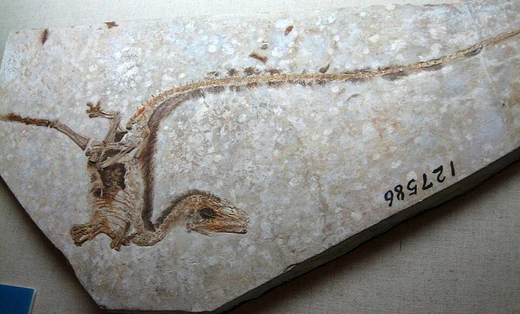
A duck-sized troodontid preserved in a sleeping posture.

Mei long (from Chinese: 寐 mèi and 龍 lóng, meaning 'sleeping dragon') is a genus of duck-sized troodontid dinosaur from the Early Cretaceous period. Its only species, Mei long, is known from exceptionally well-preserved fossils discovered in the Yixian Formation in Liaoning, China, in 2004. The type specimen, a young juvenile, was found in a birdlike sleeping posture with its snout tucked under a forelimb and legs folded, providing a behavioral link between dinosaurs and modern birds.
Quick Facts
- Genus
- Mei
- Species
- long
Facts from the source article.
Lore & Background
Mei long lived during the Early Aptian stage of the Cretaceous, about 125.8 million years ago, in what is now Liaoning, China. The area was dominated by volcanoes and covered in coniferous forests with ferns, horsetails, ginkgos, and araucarias, alongside some of the earliest flowering plants. Rivers and streams fed into valley lakes. The apex predator was the 9-meter-long tyrannosauroid Yutyrannus, which preyed on sauropods. Mei long likely fed on small lizards, insects, and other small animals on the forest floor, and was a fast runner based on leg length. Like many troodontids, it was probably omnivorous, and its nesting habits are unknown.
Reader's Guide
Mei long is significant as a basal troodontid, closely related to Sinovenator, and provides key evidence for the behavioral link between dinosaurs and birds. Its type fossil, preserved in a sleeping posture similar to modern birds, suggests it was buried instantly in volcanic ash, possibly after dying from carbon monoxide poisoning. A second specimen, DNHM D2154, also preserved in a sleeping posture, shows a mix of juvenile and mature features, with histology indicating an individual over two years old with slowed growth. Mei long is notable for its extremely large nares and birdlike hip structure, shared with advanced maniraptorans. The species helps illustrate niche partitioning among small birdlike theropods in the Early Cretaceous ecosystem of Liaoning.
Did You Know?
- The name Mei long means 'sleeping dragon' in Chinese.
- The type fossil was found with its snout nestled under a forelimb and legs folded, like modern birds roosting.
- Mei long is a basal troodontid, most closely related to Sinovenator.
- A second specimen, DNHM D2154, was also preserved in a sleeping posture and is considered a juvenile or subadult.
More in Dinosaur species 1-24
Spotted an error? Know more?
Reader corrections go straight into our review queue. Suggest an edit · How this site is sourced