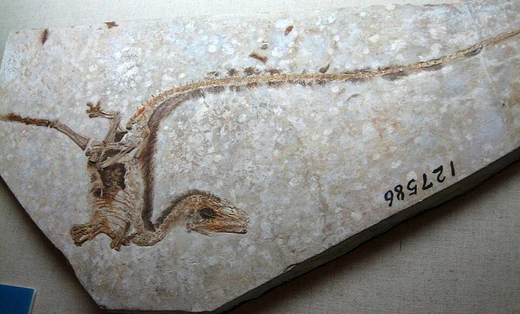
Mahakala omnogovae
A small basal dromaeosaurid from Late Cretaceous Mongolia.

Mahakala omnogovae is a species of small dromaeosaurid theropod dinosaur from the Campanian-age Upper Cretaceous Djadokhta Formation of Ömnögovi, Mongolia. It is based on a partial skeleton found in the Gobi Desert and is named for Mahakala, one of eight protector deities in Tibetan Buddhism. Despite its late appearance in the fossil record, it is among the most basal dromaeosaurids known.
Quick Facts
- Taxon
- Mahakala
- Type Species
- Mahakala omnogovae
- Type Species Authority
- Turner et al., 2007
Facts from the source article.
Lore & Background
Mahakala omnogovae is known from a single partial skeleton, holotype IGM 100/1033, which includes skull bones, vertebrae, limb bones, and portions of the pelvis and shoulder girdle. Although the individual was small—comparable in size to Archaeopteryx, Caudipteryx, and Mei—it was close to adulthood. The genus can be distinguished from other paravians by details of the ulna, thighbone, ilium, and tail vertebrae. Like Archaeopteryx and derived dromaeosaurids, but unlike basal troodontids and other dromaeosaurids, its third metatarsal was not compressed, suggesting the uncompressed version was basal. It had a typical dromaeosaurid second toe with an expanded claw.
Reader's Guide
Mahakala omnogovae is significant because phylogenetic analysis places it as the most basal known dromaeosaurid. Its small size, along with the small size of other basal deinonychosaurians, suggests that small size was not an innovation of early birds but a common trait of early paravians, meaning small size preceded flight capability. The species shows a combination of characteristics found among basal troodontids and birds but lacks some present in more derived dromaeosaurids. Later studies have placed it within the subfamily Halszkaraptorinae, though some analyses have recovered it in a polytomy with other groups. The paleoenvironment of the Djadokhta Formation was semiarid with sand dunes and intermittent streams, and Mahakala would have been a small active predaceous carnivore. As a halszkaraptorine, it may have been a strong swimmer.
Did You Know?
- Mahakala is named after one of eight protector deities (dharmapalas) in Tibetan Buddhism.
- The holotype specimen, though small and comparable in size to Archaeopteryx, was close to adulthood.
- Mahakala's third metatarsal was not compressed, unlike basal troodontids and some other dromaeosaurids.
- The Djadokhta Formation where Mahakala was found lacked aquatic animals like fish.
More in Dinosaur species 1-24
Spotted an error? Know more?
Reader corrections go straight into our review queue. Suggest an edit · How this site is sourced