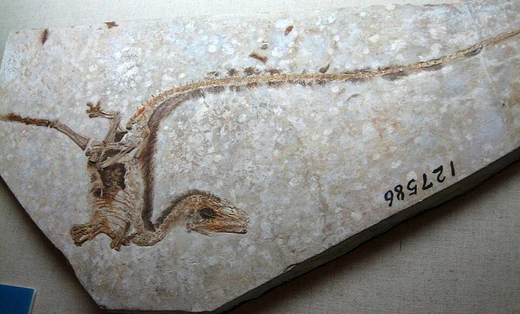
Dilong paradoxus
Small feathered tyrannosauroid from Early Cretaceous China.

WehaveaTrex · via Wikipedia: Dilong paradoxus · CC BY-SA 4.0
Dilong paradoxus is a species of small basal tyrannosauroid dinosaur from the Lower Cretaceous Yixian Formation of East Asia, in what is now China. Its discovery was significant because it provided the first direct evidence of feathers in tyrannosaurs, a feature long suspected for the group. The genus name Dilong means 'emperor dragon' in Chinese, referencing its relationship to the later 'king' tyrannosaurid Tyrannosaurus rex.
Quick Facts
- Genus
- Dilong
- Species
- paradoxus
Facts from the source article.
Lore & Background
The holotype specimen of Dilong paradoxus was discovered in the Lujiatun Unit of the Yixian Formation near Lujiatun, Beipiao, in western Liaoning Province, China. This formation dates to between 125.8 and 126 million years old, though other specimens from different areas may vary in age. The species was described by Xu Xing and colleagues in 2004. The specific name paradoxus is a Latinisation of the Ancient Greek word meaning 'against received wisdom', reflecting the unexpected presence of feathers in a tyrannosaur relative.
The type specimen (IVPP 14243) is a nearly complete, semi-articulated skull and skeleton of a juvenile about 1.6 m long. Referred material includes additional skulls and vertebrae. Dilong paradoxus had a covering of simple feathers or protofeathers, preserved as skin impressions near the jaw and tail. These feathers lacked a central shaft and were likely used for insulation, not flight. Adult tyrannosaurs from other regions show pebbly scales, leading researchers to speculate that tyrannosauroids may have had different skin coverings on different body parts, and that feathers may have been lost as animals grew larger.
Braincase scans indicate Dilong had an S-shaped brain protected by thin meninges, unlike the more linear brain of Tyrannosaurus. Its large flocculus suggests agility and good balance, while small olfactory tracts indicate a less refined sense of smell compared to later tyrannosauroids. A 2023 study estimated its bite force at 337 N.
Reader's Guide
Dilong paradoxus holds a pivotal place in dinosaur paleontology as the first tyrannosauroid found with direct evidence of feathers. This discovery confirmed long-held suspicions that feathers were not limited to birds and small theropods but extended into the lineage leading to giant tyrannosaurs like Tyrannosaurus rex. The simple, shaftless protofeathers of Dilong suggest that early feathers evolved for insulation or display rather than flight, supporting the idea that feathers originated in coelurosaurian dinosaurs before the evolution of flight.
The classification of Dilong has been debated. Initially described as a primitive tyrannosauroid, some later studies placed it outside Tyrannosauroidea, while others reaffirmed its position within the group. A 2024 analysis even recovered Dilong and proceratosaurids outside Tyrannosauroidea. This ongoing uncertainty highlights the complexity of early coelurosaurian evolution and the importance of Dilong as a key taxon for understanding the early diversification of tyrannosauroids.
Dilong also provides insights into the paleobiology of early tyrannosauroids. Its brain anatomy suggests it was an agile predator with good balance but a less developed sense of smell than later, larger tyrannosaurids. The estimated bite force of 337 N is modest compared to later tyrannosaurs, consistent with its small size. The possibility that juvenile tyrannosaurs were feathered while adults were scaly raises intriguing questions about ontogenetic changes in integument and thermoregulation across the tyrannosaur lineage.
Did You Know?
- Dilong paradoxus was the first tyrannosauroid dinosaur found with direct evidence of feathers.
- The specific name 'paradoxus' means 'against received wisdom' in Ancient Greek.
- The type specimen is a juvenile about 1.6 m long, but adults may have exceeded 2 m.
More in Dinosaur species 1-24
Spotted an error? Know more?
Reader corrections go straight into our review queue. Suggest an edit · How this site is sourced