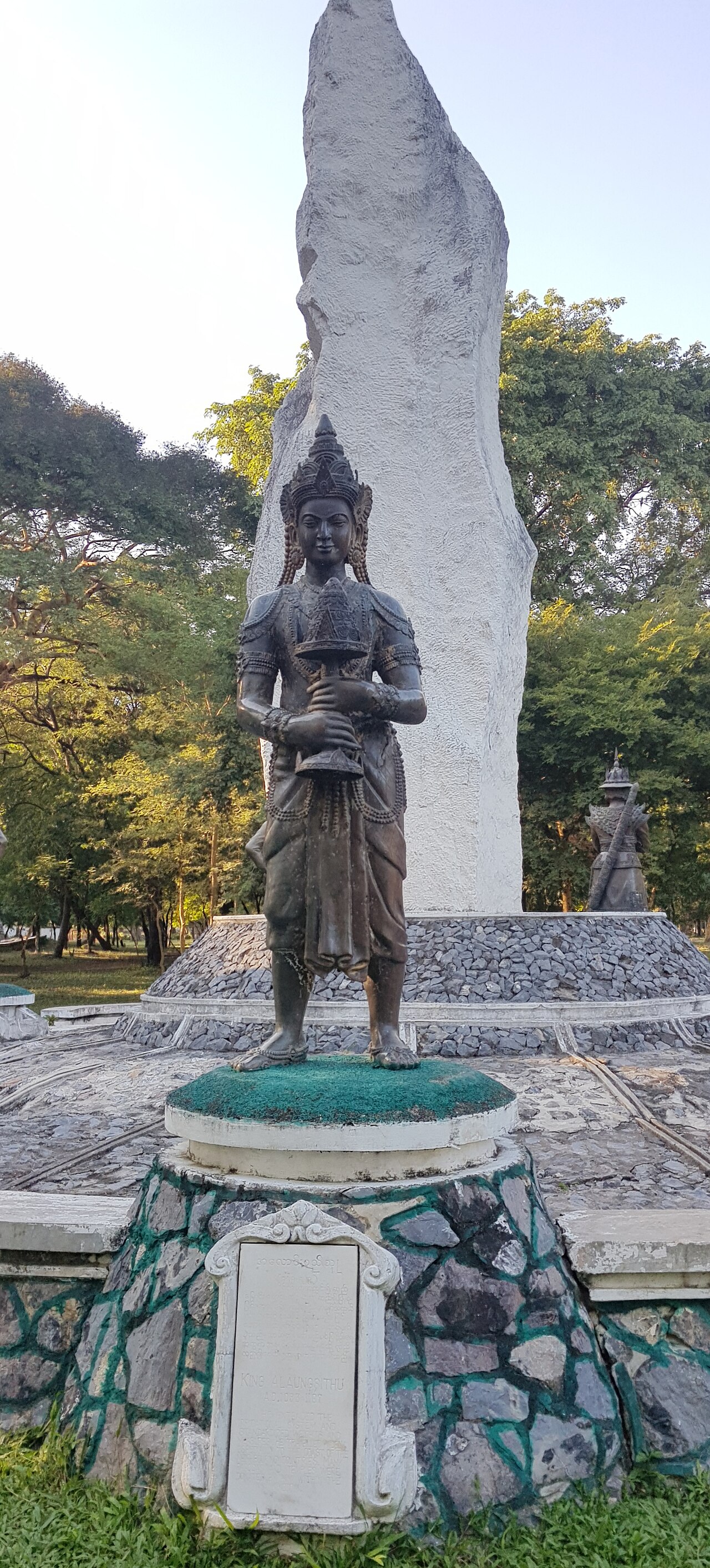
Alaungsithu
Peripatetic king of Pagan who built monuments, nurtured Buddhism, and became a nat.

Kantabon · CC BY-SA 4.0
Alaungsithu or Sithu I (also Caññsū I; 1090–1167) was king of the Pagan Dynasty of Burma (Myanmar) from 1112/13 to 1167. According to Zatadawbon Yazawin, he was born on 13 December 1089. The chronicles do not agree on the dates regarding his life and reign.
Quick Facts
- Title
- King Sithu I of Pagan
- Reign
- 1112/13 – 1167
- Succession
- King of Burma
- Predecessor
- Kyansittha
- Successor
- Min Shin Saw (Consecrated) / Narathu
- Suc Type
- Successor
- Reg Type
- Chief Minister
- Regent
- Aleimma
- Spouse
- Yadanabon / Ti Lawka Sanda Dewi / Yazakumari / Taung Pyinthe
- Issue
- Min Shin Saw / Narathu / Htauk Hlayga / Taung Phya / Shwe Kyu / Chit Oo / Kyaungdaw
- Full Name
- Jeyyasūra Caññsū I
- Regnal Name
- Śri Tri-bhuvanādityā pavarapaṇḍita sudhammarājā mahādhipati Caññsū
Facts from the source article.
Lore & Background
Sithu is remembered as a peripatetic king who traveled extensively throughout his realm, built monuments and nurtured Theravada Buddhism with acts of piety. He was born Zeyathura Sithu to Saw Yun (son of King Saw Lu) and Shwe Einthi (daughter of King Kyansittha) on 17 January 1090 (or 13 December 1089 per Zatadawbon Yazawin). At his birth, Kyansittha crowned the infant as king and presented him to the people saying 'Behold your king! Henceforth, I reign only as his regent.' Sithu faced no opposition to the throne after Kyansittha died in 1112. He was the great-grandson of Anawrahta on his father's side. His reign was prosperous, with Pagan as an integral part of inland and maritime trading networks. He engaged in a massive building campaign including colonies, forts, ordination halls, pagodas, reservoirs, dams, and other land improvements. He introduced standardized weights and measures. He presided over the beginning of a transition from Mon culture toward a distinctive Burman style. He traveled widely, reportedly sailing as far south as Malaya and Bengal, and also to Nanzhao Kingdom. In the 1150s, he visited the court of Parakramabahu I in Sri Lanka. His eldest son Min Shin Saw was banished for ill treatment of people; Sithu then appointed second son Narathu as heir apparent. In 1167, Sithu fell ill, and Narathu smothered him with bedclothes at Shwegugyi Temple. Sithu is posthumously remembered as Alaungsithu (lit. Sithu the Maitreya Buddha) and inducted into the pantheon of Burmese animist nats as Min Sithu.
Reader's Guide
Min Sithu is one of the 37 nats in the Burmese pantheon. He is the nat representation of King Alaungsithu. He is portrayed sitting on a throne with one knee up and his foot on the seat, wearing royal garments.
Did You Know?
- According to Zatadawbon Yazawin, Alaungsithu was born on 13 December 1089, though other chronicles give 17 January 1090.
- He was crowned as an infant by his grandfather Kyansittha, who then reigned as regent.
- Sithu built the Thatbyinnyu Temple, the tallest of all Pagan monuments, consecrated in 1144.
- He was assassinated by his own son Narathu, who smothered him with bedclothes.
A Wandering Sovereign
Sithu's rule was defined by constant movement. Rather than governing from a fixed capital, he traversed his vast dominions on pious pilgrimages, constructing works of merit wherever he traveled. His journeys reportedly carried him as far south as Malaya and as far west as Bengal by sea, and he even made the overland trip to the Nanzhao Kingdom, following in the footsteps of his great-grandfather Anawrahta. Yet these extended absences left the capital in a state of considerable disorder.
In the early years of his reign, Sithu had to secure his borders through military force. Revolts flared in Tenasserim and northern Arakan. A Pali inscription discovered at Mergui confirms that the Tenasserim coast acknowledged Pagan's suzerainty. In Arakan, a local chief named Kahtom had displaced the legitimate heir; Pagan's first combined land-and-sea expedition to restore Letya Min Nan failed, but a second campaign in 1118 succeeded. The grateful Letya Min Nan subsequently repaired the Buddhagaya shrine in Sithu's honor. His judicial rulings, some issued personally, were once preserved in a collection known as the Alaungsithu Hpyatton.
Trade, Standardization, and a Sri Lankan Flashpoint
Sithu presided over a period in which Pagan became deeply woven into both overland and maritime commercial networks. To underpin this prosperity, he launched an enormous infrastructure program spanning the entire kingdom: colonies, forts, and outposts were established at strategic frontier points; ordination halls and pagodas were raised to sustain the Buddhist sangha; and reservoirs, dams, and other agricultural improvements were built to support the farming population. A particularly consequential reform was the introduction of standardized weights and measures across the realm, a measure that streamlined both governance and commerce and set in motion the gradual monetization of Pagan's economy, though its full effects would not materialize until later in the twelfth century.
Diplomacy also played a prominent role. In the 1150s, Sithu sent an ambassador to the court of Parakramabahu I in Sri Lanka. Burmese chronicles celebrate the episode as a royal marriage alliance, claiming Sithu wed a daughter of the Sri Lankan king. The Sinhalese Cūḷavaṃsa, however, tells a very different story: Sithu intercepted a letter bound for Cambodia, attempted to block Sri Lanka's elephant trade with that kingdom, and seized a lesser Sinhalese princess en route to the Cambodian court, provoking a short naval conflict.
From Mon Heritage to Burman Identity
The temple-building boom that had begun under Sithu's grandfather Kyansittha reached a new phase during his reign, and with it came a subtle but profound architectural transformation. The structures erected in this period include the final expressions of the Mon-influenced style at Pagan alongside the earliest deliberate attempts to articulate a distinctly Burman aesthetic. The most celebrated example of this new direction is the Thatbyinnyu, consecrated in 1144. Standing roughly five hundred yards from the Ananda Temple, its spire soars to more than two hundred feet, making it the tallest monument in the entire Pagan complex. Sithu also raised the Shwegugyi Temple in close proximity to the royal palace, further embedding sacred architecture into the heart of the capital.
This stylistic shift was not merely decorative. It marked the broader cultural transition away from the Mon traditions that had long shaped Pagan's artistic and religious life toward an expression of a distinctly Burman identity. The wealth generated by Sithu's prosperous trade networks and standardized economy provided the material foundation for this creative flowering, ensuring that the kingdom's spiritual landscape would carry a new visual signature for generations to come.
A Tragic End and an Eternal Place
Sithu's final years were marred by a bitter succession conflict. His eldest son, Min Shin Saw, had served as heir-apparent for most of the reign, but in the 1160s the king banished him to a small town roughly ninety miles north of Pagan, citing the prince's ill treatment of people. Sithu then elevated his second son, Narathu, to the position of heir.
In 1167, the aging king fell gravely ill. Narathu, impatient to claim the throne, had his father moved from the palace to the nearby Shwegugyi Temple. When Sithu regained consciousness and discovered he had been set aside, he was furious. Narathu entered the room and smothered the king with bedclothes.
Yet death did not erase Sithu's memory. In Burmese historical tradition he is honored as Alaungsithu, a name invoking the Maitreya Buddha, a reflection of his lifetime of pious deeds. He was also inducted into the pantheon of thirty-seven Burmese animist nats as Min Sithu, depicted seated on a throne with one knee raised and his foot resting on the seat, draped in royal garments. Notably, all but one of the nat spirits in this pantheon were, in life, victims of murder.
Gallery
Frequently Asked Questions
Who is Alaungsithu?
Alaungsithu, also called Sithu I, was a Pagan Dynasty king of Burma who ruled from roughly 1112 or 1113 until 1167. In the deified-monarch tradition he is remembered as a wandering sovereign who traveled broadly across his realm while actively promoting Theravada Buddhism.
What role does Alaungsithu play as a deified monarch?
His deified persona centers on the patron of sacred architecture and the bridge between Mon and Burman cultural traditions. Fans emphasize his role as a mobile, hands-on ruler who personally oversaw construction and religious life rather than governing from a fixed capital.
Why is Alaungsithu important in the deified-monarch canon?
He is a key figure because his reign accelerated the shift from Mon cultural dominance to a distinctly Burman identity in the Pagan region. His integration of the city into both overland and maritime trade routes cemented Pagan's economic and spiritual prominence for generations.
What is Alaungsithu most known for?
His massive temple and infrastructure building campaign remains his signature legacy, paired with his reputation as a peripatetic king who governed by traveling. Fans also highlight his active nurturing of Theravada Buddhism as a unifying force across his realm.
More in Deified male monarchs 1-24
Spotted an error? Know more?
Reader corrections go straight into our review queue. Suggest an edit · How this site is sourced