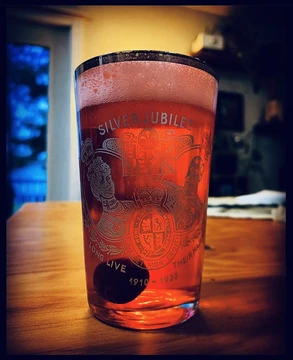
Blow my skull
A notoriously potent Australian punch from the mid-19th century.

Blow my skull is an alcoholic punch drink that originated in mid-19th century Australia. It is listed in *The English and Australian Cookery Book* by Edward Abbott and has been described as a 'notoriously potent alcoholic concoction'. The drink is sometimes alternatively called blow my skull off, though that name more accurately refers to a separate, later recipe made with rum, Cocculus indicus, spirits of wine, cayenne pepper, Turkish opium, and water.
Quick Facts
- Ingredients
- 1 pint rum / 1 pint porter or ale / 1/2 pint brandy / 2 pints boiling water / lime or lemon juice to taste / sugar to taste
- Drinkware
- Mug
Facts from the source article.
Lore & Background
Despite persistent claims, the drink was not invented by Lieutenant Governor Thomas Davey of Tasmania. The association appears to be a modern myth or conflation. The recipe first appears in *The English and Australian Cookery Book* (1864) by Edward Abbott, with no mention of Davey. The separate 'blow my skull off' version—containing opium, Cocculus indicus, and spirits of wine—is a later recipe with no direct link to Davey's punch. The two names have often been conflated, but they refer to distinct concoctions.
Reader's Guide
Blow my skull is significant as a historical Australian punch with roots in rum punch drinks from the Oceanic region. Its recipe, as listed in The English and Australian Cookery Book, calls for two pints of boiling water, sugar loaf, lime or lemon juice, one pint of ale or porter, one pint rum, and a half a pint of brandy. The version containing opium was a popular drink among gold miners in Australia in the 1850s. The 'blow my skull off' has been characterized as probably being 'the most famous cocktail created in Australia'. Cocktail historian Sebastian Raeburn has stated that Melbourne was 'one of the great cocktail centres of the world.' In the 21st century, 'Blow my skull' punch is sometimes served as a flaming drink when placed into a large skull shaped tiki bowl, using Jamaican pot-still rum, dark porter, brandy, and lime juice mixed with demerara sugar and boiling water. Other 21st century drink guides may still refer to such a beer cocktail as a 'blow my head off'. When the drink is referenced in 21st century cocktail books both names should be interpreted as meaning the porter-based version unless the guide specifically indicates to the contrary.
Composition and Core Ingredients
Blow My Skull is a beer cocktail built on a foundation of either ale or porter, with the beer serving as the primary ingredient of the drink. To this base, two distilled spirits are incorporated: rum and brandy. This construction places the drink firmly within the category of beer cocktails, which are defined as mixed drinks created by combining beer with other ingredients, such as a distilled beverage, or with another style of beer. In every beer cocktail of this type, the beer remains the dominant component, and Blow My Skull adheres to that principle. The flexibility to choose between ale and porter gives the drink a degree of adaptability, as the preparer can select whichever beer style suits the occasion or personal preference. Both options function as the structural backbone around which the rum and brandy are added. The result is a cocktail that, while rich in distilled spirits, still identifies itself first and foremost as a beer-based creation rather than a traditional spirit cocktail with beer serving merely as a secondary element.
Classification and the Beer Cocktail Tradition
Blow My Skull occupies a specific niche within the broader family of beer cocktails, a category that encompasses drinks ranging from simple pairings of beer with citrus juice to complex layered constructions involving multiple spirits. The defining characteristic of this entire class is that the primary ingredient is usually beer, and Blow My Skull follows that convention by anchoring its recipe in ale or porter. Unlike some of its peers in the beer cocktail list, which rely on a single distilled addition—such as the Boilermaker, which pairs mild ale with a shot of whiskey, or the Sake Bomb, which drops a shot of sake into beer—Blow My Skull incorporates two distinct spirits simultaneously. This dual-spirit approach sets it apart from the simpler one-spirit combinations found elsewhere in the category. It also distinguishes itself from layered drinks like the Black and Tan or the Black Velvet, where the mixing technique and ingredient types differ considerably. Blow My Skull sits in the spirit-forward corner of the beer cocktail tradition, where the beer provides volume and character while the rum and brandy contribute depth and warmth.
The Dual-Spirit Approach
What distinguishes Blow My Skull from many other entries in the beer cocktail canon is its use of two distilled beverages—rum and brandy—added to the beer base. Most beer cocktails in the broader list feature a single spirit or non-alcoholic addition: the Porchcrawler adds vodka and lemonade concentrate, the Snakebite pairs lager with cider, and the Shandy combines beer with lemonade or fruit juice. Even among the spirit-heavy examples, the Irish Car Bomb uses Irish cream and Irish whiskey, while the Hangman's Blood combines porter with brandy, gin, and rum. Blow My Skull's pairing of rum and brandy over ale or porter creates a specific profile that overlaps with, yet remains distinct from, the Hangman's Blood, which adds a third spirit (gin) to a similar porter base. The choice of two rather than one or three spirits gives Blow My Skull a focused intensity, concentrating the distilled character into just two complementary alcohols while the beer provides the body and volume that define the entire beer cocktail category.
Position Among Peer Beer Cocktails
Within the extensive list of recognized beer cocktails, Blow My Skull finds its neighbors among a diverse array of drinks that span multiple traditions and techniques. It shares the porter-and-spirit framework with the Hangman's Blood, which layers brandy, gin, and rum over porter, though Blow My Skull omits the gin and allows ale as an alternative base. It contrasts sharply with citrus-driven cocktails like the Michelada, which combines beer with lime juice, tomato juice, chili sauce, and Worcestershire sauce, or the Red Eye, which pairs beer with tomato juice and optional hot sauce. It also differs from the layered constructions of the Black and Tan, where pale ale and a dark beer are carefully poured in sequence, or the Black Velvet, which pairs stout with sparkling wine or champagne. Blow My Skull's identity as a straightforward combination of beer, rum, and brandy places it in the company of the Boilermaker and the U-Boot, drinks where a spirit is simply added to a glass of beer, though Blow My Skull's use of two spirits and its choice of ale or porter give it a slightly more complex character than those simpler pairings.
Frequently Asked Questions
What is Blow my skull?
Blow my skull is a heavily alcoholic punch that emerged in mid-19th-century Australia. It was documented in Edward Abbott's *The English and Australian Cookery Book* and quickly earned a reputation for being an extraordinarily strong drink.
Who invented Blow my skull?
No definitive creator has been identified for the recipe. The widespread claim that Tasmania's Lieutenant Governor Thomas Davey devised it is a modern conflation with no firm historical evidence behind it.
How is "Blow my skull" different from "Blow my skull off"?
Although the two names are frequently mixed up, "blow my skull off" more accurately points to a separate, later recipe that calls for rum, Cocculus indicus, spirits of wine, cayenne pepper, and Turkish opium. The original "blow my skull" is its own distinct punch formulation.
Where and when did Blow my skull originate?
The drink traces back to Australian drinking culture in the mid-1800s, where it was already regarded as a particularly fierce concoction. It appeared in period cookery publications of that era, confirming its circulation well before the 20th century.
Why is Blow my skull notable in cocktail history?
It stands out as one of the most notoriously potent punches of 19th-century Australia, remembered for both its extreme strength and the blunt, self-deprecating name. Its legacy persists as a cautionary footnote in the history of strongly alcoholic mixed drinks.
More in Cocktails with beer 1-24
Spotted an error? Know more?
Reader corrections go straight into our review queue. Suggest an edit · How this site is sourced