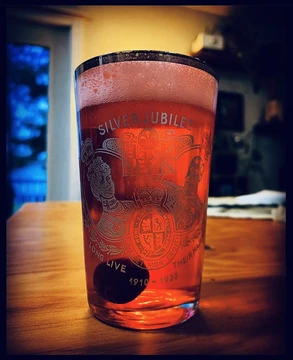
Black and tan
A layered beer cocktail of pale ale and stout.

A black and tan is a beer cocktail created by layering a pale beer, typically pale ale, over a dark beer, usually stout. In Ireland, this drink is referred to as a half and half. The name likely has English origins, where mixing different beers has been practiced since at least the 1600s. This blending tradition is sometimes linked to 18th-century London, where drinks called "three-threads" and "five-threads" were once thought to be common—though modern beer historians consider "three-threads" likely a myth or misnomer, and "five-threads" even less substantiated. The tax-avoidance explanation for these blends is speculative and not supported by established historical consensus. The first known use of the term "black and tan" for a drink appears in the 1881 issue of the American magazine *Puck*, according to the Oxford English Dictionary, though that citation refers to a different drink (ale and porter), not the layered beer cocktail. The earliest British use in a drink context is not clearly established; the OED does not list a British use until later, and claims of an 1889 usage are unverified.
In Ireland, the drink's name can be mistaken as a reference to the Black and Tans, a controversial British paramilitary force deployed during the Irish War of Independence (1919–21). In March 2006, Ben & Jerry's sparked controversy by releasing a Saint Patrick's Day ice cream flavor inspired by the drink. The company apologized, with a spokesman telling Reuters that any reference to the British Army unit was unintentional and no harm was meant. The name resurfaced in March 2012 when Nike included a shoe called the "Black and Tan" in an Irish-themed design set. In Australia, a similar drink called a "Tooheys Recent" uses Tooheys Old for the dark beer and Tooheys New for the pale beer.
To prepare a black and tan, fill a glass halfway with pale ale, then top it off with stout. An upside-down tablespoon can be placed over the glass to prevent splashing and keep the layers separate. A specially designed black-and-tan spoon, bent in the middle to rest on the pint glass rim, makes pouring easier. The layering of Guinness on top of pale ale or lager works because Guinness has a lower relative density. Several American breweries now sell premixed versions, such as Yuengling's Original Black and Tan.
Quick Facts
- Ingredients
- Pale ale or lager and stout or porter
- Served
- Neat: undiluted and without ice
- Drinkware
- Pint glass
Facts from the source article.
Lore & Background
The tradition of blending beers is sometimes traced to London during the 1700s where beer blends or 'three-threads' and 'five-threads' were thought to be consumed. However, modern beer historians have shown that 'three-threads' was likely a myth or misnomer, and 'five-threads' is even less substantiated. The claim that alehouses sold three-threads to avoid paying a higher tax on beer is speculative and not supported by established historical consensus. This tax-avoidance explanation is not considered reliable.
Reader's Guide
The black and tan is significant as a classic beer cocktail that demonstrates the long history of blending beers, a practice traceable to 17th-century England. Its name, first recorded in an American magazine in 1881, has caused controversy in Ireland due to its association with the Black and Tans, a paramilitary force sent by the British during the Irish War of Independence (1919–21). This sensitivity led to incidents in 2006 when Ben and Jerry's released an ice cream flavor inspired by the drink, and in 2012 when Nike released a shoe design called 'Black and Tan.' The drink's preparation relies on the lower relative density of stout, allowing it to be layered on top of pale ale. In Australia, a similar drink called 'Tooheys Recent' uses Tooheys Old and Tooheys New. Several American breweries, such as Yuengling, produce premixed versions. The black and tan remains a popular cocktail, though its name is avoided in Ireland in favor of 'half and half.'
Did You Know?
- The term 'black and tan' was first recorded in the American magazine Puck in 1881, but for a different drink (ale and porter), not the layered beer cocktail.
- In Ireland, the drink is called a half and half to avoid association with the Black and Tans paramilitary force.
- The layering of Guinness on top of pale ale is possible because of the lower relative density of the Guinness.
- In Australia, a similar drink is called a 'Tooheys Recent', using Tooheys Old and Tooheys New.
Roots in Tax Evasion and English Alehouses
The practice of combining different beers in a single glass stretches back to at least the seventeenth century in England, long before the name black and tan entered common parlance. By the 1700s, London alehouses had developed an elaborate system of threads, where each thread represented a distinct beer type poured into one drink. Patrons could order a three-threads or five-threads blend, and the practice carried a clear commercial motive behind its apparent simplicity. Brewers would mix a strong, heavily taxed beer with a cheaper, lower-taxed small beer, effectively sidestepping the higher duty while still delivering a robust-tasting pint. This tax-avoidance strategy flourished from the late 1690s through the early eighteenth century. The specific phrase black and tan did not appear in the drink context until 1881, when it surfaced in the American magazine Puck, as recorded by the Oxford English Dictionary. A full seven years later, in 1889, the term was first documented in a British setting, cementing its place in the English-speaking bar vocabulary.
A Name That Invites Misunderstanding
In Ireland, the phrase black and tan carries a weight far beyond a simple description of two layered beers. The name is easily mistaken for a nod to the Black and Tans, the paramilitary force dispatched by Britain during the Irish War of Independence between 1919 and 1921, a group remembered for its brutality. This association has repeatedly drawn the drink into public controversy. In March 2006, the ice cream company Ben and Jerry's introduced a Saint Patrick's Day flavour inspired by the cocktail, only to face backlash and issue a formal apology. A company spokesman told Reuters that any resemblance to the British Army unit was entirely unintentional and that no ill will was meant. The name resurfaced in headlines in March 2012, when Nike launched a pair of shoes branded Black and Tan as part of an Irish-themed collection of designs. Each incident underscores how a two-word drink name can inadvertently collide with deeply painful historical memory, particularly on the island of Ireland.
The Science and Craft of Layering
Preparing a black and tan is deceptively simple yet rewards a careful hand. The standard method calls for filling a glass to the halfway mark with a pale ale, then gently topping it off with a stout to complete the pint. To keep the two liquids from tumbling into one another, a bartender may rest an upside-down tablespoon across the rim of the glass, letting the stout slide down the back of the spoon in a slow, controlled stream. A purpose-built black-and-tan spoon, bent at a right angle in its middle, offers an even more stable perch on the lip of a standard pint glass, freeing the pourer's grip. The reason the layers hold at all is physics: Guinness and similar stouts carry a lower relative density than the pale ale beneath them, so the darker beer naturally floats on top rather than sinking. For those who prefer convenience, several American breweries now bottle the combination in advance, with Yuengling's Original Black and Tan being one well-known example of a premixed version available on store shelves.
One Drink, Many Names Around the World
Although the black and tan is most widely recognized by its English-language name, the same layered concept goes by different labels in different countries, reflecting local brewing traditions and linguistic preferences. In Ireland, where the drink is equally popular, it is simply called a half and half, a straightforward description that sidesteps the politically charged alternative name entirely. The typical construction remains the same: a pale beer, most often a pale ale, forms the base, while a dark beer, usually a stout, crowns the glass. Across the Tasman Sea, Australian pubs have their own shorthand. A customer can request a Tooheys Recent, a local twist that pairs Tooheys Old as the dark component with Tooheys New as the pale one, anchoring the cocktail firmly in the nation's most familiar brewery brand. These regional variations demonstrate that while the underlying technique of layering two distinct beers is universal, the identity of the drink is shaped by the specific brands, naming conventions, and cultural contexts of each community that embraces it.
Frequently Asked Questions
What is a Black and tan?
A Black and tan is a layered beer cocktail in which a pale ale is poured gently over a dark stout so the two liquids form distinct visual bands. The result is a two-toned drink with the lighter beer floating on top of the darker one.
How do you make a Black and tan?
Fill a pint glass roughly halfway with a dark stout, then pour a pale ale slowly down the side of the glass or over the back of a spoon so it settles on top without breaking the layer. A gentle, steady pour is the key to keeping the two beers visually separated.
What's the difference between a Black and tan and a half and half?
They describe the same layered pale-over-dark beer drink; the distinction is purely regional naming. In Ireland the cocktail is most commonly called a "half and half," while "Black and tan" is the term more widely used in English-speaking contexts.
Where does the name "Black and tan" come from?
The name likely traces back to an English tradition of blending different beers that dates to at least the 1600s, and it has sometimes been linked to 18th-century London drinks such as "three-threads," though modern beer historians regard those references as probable myths. The earliest confirmed written use of the phrase appears in 1881 in the American magazine Puck, but that reference described ale and porter rather than the layered cocktail familiar today.
What beers are traditionally used in a Black and tan?
The classic pairing is a pale ale layered over a dark stout, producing the signature light-top, dark-bottom look. Porters or other dark lagers can stand in for the stout, and lighter lagers can replace the pale ale, but the essential structure always calls for a pale beer over a dark one.
More in Cocktails with beer 1-24
Spotted an error? Know more?
Reader corrections go straight into our review queue. Suggest an edit · How this site is sourced