
Whitetail dascyllus
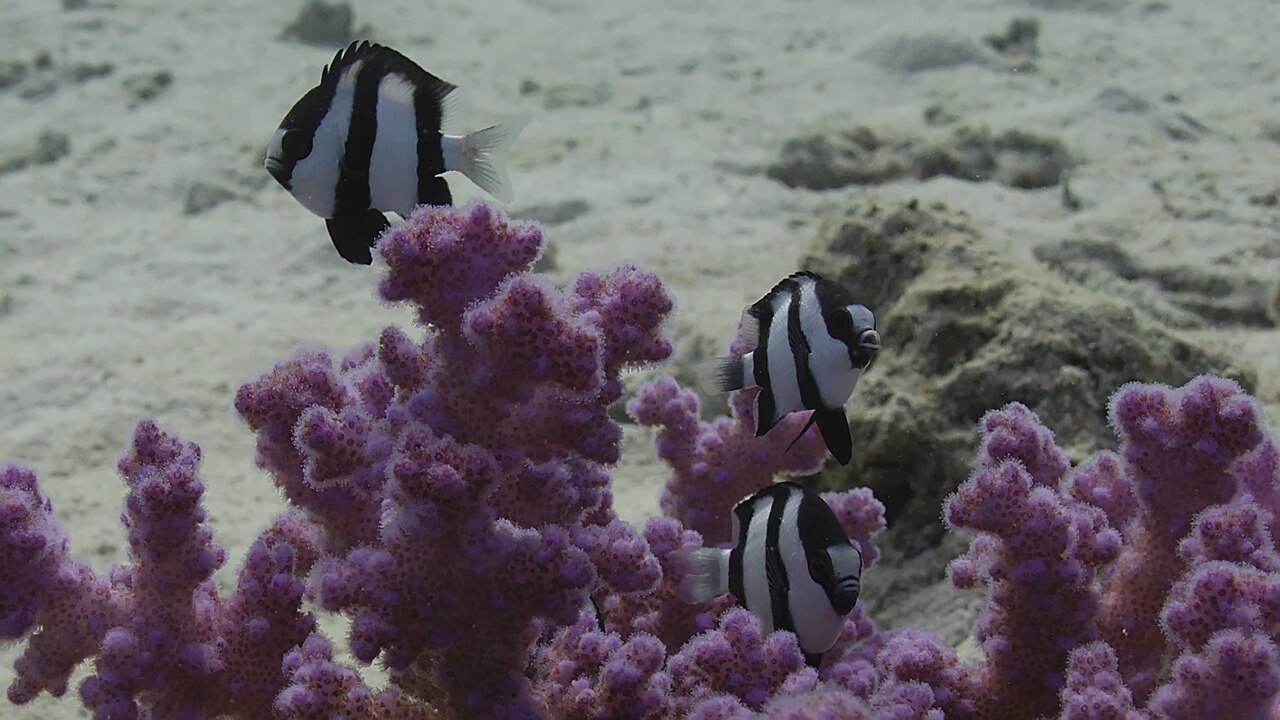
A territorial planktivore with bold black-and-white bars.

Tim Sheerman-Chase · CC BY 2.0
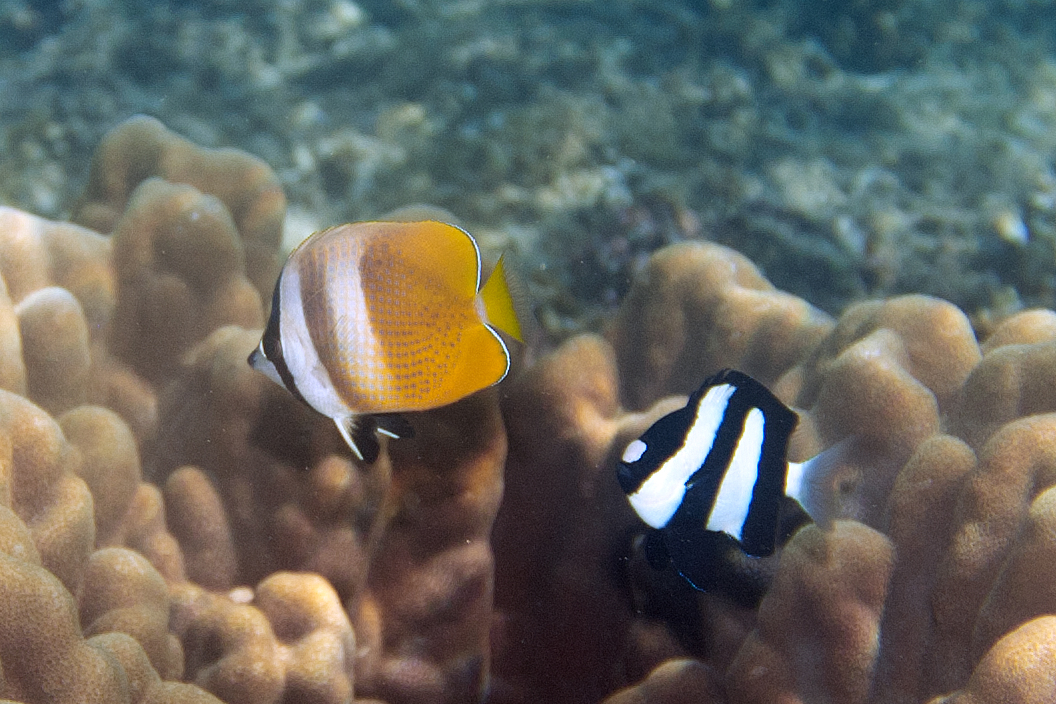
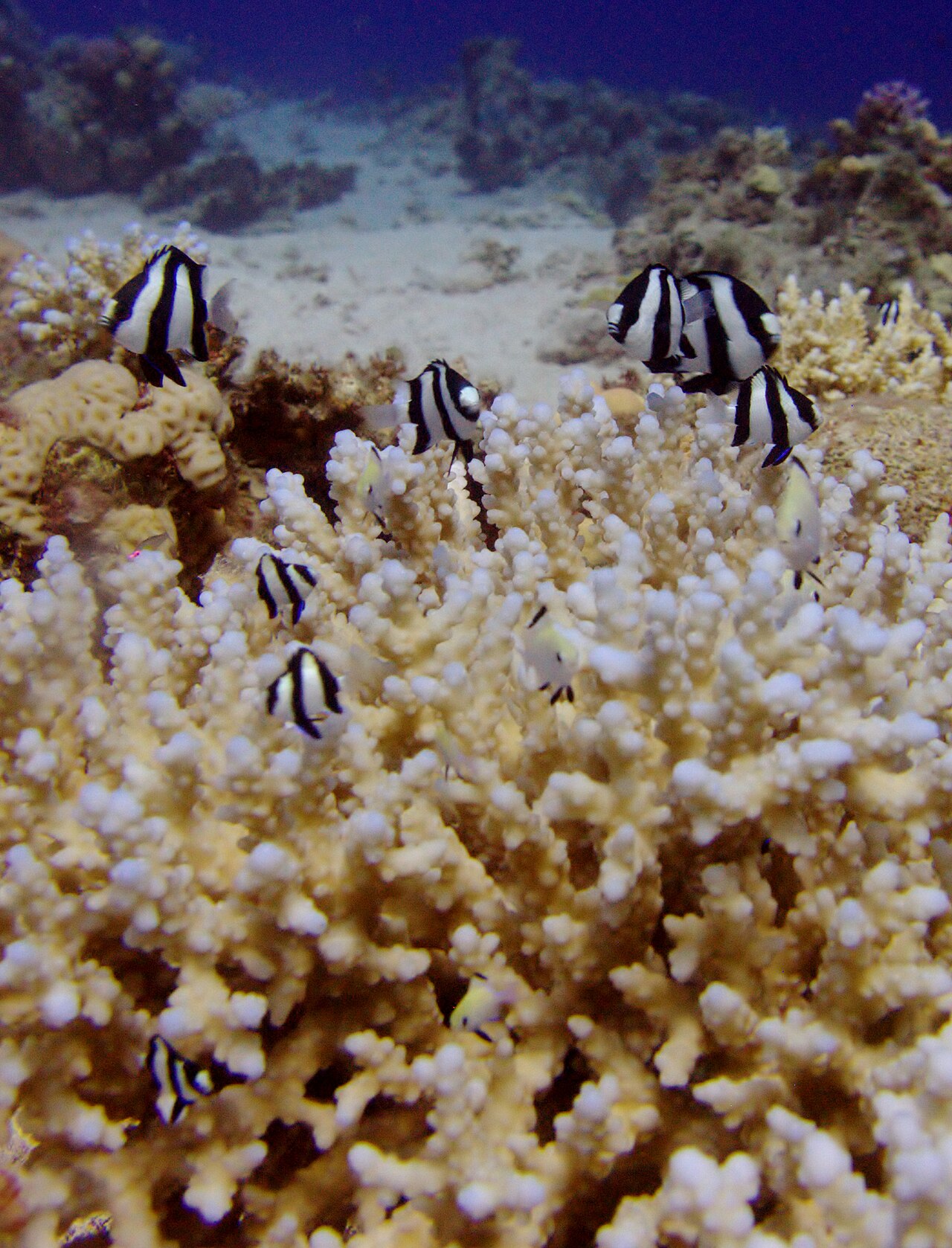
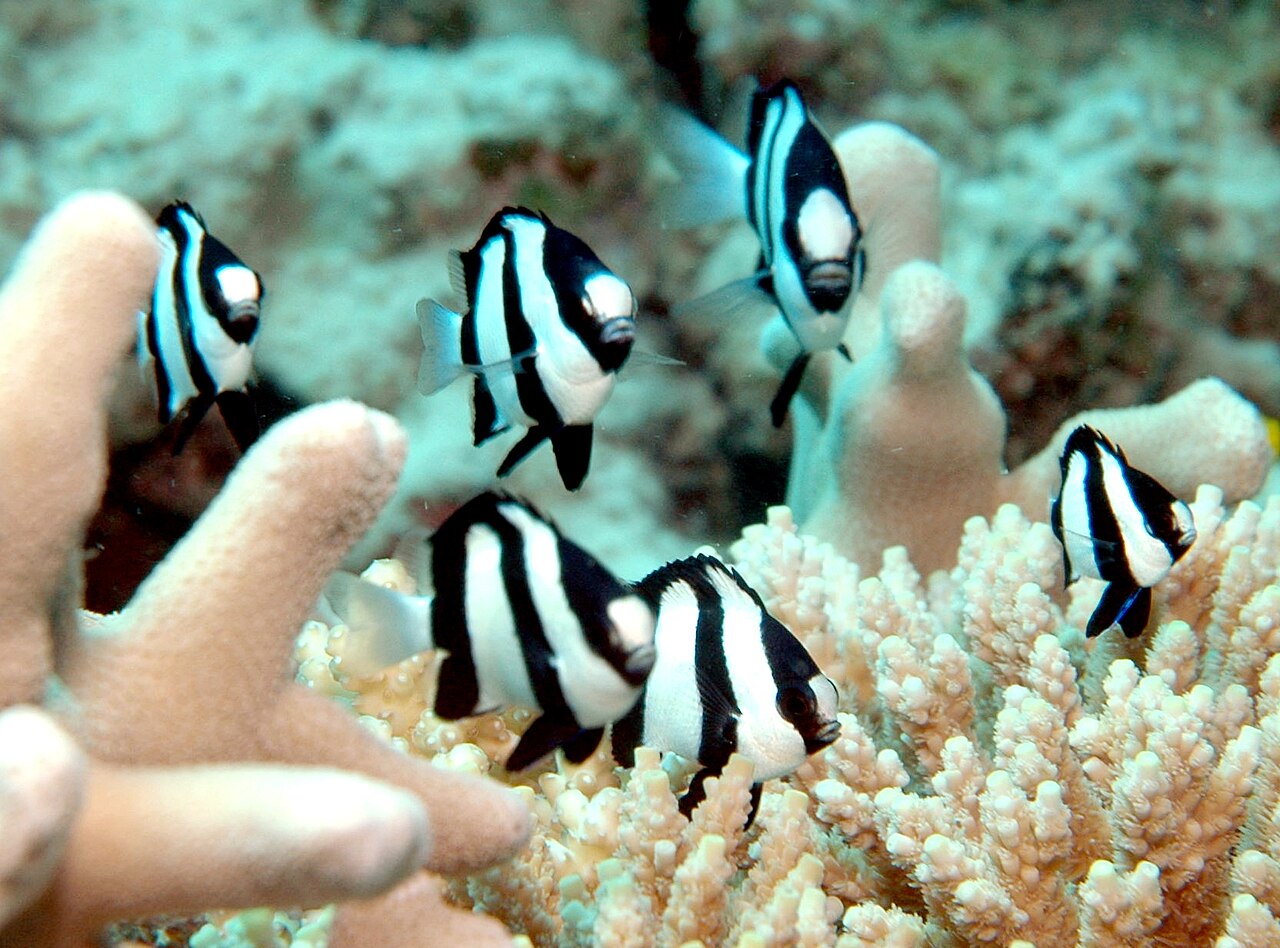
Dascyllus aruanus, commonly called the whitetail dascyllus or humbug damselfish, is a marine fish belonging to the Pomacentridae family. It reaches a maximum length of 10 centimeters, though most individuals are around 6 centimeters. The body is white with three vertical black bars, and it has a small mouth, a flat spine, and a prominent white spot between the eyes. This species is physically identical to *D. emamo*, differing only in the sounds they produce and where they live. It also closely resembles *D. abudafur* and can be confused with *D. melanurus*, which has four black stripes instead of three. The fish grows to about 6 centimeters in its first year, reaches full size by the end of its second year, and remains at roughly 10 centimeters for another three to four years before dying. Its black-and-white coloration stays constant throughout life; it likely helps attract others of the same species while also signaling the toxicity of their host coral to predators.
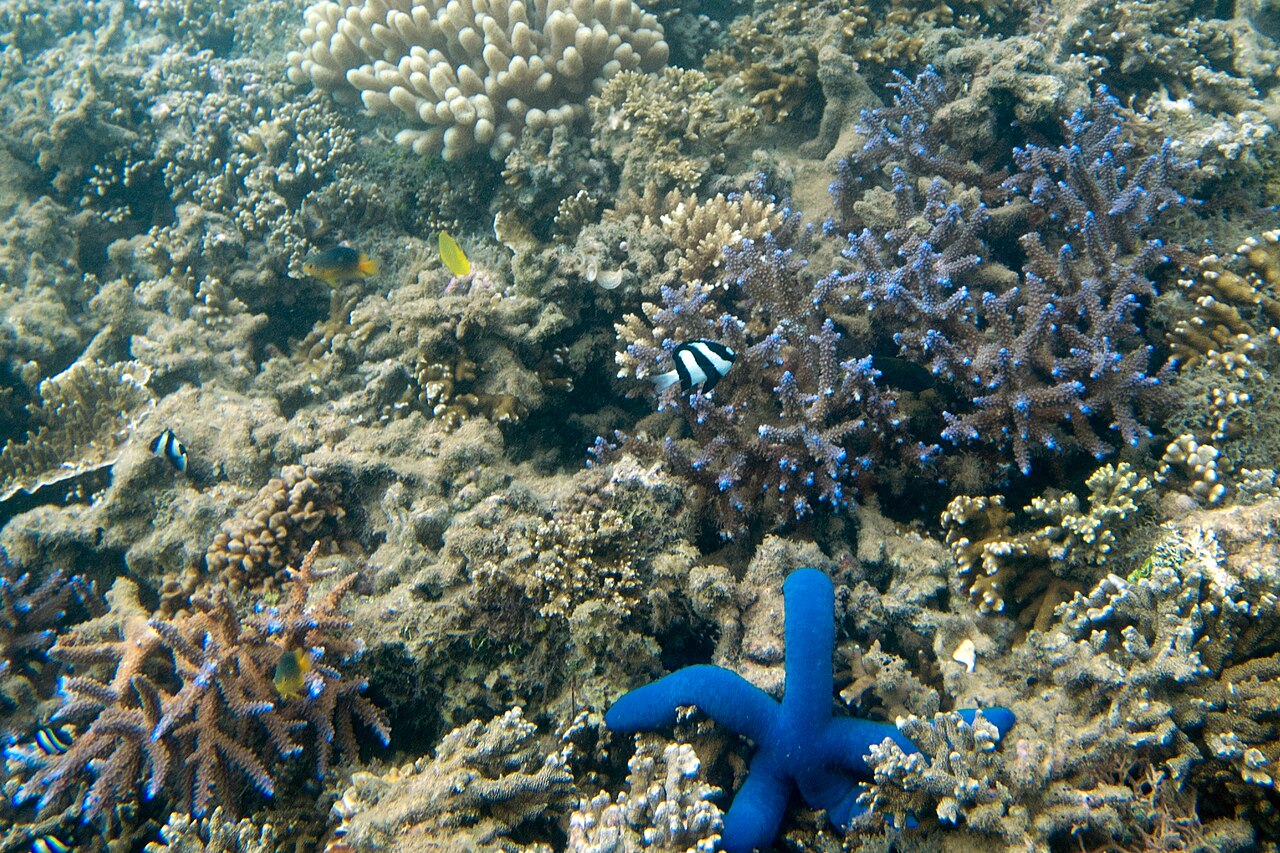
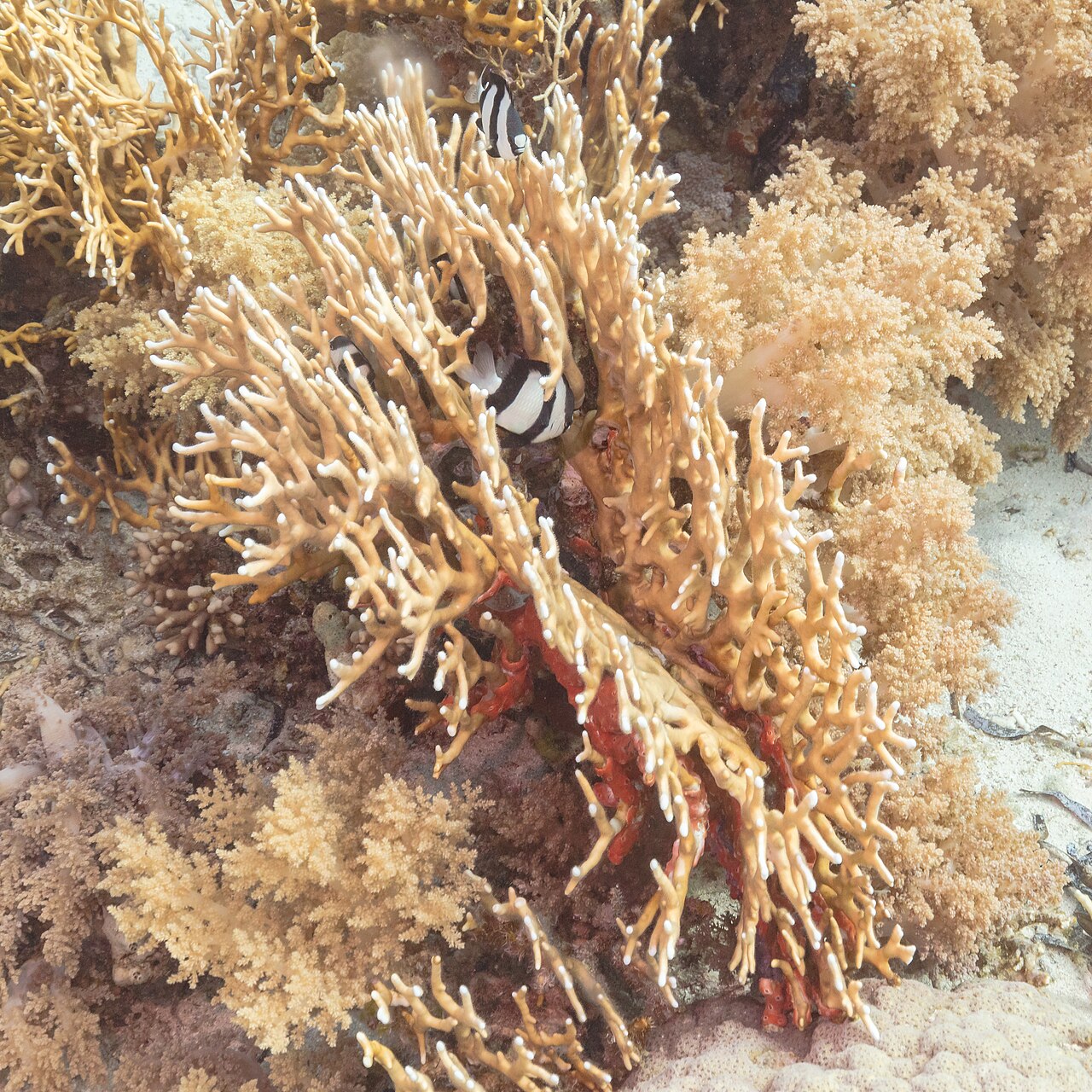
These fish are associated with coral reefs, usually gathering in groups above *Acropora* coral heads. They have a symbiotic relationship with the coral: as planktivores, they graze on unwanted algae and excrete phosphate and ammonium, acting as gardeners, while the coral provides shelter and protection. They leave the reef only when necessary, feeding on waste and small prey nearby. *Dascyllus aruanus* inhabits the Indo-Pacific, east and north of the Sunda Shelf. The population in French Polynesia is now considered a separate cryptic species, *D. emamo*. They live in small groups of about 30 individuals, preferring shallow coral reefs between one and ten meters deep, and rarely stray far from their birthplace. These reefs tend to be smaller and have less species diversity. The humbug is highly territorial and aggressively defends its coral shelter, but it can cohabitate with *Dascyllus marginatus* in the same coral, having adapted similar behaviors rather than competing.
Staying at the same reef for life, *Dascyllus aruanus* is very aggressive about its territory. All resources are heavily guarded, and any unfamiliar species is seen as a threat. Living in shallow waters means constant vigilance; some individuals attack first rather than wait for warning signs. They recognize members of their own species by the pattern of black stripes, not by movement.
Quick Facts
- Genus
- Dascyllus
- Species
- aruanus
Facts from the source article.
Lore & Background
The whitetail dascyllus is morphologically identical to Dascyllus emamo, differing only in the sounds they make and their geographic distribution. It also appears very similar to Dascyllus abudafur and may be mistaken for Dascyllus melanurus, which has four black stripes instead of three. The fish has a small mouth, a flat spine, and a large white spot between the eyes. Its colors remain the same throughout life and serve multiple purposes; it has been hypothesized that the bold contrast attracts same-species fish while signaling host coral toxicity to predators.
Associated with coral reefs, the humbug damselfish usually lives in groups above Acropora coral heads. It maintains a symbiotic relationship with the coral: as a planktivore, it grazes on unwanted algae and excretes phosphate and ammonium, while the coral provides shelter. The fish rarely strays far from its home reef and is particularly territorial, guarding its shelter against unfamiliar species. It can cohabitate with Dascyllus marginatus by adapting similar behaviors.
Social behaviors begin at a young age. Juveniles stay in schools and rely on each other for warning signals and food location. Hierarchies are based on size, with larger fish leading foraging groups and getting first priority of food. Males use a 'signal jump' to attract mates, and females prefer to spawn at sites that already contain eggs, a strategy called mate copying. Mating occurs daily with no spawning season, and males build and guard nests.
Reader's Guide
The whitetail dascyllus is significant as a common and resilient species in the aquarium trade, often called a 'starter fish' because it tolerates variable conditions and helps condition tanks for less hardy fish. It has been reared in captivity, though adults can be quite aggressive. In the wild, its constant and efficient reproduction system—daily mating, rapid egg production, and mate copying—likely contributes to its stable Least Concern conservation status. However, climate change poses a threat: warmer oceans are predicted to increase mobility and decrease aggression, potentially shifting social dynamics among cohabiting species. The humbug's symbiotic relationship with coral is critical, as its nutrient excretion helps coral store macromolecules that increase resistance to thermal stress. The species shows plasticity, adapting to dead coral colonies and broadening its diet to include small fish and debris, but the long-term viability of these adaptations remains uncertain. The scientific community's current focus is on preserving coral reefs, which are essential to the humbug's future.
Did You Know?
- It can produce up to 2,000 eggs every two days, with mating occurring daily.
- Females practice mate copying, preferring to spawn at sites that already contain eggs.
- The species can adapt to dead coral colonies and has a broad diet that includes small fish and debris.
Gallery
Frequently Asked Questions
What is the whitetail dascyllus?
It is a small, territorial reef fish (Dascyllus aruanus) in the Pomacentridae family, also known as the humbug damselfish. It feeds on plankton and is most often seen in tight shoals of roughly thirty members hovering over shallow coral.
How big does a whitetail dascyllus get?
Most adults measure about 6 centimeters, with an absolute maximum of 10 centimeters. That makes it a relatively compact damselfish compared to some of its larger reef neighbors.
What does a whitetail dascyllus look like?
Its body is white and carries three bold vertical black bars, a small mouth, a flattened dorsal spine, and a conspicuous white spot sitting between the eyes. The high-contrast black-and-white pattern is what gives it the 'humbug' nickname.
How do I tell a whitetail dascyllus from look-alike species?
It is physically identical to D. emamo and easily confused with D. abudafur, while D. melanurus can be ruled out because it has four stripes instead of three. The only reliable way to separate it from D. emamo is by the distinct vocalizations each produces or by knowing which region you are in.
Is the whitetail dascyllus endangered?
No—the IUCN currently classifies it as Least Concern. It is a fairly widespread shallow-water species, typically found between 1 and 10 meters depth across its range.
More in Clownfish and Damselfish, Part 2 1-24
Spotted an error? Know more?
Reader corrections go straight into our review queue. Suggest an edit · How this site is sourced