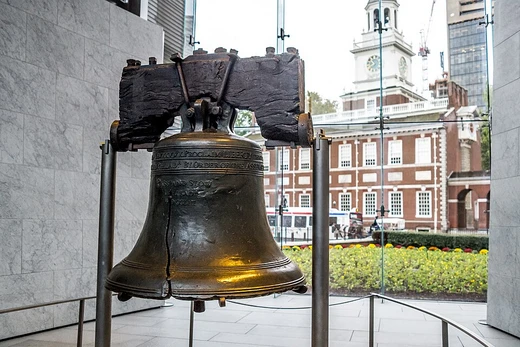
Liberty Bell Pavilion
Last updated

via Wikipedia: Liberty Bell Pavilion · see source
Where it is
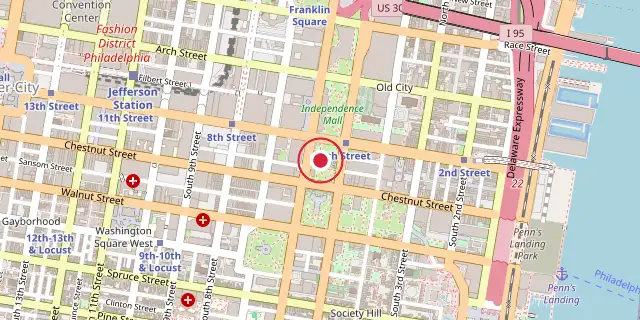
Coordinates: 39°57′00″N 75°09′00″W (39.9500, -75.1500) · Open in OpenStreetMap
Coordinates and connected clubs: the infobox of Wikipedia: Liberty Bell Pavilion (CC BY-SA 4.0). Map: drawn by Codexery from OpenStreetMap tiles.
For three decades starting in 1976, the Liberty Bell was displayed in a pavilion at Independence National Historical Park in Philadelphia. Designed by the architectural firm Giurgola Associates to be the Bell's permanent home, the steel-and-glass, hourglass-shaped building stood for only 30 years. The Bell is currently housed in a much larger building, the Liberty Bell Center, completed in 2003. The Pavilion was demolished in 2006.
Moving the Bell
The Liberty Bell was made in 1752 for the Pennsylvania Statehouse, the building now called Independence Hall where the Declaration of Independence and the U.S. Constitution were debated and signed. It first hung in the lowest part of the building's wooden spire, but was moved to the brick tower after the spire rotted and was taken down. In 1852, the cracked bell was removed and placed on display in the Hall's ground floor. By 1969, Independence National Historical Park feared that large crowds for the 1976 Bicentennial could damage Independence Hall, so it proposed moving the bell away.
An early plan to put it in a visitor center two and a half blocks east was dropped after strong public and congressional criticism. A second plan for a pavilion a quarter-mile north was also rejected. Philadelphia mayor Frank Rizzo pushed for a site on the block directly north of Independence Hall. Architect Romaldo Giurgola began designing the pavilion in early 1974, construction started in early 1975, and it was finished by year's end.
The bell was moved 600 feet north as part of Philadelphia's 1975 New Year's Eve celebration, and the pavilion opened at 12:01 a.m. on January 1, 1976.
Building
The steel-and-glass, hourglass-shaped building had a vestibule that gathered visitors and funnelled them down a hallway to the Bell Chamber. There, the Bell stood before a wall of glass with Independence Hall as its backdrop, and a ranger or guide gave a 5- to 10-minute presentation. A longitudinal line of skylights illuminated the interior and reinforced the central axis of Independence Mall. Glass walls on the north and south facades and canted side walls made the Bell visible from multiple angles, especially at night when lit by spotlights.
The building drew near-unanimous praise from architects, but some members of the public found it cold and insufficiently dignified, comparing it to a drive-in bank or subway station. With a capacity of about 100 people, it did not function well with large crowds; even without ranger presentations, lines could be hours long on peak days. After the Liberty Bell Center opened in 2003, the vacant Pavilion was used as a security screening building. Attempts to sell it for the $800,000 cost of disassembly and removal failed, and it was demolished in 2006, with some materials salvaged.
More in Buildings and Structures in Independence National Historical Park
Sources
Compiled from Wikipedia and the sources listed below. Text from Wikipedia is available under CC BY-SA 4.0; this entry is adapted from it.
- Wikipedia: Liberty Bell Pavilion (CC BY-SA 4.0).
Spotted an error? Know more?
Reader corrections go straight into our review queue. Suggest an edit · How this site is sourced