Edgar Allan Poe National Historic Site
Last updated
Where it is
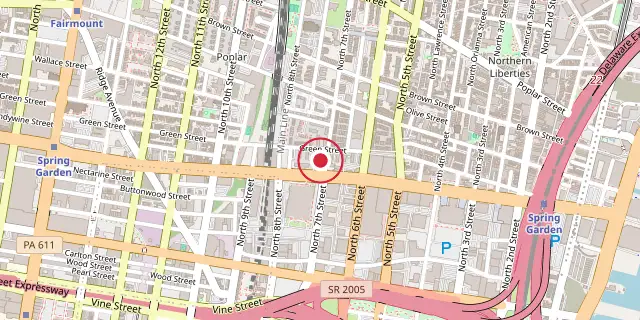
Coordinates: 39°57′43″N 75°09′00″W (39.9620, -75.1500) · Open in OpenStreetMap
Coordinates and connected clubs: the infobox of Wikipedia: Edgar Allan Poe National Historic Site (CC BY-SA 4.0). Map: drawn by Codexery from OpenStreetMap tiles.
In Philadelphia's Spring Garden neighborhood, at 532 N. 7th Street, stands the only surviving Philadelphia residence of Edgar Allan Poe. The author rented this home during his years in the city from 1838 to 1844, though he lived in several others. It became a National Historic Landmark in 1962.
Poe's time in Philadelphia
Poe lived in at least three Philadelphia locations, including homes on Arch Street, on 16th and Locust Streets, and on Coates Street near 25th Street. During his time in the city, he published 31 stories and several literary criticism pieces, among them "The Tell-Tale Heart," "The Murders in the Rue Morgue," and "The Gold-Bug." His February 1841 review of Charles Dickens's novel Barnaby Rudge correctly predicted the novel's resolution before its final installment; Dickens reportedly remarked, "The man must be the devil." Poe's years in Philadelphia have been described as the happiest of his life.
Home's history
Edgar Allan Poe lived in this Philadelphia home for roughly a year, starting in early 1843, with his wife Virginia and his aunt and mother-in-law Maria Clemm. The family likely settled in before June, as a letter Poe wrote on June 20 gives his address as 234 North Seventh Street, above Spring Garden on the West Side. The neighborhood was mostly Quaker at the time. Maria Clemm kept the household running; a neighbor remembered her cleaning the yard, washing windows, and whitewashing the fence.
One visitor described the place as little more than a lean-to. Poe sometimes struggled to pay rent, but his landlord, a plumber, was understanding. The family moved out in the first week of April 1844, possibly because Virginia’s tuberculosis was worsening. After Poe, several families lived in the house until 1933, when Richard Gimbel, son of the Gimbels department store founder, bought it.
A Poe enthusiast, he restored the home and opened it as a museum, leaving it to the city of Philadelphia in his will. It became a National Historic Landmark in 1962, and the National Park Service took over in 1978, reopening it to the public in 1980.
Home today
The site combines Poe's former residence with two adjoining houses built after Poe left Philadelphia. The rooms are left in arrested decay and are not furnished to period. The neighboring houses contain a welcome area, gift shop, film screening room, and minor exhibits.
A reading room, decorated based on Poe's "The Philosophy of Furniture," is the only room furnished to a 19th-century appearance; it was not part of Poe's original home and is not meant to suggest he had a similar room. The room holds a complete collection of Poe's works and audio interpretations. A statue of a raven stands outside.
The cellar resembles one described in "The Black Cat" (1843). No items originally owned by the Poe family are on site, though many are held at the Free Library of Philadelphia. The site has been closed for fire safety upgrades since July 2024.
More in Buildings and Structures in Independence National Historical Park
Sources
Compiled from Wikipedia and the sources listed below. Text from Wikipedia is available under CC BY-SA 4.0; this entry is adapted from it.
- Wikipedia: Edgar Allan Poe National Historic Site (CC BY-SA 4.0).
Spotted an error? Know more?
Reader corrections go straight into our review queue. Suggest an edit · How this site is sourced