President's House (Philadelphia)
Last updated
Where it is
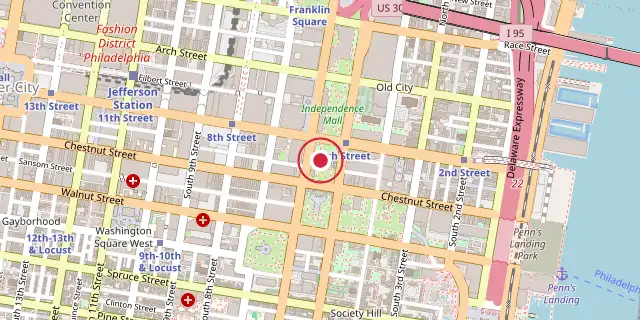
Coordinates: 39°57′00″N 75°09′00″W (39.9500, -75.1500) · Open in OpenStreetMap
Coordinates and connected clubs: the infobox of Wikipedia: President's House (Philadelphia) (CC BY-SA 4.0). Map: drawn by Codexery from OpenStreetMap tiles.
The President's House in Philadelphia served as the third U.S. presidential mansion, occupied by George Washington and John Adams during the temporary national capital period. It was built around 1767 by widow Mary Masters and later became the residence of Robert Morris before being used by Washington. The site is notable for its later commemoration of the enslaved Africans who worked in Washington's household.
History
The three-and-a-half-story brick mansion on the south side of Market Street was built in 1767 by widow Mary Lawrence Masters. In 1772, she gave it as a wedding gift to her elder daughter, Polly, who married Richard Penn, the lieutenant-governor of the colony and a grandson of William Penn. Richard Penn entertained delegates to the First Continental Congress, including George Washington, at the house. Penn was entrusted to deliver Congress' Olive Branch Petition to King George III.
Penn, his wife, and in-laws departed for England in July 1775. During the September-1777-to-June-1778 British occupation of Philadelphia, the house was occupied by General Sir William Howe, who used it as the British Army's American headquarters. Following the British evacuation, it housed the American military governor, Benedict Arnold, who began a secret and treasonous correspondence with the British while living there. The next resident was John Holker, a purchasing agent for the French.
During Holker's residency, the house suffered a fire. Robert Morris purchased the house following a January 1780 fire, and restored and expanded it. Transfer of the deed was delayed because of the Revolutionary War. Morris refurbished and expanded the house, and lived there while Superintendent of Finance.
George Washington was Morris's houseguest during the four-month Constitutional Convention in 1787. Philadelphia served as the temporary national capital from 1790 to 1800.
Morris also owned the house next door, to which he and his family moved. In November 1790, Washington brought eight enslaved Africans from Mount Vernon to work in his presidential household: Moll, Oney Judge, Christopher Sheels, Austin, Giles, Paris, Hercules Posey, and Posey's son Richmond. A ninth enslaved African, "Postilion" Joe, joined following Austin's death on December 20, 1794 in Maryland.
President Washington in Philadelphia
When George Washington, the nation’s first president, took up residence in Philadelphia, he lived there with First Lady Martha Washington and two of her grandchildren, Wash Custis and Nelly Custis. The household initially included about 24 staff members, eight of whom were enslaved Africans, along with an office staff of four or five who also lived and worked in the building. With more than 30 people under one roof, the house proved too cramped, so Washington ordered expansions: a large two-story bow added to the south side of the main house, making the rear rooms thirty-four feet long; a one-story servants’ hall built on the east side of the kitchen ell; bathtubs removed from the bath house’s second floor, with that room turned into the president’s private office; additional servant rooms; and an enlarged stable.
During his presidency, Washington oversaw the creation of the federal judiciary, the planning and location of the future District of Columbia, and the suppression of the Whiskey Rebellion in western Pennsylvania.
Use of slave labor
In 1790, Washington brought eight enslaved Africans from his Mount Vernon plantation to Philadelphia: Moll, Christopher Sheels, Hercules and his son Richmond, Oney Judge and her half-brother Austin, Giles, and Paris. Pennsylvania had begun a gradual abolition of slavery in 1780, which froze the number of enslaved people in the state and granted freedom only to their future children. The law did not free anyone immediately but allowed slaveholders from other states to keep personal slaves in Pennsylvania for six months; after that, those enslaved could legally petition for their freedom.
Washington knew slavery was unpopular in Philadelphia but privately argued he remained a Virginia resident subject to its laws. To avoid the six-month residency rule, he gradually replaced most enslaved servants at the President’s House with German indentured servants and rotated the remaining enslaved individuals in and out of the state. He also made sure he himself never spent six continuous months in Pennsylvania. The only enslaved person added to the presidential household after the initial group was Joe (Richardson), brought from Virginia in 1795, following Austin’s death in Maryland on December 20, 1794.
Archaeology and advocacy
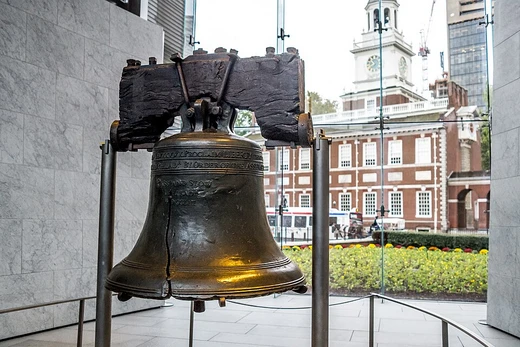
In the late 1990s, planners designed a new home for the Liberty Bell on Independence Mall. The Liberty Bell Center, nearly as long as a football field with a 40-foot porch, was set to run along Sixth Street from near Chestnut to Market. During November and December 2000, archaeologists dug into the site. They found the lower half of an icehouse pit, a relic of the President’s House.
Robert Morris had built this icehouse in the early 1780s. It was a windowless structure over an octagonal stone pit, 13 feet across and 18 feet deep. Each winter, workers packed the pit with ice blocks from the Schuylkill River, keeping food cold for most of the year. The National Park Service measured and photographed the truncated pit, then buried it again.
It now sits under the Liberty Bell Center’s concrete floor. The Liberty Bell got its name from abolitionists in the 1830s, who used it as a symbol for ending slavery. In 1790, George Washington brought eight enslaved Africans from Mount Vernon to work in his Philadelphia presidential household. He ordered that his white coachman and enslaved stablehands live in a building behind the kitchen.
That building’s footprint lay under the planned Liberty Bell Center’s porch, about five feet from the main entrance. In January 2002, while the center was under construction, the Historical Society of Pennsylvania published Edward Lawler, Jr.’s research. It revealed that future visitors would “walk over” the footprint of Washington’s slave quarters as they entered the new building.
President's House Memorial
Opened in 2010, the President's House: Freedom and Slavery in the Making of a New Nation memorial is an open-air pavilion that traces the footprint of the original buildings and lets visitors see the surviving foundations. The pavilion holds some artifacts, and until early 2026, signs and video displays covered the building's history along with the roles of George Washington's enslaved workers in his household and the broader place of slavery in American society.
CBS called it the only federal historic site dedicated to remembering slavery in the United States. The City of Philadelphia and the National Park Service jointly created the memorial. In March 2025, President Donald Trump issued Executive Order 14253, titled "Restoring Truth and Sanity to American History," which instructed the Interior Department—the agency that runs the National Park Service—to make sure memorials do not "inappropriately disparage Americans past or living" and instead "focus on the greatness of the achievements and progress of the American people."
The Park Service then reviewed all 433 national parks, monuments, and historic sites. Employees were told to flag items for possible removal and to put up signs and QR codes at every location. At the President's House, 13 items across six exhibits were flagged. An Interior Department spokesperson explained that interpretive materials concentrating only on difficult parts of U.S. history, without including broader context or national progress, might give an incomplete picture rather than a richer one.
On January 22, 2026, all exhibit panels and videos were taken down—not just the flagged ones—leaving only the names of nine enslaved people carved into a cement wall. Politico noted that the Interior Department did not say what would replace the removed exhibits.
More in Buildings and Structures in Independence National Historical Park
Sources
Compiled from Wikipedia and the sources listed below. Text from Wikipedia is available under CC BY-SA 4.0; this entry is adapted from it.
- Wikipedia: President's House (Philadelphia) (CC BY-SA 4.0).
Spotted an error? Know more?
Reader corrections go straight into our review queue. Suggest an edit · How this site is sourced