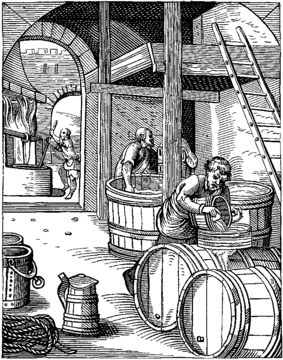
Gypsy brewer
A brewer without a fixed brewery, using others' facilities.

A gypsy brewer is a brewer who does not own a fixed brewery facility but instead contracts with existing breweries to produce their beer. This practice is notable for allowing brewers to enter the market without the capital investment required for a physical plant, while relying on the equipment and processes of established breweries.
- Earliest known brewing
- 2500 BC
- Oldest functional brewery
- Weihenstephan brewery, Freising, Bavaria, traced to 1040 AD
- Early brewery workers
- 8 to 10 workers by 11th and 12th centuries
- Us brewery count 1850
- 431
- Us brewery count 1873
- 4131
Lore & Background
The source article describes the historical evolution of breweries from domestic production to dedicated facilities. Early brewing was a cottage industry, with production at home, and by the ninth century monasteries and farms produced beer on a larger scale. By the eleventh and twelfth centuries, larger dedicated breweries with eight to ten workers were built. The article notes that the diversity of size in breweries is matched by diversity of processes, degrees of automation, and kinds of beer produced. A brewery is typically divided into distinct sections, each reserved for one part of the brewing process. The modern brewery uses stainless steel equipment, and heating is achieved through pressurized steam, while cooling is done by cooling jackets on tanks. The brewing process is divided into nine steps: milling, malting, mashing, lautering, boiling, fermenting, conditioning, filtering, and filling. Fermentation tanks come in many shapes and sizes, from enormous cylindroconical vessels to 20-litre glass carboys used by homebrewers.
Reader's Guide
The significance of the gypsy brewer lies in its contrast to the historical and modern brewery models described in the article. Historically, breweries were fixed facilities, often built on multiple stories to use gravity for product transfer, and later equipped with steam engines and refrigeration. The gypsy brewer bypasses the need for such a plant by using existing brewery equipment. The article notes that almost all brewery equipment today is made of stainless steel, and that modern brewing plants perform myriad analyses for quality control. A gypsy brewer would rely on the host brewery's equipment and processes, including its cylindroconical vessels, cooling jackets, and quality control procedures. The practice allows for flexibility and lower entry costs, but the gypsy brewer must work within the constraints of the host facility's layout and capabilities. The article's description of the brewing process—from mashing to filling—applies equally to beer made by a gypsy brewer, as the same steps are followed regardless of ownership of the plant.
Did You Know?
- The oldest functional brewery is the German state-owned Weihenstephan brewery, traced to 1040 AD.
- Early breweries were built on multiple stories so gravity could assist in transferring product between stages.
- The steam engine, improved by James Watt in 1775, brought automatic stirring and pumps to breweries.
- Carl von Linde developed the refrigeration machine in 1871, allowing year-round beer production.
More in Brewing Processes 1-24
Spotted an error? Know more?
Reader corrections go straight into our review queue. Suggest an edit · How this site is sourced