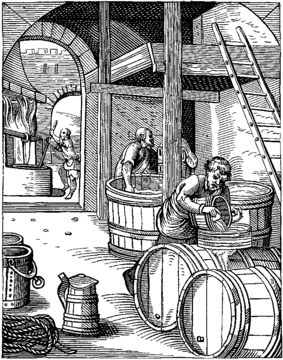
Beer
One of the oldest and most widely consumed alcoholic drinks.

Beer is an alcoholic drink created through brewing and fermenting starches sourced from cereal grains, with malted barley being the most common base, though wheat, maize, rice, and oats are also used. The process begins by mashing the grain, which turns its starches into sugars that dissolve in water to create a liquid called wort. Yeast then ferments the wort, producing ethanol and carbonation. It ranks among the oldest and most widely consumed alcoholic beverages globally and is one of the most popular drinks overall. Most contemporary beer includes hops, which add bitterness and other flavors while also serving as a natural preservative and stabilizer. Other flavorings like gruit, herbs, or fruits may be added or substituted for hops. In commercial production, natural carbonation is often replaced with forced carbonation. Beer is sold in bottles and cans and is frequently available on draught in pubs and bars. The brewing industry operates worldwide, dominated by a few large multinational corporations alongside thousands of smaller producers, from brewpubs to regional breweries. Modern beer typically has an alcohol content of about 4% to 6% by volume. Early writings, such as the Code of Hammurabi from 1750 BC, include laws regulating beer, and "The Hymn to Ninkasi," a prayer to the Mesopotamian goddess of beer, contains a recipe for it. Beer is embedded in the culture of many nations, linked to social traditions like beer festivals and activities such as pub games. Frequent or excessive consumption can lead to health issues, as alcohol is classified as a Group 1 carcinogen by the IARC.
- Alcohol by volume
- usually around 4% to 6% ABV
- Earliest archaeological evidence
- 13,000 year-old residues at Raqefet Cave, Israel
- Earliest chemical evidence from barley
- about 3500–3100 BC, Godin Tepe, Iran
- Global sales as of 2006
- more than 133 billion litres per year
- Global revenues as of 2006
- US$294.5 billion
- China beer consumption 2010
- 45 billion litres
Lore & Background
Beer is recorded in the written history of ancient Egypt, and archaeologists speculate that beer was instrumental in the formation of civilisations. The Sumerians drank a variety of beers, and the goddess Ninkasi was believed to oversee the brewing process. Some of the earliest Sumerian writings contain references to beer, including 'The Hymn to Ninkasi', which served as both a prayer and a method of remembering the recipe. The Ebla tablets show that beer was produced in the city in 2500 BC. A fermented drink using rice and fruit was made in China around 7000 BC. During the Vedic period in Ancient India, there are records of the consumption of the beer-like sura. 4th century BCE Greek philosopher Xenophon noted that 'barley wine' was produced in Armenia and drunk through straws.
Beer was spread through Europe by Germanic and Celtic tribes as far back as 3000 BC, and was mainly brewed on a domestic scale. Early European beers may have contained fruits, honey, plants, spices, and other substances such as narcotic herbs; this mixture was called gruit. Hops were a later addition, first mentioned in Europe around 822 by a Carolingian Abbot and again in the twelfth century by abbess Hildegard of Bingen. In 1516, William IV, Duke of Bavaria adopted the Reinheitsgebot (purity law), allowing only water, hops, and barley-malt. During the Industrial Revolution, production moved from artisanal to industrial manufacture.
Most modern beer is brewed with hops, which add bitterness and other flavours and act as a natural preservative and stabilizer. Other flavouring agents, such as gruit, herbs, or fruits, may be included or used instead of hops. In commercial brewing, natural carbonation is often replaced with forced carbonation. Beer is distributed in bottles and cans, and is commonly available on draught in pubs and bars. The brewing industry is a global business, consisting of several dominant multinational corporations and many thousands of smaller producers ranging from brewpubs to regional breweries.
Reader's Guide
Beer's significance lies in its ancient origins and its role as one of the world's oldest prepared alcoholic drinks, with archaeological evidence dating back 13,000 years. It has been integral to early civilisations, from the Sumerians and Egyptians to the Vedic period in India and ancient China. The Code of Hammurabi (1750 BC) included laws regulating beer, and 'The Hymn to Ninkasi' contains a recipe for it. Beer forms part of the culture of many nations and is associated with social traditions such as beer festivals and pub games. The brewing industry is a global business, with more than 133 billion litres sold per year as of 2006, generating US$294.5 billion in revenues. China's beer consumption in 2010 hit 45 billion litres, nearly twice that of the United States. The Reinheitsgebot of 1516 is perhaps the oldest food-quality regulation still in use. Beer can cause health issues if consumed often or in excess; alcohol is an IARC group 1 carcinogen. A widely publicised study in 2018 suggested that sudden decreases in barley production due to extreme drought and heat could cause substantial volatility in the availability and price of beer.
Did You Know?
- The earliest archaeological evidence of beer consists of 13,000 year-old residues used by the Natufians for ritual feasting at Raqefet Cave in Israel.
- The Sumerian goddess Ninkasi was believed to oversee the brewing process, and production and distribution of beer was attributed there to women.
- In 1516, William IV, Duke of Bavaria adopted the Reinheitsgebot, which allowed only water, hops, and barley-malt in beer.
- Brown bottles began to be used in 1912 by the Joseph Schlitz Brewing Company to prevent light rays from degrading beer quality.
More in Brewing Processes 1-24
Spotted an error? Know more?
Reader corrections go straight into our review queue. Suggest an edit · How this site is sourced