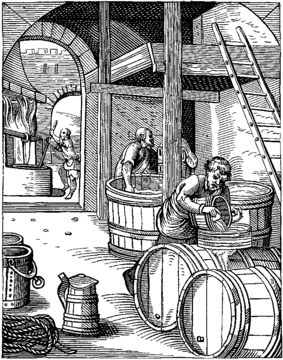
Barrel-aged beer
Beer aged in wooden barrels for added flavour and complexity.

Barrel-aged beer is simply beer that spends time maturing inside a wooden barrel. Most of these barrels previously held bourbon, whisky, wine, or, less often, brandy, sherry, or port. Brewers age beer in barrels for several reasons: to draw flavors from the wood itself—like tannins and lactones—to pick up traces of whatever the barrel once stored, or to encourage a secondary fermentation with Brettanomyces yeast. Oak is the most common wood used, though chestnut, ash, poplar, cedar, acacia, cypress, redwood, pine, and even eucalyptus have all been tried, with mixed results.
The flavors an oak barrel gives depend heavily on the species of oak, where it was grown, and how the wood was treated. New oak barrels are rarely used for beer because they are expensive, but when they are, they can contribute notes of wood, vanilla, dill, spice, and toastiness.
**History**
Belgium has a long tradition of barrel-aging, especially with lambic beers. Lambics have been brewed in the Zenne Valley and Pajottenland since the 13th century. By 1900, there were at least 300 lambic producers in Brussels and the surrounding countryside. Timmermans, one of the oldest surviving breweries, dates back to 1702, and the blended lambic derivative gueuze is believed to have originated that same year. In the 19th century, Eugene Rodenbach began brewing Flanders red ale after learning how to “ripen” beer in oak barrels while in England. Rodenbach Classic blends young beer with beer that has matured on oak for two years, while Rodenbach Vintage is entirely beer aged for two years in a single foeder. Another Belgian sour style, Oud bruin, is not usually barrel-aged, though some examples exist from both Belgium and North America.
In Bamberg, Germany, smoked beer, or Rauchbier, has been served directly from oak casks at the Schlenkerla tavern since the 15th century. Greene King’s Strong Suffolk Ale is an 18th-century “country beer” blended from Old 5X, which is aged for two years in oak tuns. Large oak vats were once standard for fermenting and storing beer in England—a practice that became infamous in 1814 when one of these vats burst in London, killing eight people.
In the United States, the historic Ballantine Brewery aged its beer in wooden vats for up to a year. These vats were originally made of oak and later of cypress.
- First bourbon barrel aged beers
- early 1990s in the United States
- Oldest existing lambic brewery
- Timmermans, dating back to 1702
- Lambic breweries in 1900
- at least 300 in Belgium's Zenne Valley and Pajottenland
- Typical lambic aging period
- one to three years
- Largest foeder capacity
- up to 10,000 litres
- Year goose island bourbon county stout f
- 1992
Lore & Background
Lambics have been brewed in Belgium's Zenne Valley and Pajottenland since the 13th century. There were at least 300 lambic makers in the region in 1900. Timmermans is one of the oldest existing breweries, dating back to 1702, and the production of the blended lambic derivative gueuze is believed to have started in the same year. Eugene Rodenbach started brewing Flanders red ale in the 19th century after learning how to 'ripen' beer in oak barrels in England. In the German town of Bamberg, smoked beer or Rauchbier has been tapped directly from oakwood casks at the Schlenkerla tavern since the 15th century. Greene King's Strong Suffolk Ale is an example of an 18th-century 'country beer', blended from Old 5X aged for two years in oak tuns. Large oak vats were once the norm for fermentation and storage of beer in England, a fact made notorious when one burst in London in 1814, killing eight people.
In the United States, the historic Ballantine Brewery aged their beer in wooden vats for up to a year, originally made of oak and later of cypress wood. The first bourbon barrel-aged beers were produced in the United States in the early 1990s. Goose Island's Bourbon County Stout was one of the first, first produced by Greg Hall in Chicago in 1992 when Jim Beam gave the brewer a couple of used barrels. Other breweries followed, typically ageing rich Imperial stouts. Some early successes were Founders KBS, The Bruery's Black Tuesday, and The Lost Abbey's Angel's Share. America's enthusiasm inspired Harviestoun in Scotland to join forces with Highland Park Scotch whisky distillery, resulting in the Ola Dubh range aged in whisky casks up to 40 years.
Lambics are fermented and aged in wooden barrels similar to those used to ferment wine. The microflora from the wood contribute to spontaneous fermentation. The barrels used by traditional Belgian lambic breweries can be up to 150 years old, and the ageing process typically lasts from one to three years. New barrels are rarely used; instead, used barrels are procured from wine regions of Spain, Portugal, Greece, and especially France. Barrels come in three sizes: Brussels tuns (approx. 250 litres), pipes (approx. 600 litres), and foeders (up to 10,000 litres). Most pipes are used port wine barrels that came into wide use after World War I.
Reader's Guide
Barrel-aged beers have become a significant and notable segment of the brewing world. By 2016, Craft Beer and Brewing wrote that 'barrel-aged beers are so trendy that nearly every taphouse and beer store has a section of them.' Food and Wine wrote in 2018: 'A process that was once niche has become not just mainstream, but ubiquitous.' However, in 2023 the Boston Globe reported that demand for barrel-aged beers had dropped, and they were becoming much harder to come by. The article notes that some breweries produce exclusively barrel-aged beers, such as Belgian lambic producer Cantillon and sour beer company The Rare Barrel. Others specialize in barrel-ageing particular styles, such as Põhjala with Baltic porters and Jester King with its Méthode Traditionnelle. International craft brewer Mikkeller operates a custom barrel-ageing facility at an old shipyard in Copenhagen, Denmark. The article also describes a dispute over naming: in 2016 Jester King Brewery released a beer labelled 'Méthode Gueuze,' but the High Council for Artisanal Lambic Beers (HORAL) objected, and it was agreed that American brewers would use 'Méthode Traditionelle' instead. Chicago hosts an annual Festival of Wood- and Barrel-Aged Beer (FoBAB), described as the world's largest beer festival and competition of its kind.
Did You Know?
- By US law, 'straight bourbon' must be aged in new American white oak barrels, making used barrels surplus for breweries.
- A large oak vat burst in London in 1814, killing eight people.
More in Brewing Processes 1-24
Spotted an error? Know more?
Reader corrections go straight into our review queue. Suggest an edit · How this site is sourced