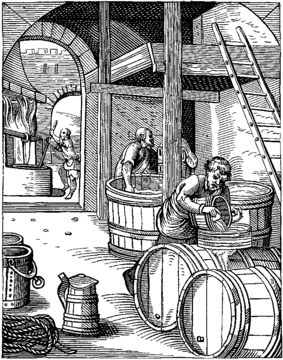
Brewing
Brewing is the production of beer by steeping starch and fermenting with yeast.

Brewing is the process of making beer. It begins by soaking a starch source—most often cereal grains like barley—in water, then fermenting the resulting sugary liquid with yeast. This can be done commercially in a brewery, at home by a homebrewer, or as a group activity. People have been brewing since at least the 11th millennium BC; archaeological evidence shows that prehistoric groups and later civilizations, such as those in ancient Egypt, China, and Mesopotamia, all made beer. Since the 1800s, the brewing industry has been a standard part of most Western economies.
The essential ingredients of beer are water and a fermentable starch source, typically malted barley. Most beer is fermented using brewer’s yeast and flavored with hops. Other starch sources, like millet, sorghum, and cassava, are less common. Brewers sometimes add secondary ingredients—called adjuncts—such as corn, rice, or sugar, often to cut costs or to achieve a specific quality, like adding wheat to help the beer retain its foamy head. The most common starch source is ground cereal, known as grist; the mix of starch or cereal ingredients in a recipe may be called the grist, grain bill, or mash ingredients.
The brewing process involves several steps: malting, milling, mashing, lautering, boiling, fermenting, conditioning, filtering, and packaging. Fermentation can happen in three main ways: warm, cool, or spontaneous. It may occur in an open or closed vessel, and a secondary fermentation can take place in a cask or bottle. Additional techniques include Burtonisation, double dropping, and the Yorkshire Square method. After fermentation, brewers may filter the beer or age it in barrels.
**History**
Brewing dates back at least to the 11th millennium BC. Archaeological finds indicate that prehistoric peoples and later societies—including those in China, ancient Egypt, and Mesopotamia—made beer. The oldest known writing, cuneiform from ancient Mesopotamia, contains descriptions of beer production. In Mesopotamia, brewing had social approval and divine protection from female deities: Ninkasi oversaw beer production, Siris was a metonym for beer, and Siduri, a divine alewife in the Epic of Gilgamesh, was associated with enjoying beer. In pre-industrial times and in developing countries, women have often been the primary brewers.
- Earliest archaeological evidence
- 13,000 years ago at Raqefet Cave in present-day Israel
- Oldest surviving beer recipe
- 3900-year-old Sumerian poem honouring Ninkasi
- Earliest pictorial evidence
- 6000-year-old Sumerian seal from Tepe Gawra (circa 4000 BC)
- Chemical evidence of barley beer
- 5500-year-old pottery from Godin Tepe in Iran
- Hops cultivation recorded
- 13th century
- Industrial revolution shift
- 19th century
Lore & Background
Brewing has taken place since at least the 11th millennium BC, with the earliest archaeological evidence found at Raqefet Cave in present-day Israel, where stone mortars indicate Natufians brewed wheat- or barley-based beer around 13,000 years ago, probably for ritual feasts. In Mesopotamia, a 6000-year-old Sumerian seal depicts two figures drinking beer through long reed straws from a communal bowl, and chemical analysis of pottery from Godin Tepe in Iran provides evidence of barley beer from about 5,500 years ago. A 3900-year-old Sumerian poem honouring Ninkasi, the patron goddess of brewing, contains the oldest surviving beer recipe, describing production from barley via bread. In pre-industrial times and in developing countries, women are frequently the main brewers. During the Industrial Revolution, production moved from artisanal to industrial manufacture, and domestic manufacture ceased to be significant by the end of the 19th century. The development of hydrometers and thermometers changed brewing by allowing greater control.
Reader's Guide
The brewing process includes steps such as malting, milling, mashing, lautering, boiling, fermenting, conditioning, filtering, and packaging. There are three main fermentation methods: warm, cool, and spontaneous. Fermentation may take place in an open or closed vessel, and a secondary fermentation may occur in the cask or bottle. Additional methods include Burtonisation, double dropping, and Yorkshire Square, as well as post-fermentation treatments like filtering and barrel-ageing. The basic ingredients are water, a fermentable starch source such as malted barley, brewer's yeast, and hops for flavouring. Hops contribute bitterness, floral and herbal aromas, antibiotic effects favouring brewer's yeast, and aid in head retention. Water mineral content influences beer character, as seen in Dublin's hard water suited to stout and Pilsen's soft water suited to pale lager. The brewing industry today is a global business with several dominant multinational companies and many thousands of smaller producers, from brewpubs to regional breweries.
Did You Know?
- The earliest archaeological evidence for beer brewing comes from Raqefet Cave in present-day Israel, dating to around 13,000 years ago.
- A 3900-year-old Sumerian poem honouring Ninkasi contains the oldest surviving beer recipe.
- Hops were not widely cultivated for beer until the 13th century; before that, beer was flavoured with plants such as yarrow, wild rosemary, and bog myrtle.
- The production of bread and beer has been argued to be responsible for humanity's ability to develop technology and build civilisation.
More in Brewing Processes 1-24
Spotted an error? Know more?
Reader corrections go straight into our review queue. Suggest an edit · How this site is sourced