Alewife (trade)
A woman who brewed and sold ale commercially.

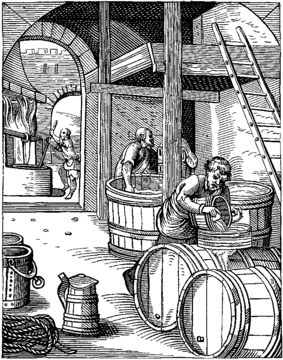
An alewife, also called a brewess or brewster, was a woman who brewed ale to sell commercially. Women have brewed since long before the process became industrialized.
The word "alewife" first appears in English records in 1393, meaning a woman who runs an ale-house, and is synonymous with "brewster." Today, it is often used in translations of ancient texts to describe any woman who brewed and sold ale, going back to the earliest recorded history.
In ancient Mesopotamia, brewing was mainly done by women. The character Siduri in the Epic of Gilgamesh is a divine alewife. Before the Black Death, women brewed most ale in England, both for home use and for sale, and some continued into the 1600s. Ale was a key part of the medieval English diet because it was the cheapest and cleanest drink available. People likely drank up to a gallon per day. Since ale went sour within days, it had to be brewed constantly. Production was large-scale but used a simple, widely known process, usually with malted barley or oats. The Assize of Bread and Ale regulated the trade across England, linking ale prices to grain prices and requiring public quality checks. Operating outside these rules was forbidden and punished severely by courts.
Medieval public records before the Black Death treat brewing as a female-only profession, showing women dominated the trade. This likely happened because brewing could be done at home, added to other income, and was passed down through generations of women. It required little specialization and took place in the home, making it an accessible way for women to earn extra money in towns and villages. Elite wives also supervised their female servants in brewing without social stigma. Records often miss poorer families, where women almost certainly brewed small amounts for their own use and occasional sale, since authorities focused on larger, regular production.
Between 1300 and 1700, daily drinking was common because water quality was poor, making alcohol preferable for taste. In France, average annual wine consumption was over 100 liters for most of this period. Workers could even request payment in alcohol instead of money. However, people drank not mainly for intoxication but as daily sustenance, replacing water.
- First recorded use
- 1393 in England
- Synonym
- brewster
- Daily ale consumption medieval england
- up to a gallon a day per person
- Alehouses per population 1577
- 1 alehouse for every 142 inhabitants
- Period of daily alcohol consumption
- 1300–1700
- Key regulation
- Assize of Bread and Ale
Lore & Background
The original brewing profession in ancient Mesopotamia was principally performed by women, and the character of Siduri in the Epic of Gilgamesh appears as a divine alewife. In England before the Black Death, women brewed the majority of ale for both domestic and commercial use, and some continued brewing into the 17th century. Ale was a key part of the medieval English diet as the most affordable and clean beverage available, though it went sour within days, requiring constant production. The ale trade was legally regulated by the Assize of Bread and Ale, which linked the price of ale to the price of grain and ordained public checks on quality.
Public records from the medieval period before the Black Death treat brewing as a solely female profession, indicating dominance by women. This likely evolved because brewing could be done in the home, supplemented other incomes, and was passed down from previous generations. The lack of needed specialization and the home-based location made it accessible for women to add income. Elite wives also engaged in a supervisory capacity over female servants without social stigma. By the late 15th century, hopped beer from the Netherlands and Belgium began supplanting ale because it kept fresh longer and was easier to transport; brewers in the Low Countries considered brewing a male trade, so women rarely engaged in beer brewing as the industry grew.
Reader's Guide
Ale brewing offered women a relatively lucrative and stable career in medieval Europe, even as the industry underwent economic changes. Women's role likely grew out of household responsibilities, and they became small-scale retailers by selling goods they already produced. Brewing and selling ale enabled women to achieve good profits, social power, and some independence from men, unlike other trades that barred women or required heavy male presence. Following the Black Death of 1347–50, the brewing trade commercialized and specialized, transforming from an industry dominated by occasional home-brewing women to a male-governed mainstream trade. Female brewers faced either greater profit or marginalization; those who remained were usually married, widowed, or had unusual access to capital. Others became tipplers or tapsters employed by male brewers. By the 16th century, guilds centralized and regulated brewing more heavily, contributing to the decline of women in the trade. Men had the legal, capital, social, and cultural resources to command the commercializing industry, while brewsters were, in a sense, disabled by many institutions.
Did You Know?
- The word 'alewife' is first recorded in England in 1393.
- Ale went sour within days after being brewed, requiring constant production.
- In 1577 there was 1 alehouse for every 142 inhabitants per town.
More in Brewing Processes 1-24
Spotted an error? Know more?
Reader corrections go straight into our review queue. Suggest an edit · How this site is sourced