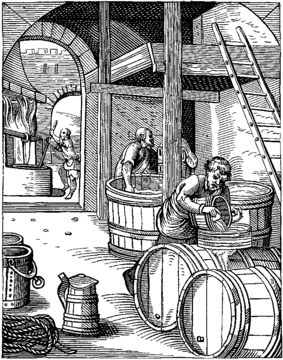
Brewhouse
A domestic building for brewing beer and ale.

A brewhouse is a structure designed for brewing beer and ale. While it can be part of a commercial brewery, historically it referred to a private building used solely for home production. Wealthy households, like those on noble estates, sometimes had elaborate brewhouses with equipment similar to that found in commercial breweries. Detailed records of such brewhouses exist for English country houses.
On ordinary farms, brewing was often done outside in certain regions, especially during summer. In the Baltic countries, a "summer kitchen" served as an outdoor area for cooking and brewing in warm weather, and similar outdoor brewing occurred in parts of Norway, Sweden, and Russia. Most farm families could not afford to set aside an entire building or even a dedicated room for brewing. Instead, brewing took place in a "rough kitchen"—a space suited for heavy, fire-intensive tasks like sausage-making, butchering, large-scale baking, laundry, and brewing. This rough kitchen could be a separate building or just a single room.
**Regional varieties** In Sweden, brewing was often done in the main house’s kitchen, and Finnish customs were likely similar. In Denmark, brewing occurred in a room called a "bryggers," which functioned as the rough kitchen. Danish farms typically had a U-shaped complex of buildings around a yard, with the bryggers as part of that complex; the same layout appeared in southern Sweden. In Norway, most farms had a separate building called an "eldhus" (meaning "fire-house") that served as the rough kitchen. Often, this was an older main house—a type without a chimney known as an "årestue"—converted into an eldhus after a newer, chimney-equipped main house was built. Across Scandinavia and Eastern Europe, several farm brewhouses still exist, though few are still in use.
- Regions mentioned
- Baltic countries, Norway, Sweden, Russia, Denmark, Finland, Scandinavia, Eastern Europe
- Building types
- brewhouse, summer kitchen, rough kitchen, bryggers, eldhus, årestue
- Associated activities
- sausage-making, butchering, large-scale baking, clothes washing, brewing
Lore & Background
In ordinary farming households brewing was in some regions done outside, particularly in summer. The Baltic countries have a concept of a 'summer kitchen', which is basically an outdoor area used for cooking and brewing in summer, but brewing could also be done outside in parts of Norway and Sweden as well as Russia. An ordinary farm household could rarely afford to dedicate an entire building, or even an entire room, to brewing, and so brewing was usually done in what is best understood as a 'rough kitchen', a kitchen suitable for coarser jobs with heavy use of fire, such as sausage-making, butchering, large-scale baking, clothes washing, and brewing. This could either be a dedicated building or just a single room.
Reader's Guide
The brewhouse is notable as a historically domestic structure, distinct from commercial breweries. English country houses have detailed records of brewhouses, indicating their prevalence among larger households. In Scandinavia and Eastern Europe there are several remaining farm brewhouses, though few are now in use. Regional varieties show adaptation: in Sweden it was not unusual to simply brew in the kitchen in the main house; in Denmark brewing generally took place in a room known as 'bryggers', serving as the 'rough kitchen'; in Norway most farms had a separate building known as eldhus which also served as the 'rough kitchen', often converted from an older building type. These structures reflect the integration of brewing into broader domestic labor, rather than a specialized industrial activity.
Did You Know?
- Larger households, such as noble estates, often had dedicated brewhouses with equipment similar to commercial breweries.
- In Denmark, brewing generally took place in a room called 'bryggers', which served as the rough kitchen.
- In Norway, many farms had a separate building known as 'eldhus' that served as the rough kitchen for brewing.
More in Brewing Processes 1-24
Spotted an error? Know more?
Reader corrections go straight into our review queue. Suggest an edit · How this site is sourced