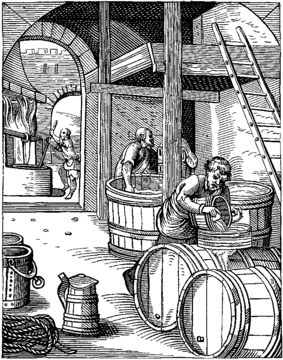
Filtered beer
Mechanically filtered beer with sediment and yeast removed.

Filtered beer is any ale, lager, or fermented malt beverage that has had the sediment from brewing removed. Modern mechanical filtration, which emerged near the end of the 1800s, can strip out all sediment—including yeast—along with the beer’s natural carbonation. The resulting product is called bright beer, and it must be force-carbonated before being bottled or served from a keg.
- Modern filtration introduced
- end of the 19th century
- Sterile filtration threshold
- 1 micrometre or less
- Common filtration ratings
- rough, fine, sterile
- Homebrew typical filtration
- at least 5 μm, some to 1.0 or 0.5 μm
Lore & Background
Ancient techniques for filtering beer included the use of straw mats, cloth, or straws, and frequently left some sediment in the drink. Modern filtration, introduced at the end of the 19th century, uses a mechanical process that can remove all sediment, including yeast, as well as natural carbonation, from the beer. In the United Kingdom, a beer which has been filtered in the brewery is known as 'brewery-conditioned', as opposed to unfiltered bottle-conditioned and cask ales.
Filtration is performed by flowing beer through layers of filter material; the two main techniques are surface filtration and cake filtration. Filters range from rough filters that remove much of the yeast and any solids left in the beer, to filters fine enough to strain constituents which give colour and body. Normal filtration ratings are defined as rough, fine, or sterile. Rough filtration leaves some cloudiness, fine filtration yields nearly transparent beer, and sterile filtration removes almost all microorganisms and sediments. Sheet filters use pre-made media, while powder medium filters (using diatomaceous earth or perlite) are more complicated but can filter more beer before needing regeneration.
Cold filtering is a process in which the beer is sufficiently chilled that some of its protein molecules clump together and are easier to filter out. Breweries tend to differentiate cold filtered beers from those that have been heat pasteurised. A 'bright beer' is one which has been left to allow its yeast to settle, and finings may be introduced to induce it to 'drop bright' more readily.
Reader's Guide
Filtered beer represents a significant shift in brewing practice, as modern mechanical filtration introduced at the end of the 19th century allowed brewers to produce beer with all sediment and yeast removed, resulting in a stable, clear product known as bright beer. This process stops natural conditioning, distinguishing brewery-conditioned beers from bottle- or cask-conditioned ales that remain in contact with live yeast. The ability to filter to sterile levels (1 micrometre or less) enables brewers to remove almost all microorganisms, though finer filtration risks removing beneficial flavor constituents. In homebrewing, canister filters with replaceable cartridges are common, typically filtering to at least 5 μm to remove most yeast and sediment. The use of finings such as silica gel, diatomaceous earth, isinglass, Irish moss, PVPP, and seaweed can help beer 'drop bright' more readily. Cold filtering, distinct from heat pasteurisation, chills the beer to clump proteins for easier removal. Overall, filtration has become a standard technique for producing clear, shelf-stable beer, though it alters the beer's character by removing yeast and natural carbonation, requiring force carbonation before serving.
Did You Know?
- Ancient filtration techniques used straw mats, cloth, or straws and often left some sediment in the drink.
- Modern mechanical filtration was introduced at the end of the 19th century.
- Sterile filtration requires a filtration level of 1 micrometre or less.
- In the United Kingdom, filtered beer is known as 'brewery-conditioned'.
More in Brewing Processes 1-24
Spotted an error? Know more?
Reader corrections go straight into our review queue. Suggest an edit · How this site is sourced