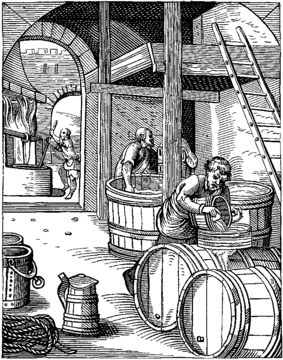
Cold liquor tank
Buffer tank for cold process water used to cool wort in breweries.

In the brewing industry, a cold liquor tank is a vessel that stores cold process water, known as liquor, for use in batch production processes. These tanks serve as buffer storage to ensure sufficient water supply for point-loading demands, such as cooling wort after the brew kettle, where production rates of water are otherwise insufficient on an instantaneous basis.
- Typical cold liquor temperature range
- 10-20°C
- Typical hot liquor temperature range fro
- 80-92°C
- Typical wort temperature target after co
- 10-20°C
- Common water sources
- ground water, river water, public utility supply
- Example water quality target
- Burton upon Trent ground water (Burtonification)
Lore & Background
Cold liquor tanks are a response to the batch nature of brewing, where water production rates are insufficient for peak demand. Rather than purchasing costly high-rate water production equipment, breweries produce water continuously at a lower rate and store it in buffer tanks like the cold liquor tank. This tank specifically holds water destined for the wort cooler, a two-stage plate heat exchanger that first uses cold liquor to reduce wort temperature, generating hot liquor in the 80-92°C range as a useful byproduct.
Reader's Guide
The cold liquor tank's significance lies in its role as a buffer that levels water production demand across a brewery, avoiding the expense of oversized water production equipment. Its temperature is typically kept low (10-20°C) to improve heat exchanger efficiency and reduce refrigerant costs, as refrigeration is expensive. In regions with high ambient temperatures, active cooling or double-skinned insulated vessels may be required. The quality of water stored can vary drastically by brewery, depending on source and treatment, with some targeting specific profiles like Burtonisation. The tank's design often reflects circumstance, such as reuse of disused vessels during plant upgrades, and includes features like manways for access and various instrumentation ports.
Did You Know?
- Cold liquor tanks are typically single-skinned vessels without insulation in areas with sufficient ambient temperature for heat exchange.
- The water in a cold liquor tank becomes hot liquor after being used to cool wort, reaching 80-92°C.
- Cold liquor tanks are often placed in cold areas of the plant away from heat-generating equipment to reduce refrigeration costs.
- In high ambient temperature regions, cold liquor tanks may be double-skinned insulated vessels and may require active cooling.
More in Brewing Processes 1-24
Spotted an error? Know more?
Reader corrections go straight into our review queue. Suggest an edit · How this site is sourced