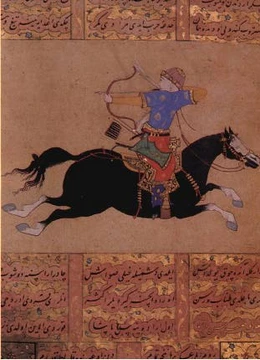
Ya (arrow)
Japanese arrow used in archery and by feudal samurai.

Ya is the Japanese term for an arrow, most often referring to those used in Japanese archery and by samurai during Japan’s feudal period. Compared to Western arrows, a ya is typically around a meter long or more. Traditional ya are crafted from natural materials, primarily bamboo, while modern versions may be made from aluminium or carbon fiber.
The shaft, called the no, is made from yadake bamboo and can be straight or tapered depending on whether the arrow is used for long-distance shooting or target practice. Lighter arrows may lose stability when shot from a strong bow, while heavier arrows follow a more arcing trajectory. Bamboo from the Kantō region is preferred because the climate there produces joints at an ideal spacing: too cold an area yields slow growth and joints too close together, while a warm area causes rapid growth and joints too far apart. The joints themselves aid in balance. After harvesting, bamboo continues to change size and shape, so it must rest for two to three years before use. Properly aged bamboo grips the tang of the arrowhead tightly. The shaft is tempered in a kiln similar to a Viking beehive style and straightened with a tool called a tomegi, also used for making bamboo fishing poles. The no’s appearance varies—some are plain, others coated in red lacquer. The correct length is measured from the archer’s throat to five centimeters beyond the tip of the outstretched left hand.
Fletching consists of feathers, or hane, about fifteen centimeters long, and can be the most expensive part of the arrow. Traditionally, the outermost tail feathers of large birds of prey were considered best. Many such birds, especially sea eagles, are now endangered, so feathers from lesser eagles, swans, geese, or turkeys are used today. Owl feathers were never used, as they were thought to bring bad luck. Feathers from the left wing curve naturally left and are used for arrows called haya, which spiral clockwise; feathers from the right wing curve right and are used for otoya, which spiral counter-clockwise.
The nock, or hazu, is often made from goat or deer horn, with archers filing the slot to match their bowstring’s diameter. Older or ceremonial ya may have bamboo nocks.
Target practice arrows have a conical iron tip called a ne.
- Length
- Close to a metre or longer; measured from the archer's throat to five centimeters beyond the tip of the outstretched left hand
- Shaft material
- Yadake bamboo from the Kanto area
- Fletching length
- About fifteen centimetres
- Arrowhead types
- Ne (target practice), Togari-ya, Yanagi-ba, Karimata, Watakushi, Tagone-ya, Kabura-ya
Lore & Background
The ya consists of several parts: the no (shaft), fletching (hane), nock (hazu), and arrowhead (yajiri or yanone). The no is made from yadake bamboo, which must rest for one to three years after cutting before use. Bamboo from the Kanto area is preferred because its joints are the perfect distance apart, balancing the arrow. The shaft is tempered in a special kiln and straightened with a tool called a tomegi. Fletching uses feathers about fifteen centimetres long, traditionally from large birds of prey such as sea eagles, though many of these birds are now endangered. Owl feathers were never used, as they were thought to bring misfortune. Feathers from the left wing produce haya arrows that spiral clockwise; right-wing feathers produce otoya arrows that spiral counter-clockwise. The nock is often made from goat or deer horn, with older or ceremonial ya using bamboo nocks. Arrowheads were forged from tamahagane steel using methods similar to traditional Japanese swords, and include many specialized types such as the barbed watakushi and the whistling kabura-ya used for signalling.
Reader's Guide
The ya holds a significant place in Japanese martial tradition, serving both as a practical weapon for samurai and as a tool for target practice. Its construction reflects a deep understanding of natural materials: bamboo from the Kanto region is chosen for its ideal joint spacing, and feathers from specific birds are selected for their aerodynamic properties. The distinction between haya and otoya arrows shows an awareness of how feather curvature affects flight. The variety of arrowheads—from the simple togari-ya to the rope-cutting karimata and the signalling kabura-ya—demonstrates the specialized roles arrows played in warfare and ceremony. The practice of signing the tang of the ya, like Japanese swords, indicates the fletcher's pride and the arrow's status as a crafted object. Modern ya may use aluminium or carbon fiber, but traditional methods persist, preserving a legacy that connects archers to centuries of Japanese history.
Did You Know?
- Ya can be signed on the tang by the fletcher in the manner of Japanese swords.
- Owl feathers were never used for fletching, as they were thought to bring misfortune.
- The kabura-ya arrowhead was used for signalling and creating fear with a loud whistling noise.
Materials & Craftsmanship of the Shaft
The no, or shaft, of a traditional ya is crafted from yadake bamboo, and the choice of source region is driven by a very specific practical concern. In cold climates, bamboo grows too slowly and its joints end up too close together; in warm regions it grows too quickly and the joints are spaced too far apart. The Kanto area, with its moderate climate, produces bamboo whose joint spacing is ideal for arrow construction, and those joints contribute directly to the arrow's balance. After harvesting, the bamboo is not immediately usable—it must rest for two and a half to three years, during which it continues shifting in size and shape. Once properly aged, the bamboo grips the tang of the yanone tightly. The shaft is then tempered in a kiln resembling the Viking beehive style and straightened using a tool called a tomegi, the same implement used in making bamboo fishing poles. The finished no may appear plain or coated in glistening red lacquer, and its shape—straight or tapered—depends on whether it is intended for long-distance shooting or target practice.
Fletching, Flight, and Cultural Taboos
The hane, or fletching, is attached to the ya and can be the most costly component of the entire arrow. Traditionally, the outermost tail feathers of large birds of prey were prized as the finest material. However, many of these species—most notably the sea eagle—are now endangered, so modern fletchers increasingly turn to feathers from lesser eagles, swans, geese, or even turkeys. A strict cultural taboo also governs the selection: owl feathers were never used, as they were believed to bring misfortune. The wing of origin matters mechanically. Feathers from the left wing are naturally curved one direction, producing a ya called a haya that spirals clockwise in flight. Feathers from the right wing curve the opposite way, yielding an otoya that spirals counter-clockwise. Each fletching is approximately fifteen centimetres in length. The choice between haya and otoya is not merely aesthetic; it affects the arrow's rotational behaviour off the bowstring, making the fletcher's selection a functional decision as much as a material one.
Warfare, Arrowhead Design, and Swordsmithing
In the hands of samurai during Japan's feudal era, the ya was a weapon whose arrowhead—called a yajiri or yanone—was forged from tamahagane, the same steel and using the same methods as traditional Japanese swords. This connection to swordsmithing meant the arrowheads carried the same craftsmanship prestige. A rich taxonomy of tip designs existed, each with its own name and purpose. The togari-ya is a simple pointed form. The yanagi-ba, or "willow-leaf," is celebrated for its elegant silhouette. The karimata features a distinctive split point and is sometimes called a "rope-cutter." The watakushi, or "flesh-torn," carries barbs designed to tear tissue. The tagone-ya is shaped like a chisel. The kabura-ya served a signalling role, producing a loud whistling noise in flight to create fear on the battlefield. For target practice, a simpler conical iron tip called a ne is used. Because the ya is large enough, fletchers could sign the tang of the arrowhead in the same manner a swordsmith signs a blade.
Structure, Measurement, and Modern Variants
A ya is a composite object whose components work together in a precise way. The overall length is notably greater than a Western arrow, typically approaching or exceeding one metre. The proper length for an individual archer is measured from the throat to five centimetres beyond the tip of the outstretched left hand, making each arrow essentially personal. At the rear, the nock—called the hazu—is often fashioned from goat or deer horn, and the archer files the slot to match the exact diameter of their own bowstring. Older or ceremonial arrows may instead feature a bamboo nock. At the front, the tip varies by purpose: a conical iron ne for practice, or one of the many named yajiri for combat. The shaft itself comes in straight or tapered profiles to suit different shooting distances. Modern ya may be built from aluminium or carbon fibre rather than bamboo, but the fundamental architecture—shaft, fletching, nock, and tip—remains unchanged.
Frequently Asked Questions
What is a Ya (arrow)?
Ya is the Japanese term for an arrow, historically used in traditional Japanese archery and by samurai during the feudal period. It is distinct from Western arrows in both construction and overall length.
What materials are used to make a Ya?
Traditional ya shafts are crafted from yadake bamboo sourced from the Kanto region, while modern versions may use aluminium or carbon fiber. The fletching section on a ya measures roughly fifteen centimetres in length.
How long is a Ya compared to a Western arrow?
A ya typically measures close to a metre or longer, making it noticeably longer than most Western arrows. Its length is traditionally gauged from the archer's throat to about five centimetres past the tip of the outstretched left hand.
What types of arrowheads exist for a Ya?
Several head types are used, including Ne for target practice, Togari-ya, Yanagi-ba, Karimata, Watakushi, Tagone-ya, and Kabura-ya. The specific head chosen depends on whether the arrow is intended for hunting, combat, or practice.
How does the weight and shape of a Ya affect its use?
Lighter arrows can lose stability when loosed from a powerful bow, while heavier ones behave differently in flight. The shaft may be straight or tapered depending on whether it is meant for long-range shooting or target work.
More in Archery, Part 2 1-24
Spotted an error? Know more?
Reader corrections go straight into our review queue. Suggest an edit · How this site is sourced