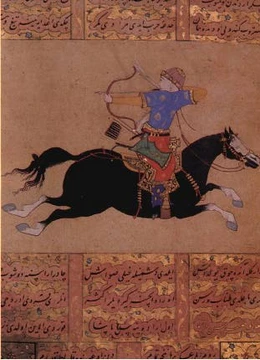
Punker of Rohrbach
Legendary 15th-century archer from Rohrbach, famed for his deadly accuracy.

Punker of Rohrbach is a legendary figure from the 15th century, tied to the German village of Rohrbach (now part of Heidelberg). He was known as an extraordinarily precise archer, and rumors of supernatural abilities surrounded him. The *Malleus Maleficarum* records that around 1430, he nearly single-handedly captured a castle—likely Lindelbrunn near Dahn—with deadly bowshots. A story similar to that of William Tell is also told about him. Count Palatine Louis III of the Rhine, impressed by Punker’s skill in battle and hunting, sought to expose him as a sorcerer. He ordered Punker to shoot a penny off his own son’s beret, under penalty of death. Punker long refused, fearing the devil might make his hands falter. Eventually he agreed. He loaded a bolt into his crossbow and tucked a second one into his tunic. He fired and struck the penny without touching the beret. When the count asked why he had a second bolt, Punker first claimed it was habit. Pressed for the truth, he said that if the devil had caused him to miss and kill his son, he would have used that second bolt on the count—since he was doomed anyway, he would have avenged his boy. Today, Punkerstraße in Rohrbach and the district magazine *der punker* bear his name.
- Century
- 15th century
- Associated location
- Rohrbach (now part of Heidelberg, Germany)
- Mentioned in
- Malleus Maleficarum
- Associated ruler
- Count Palatine Louis III of the Rhine
- Associated castle
- castrum Lendenbrunnen (presumably Lindelbrunn near Dahn)
Lore & Background
According to the Malleus Maleficarum, around 1430 there was an extremely accurate archer named Punker who was rumoured to possess supernatural powers. It was said that he had enabled the capture of a castle (castrum Lendenbrunnen, presumably Lindelbrunn near Dahn) almost single-handed with deadly shots from his bow. A legend about him, similar to one told about the Swiss William Tell, is recounted in the same work. The story goes that even the Count Palatine, Louis III of the Rhine, was in awe of Punker, so outstandingly accurate he was, whether on the battlefield or in the hunt. In order to try and trap him into admitting his magic powers, the count ordered him to use his own son as a target and shoot a penny from the top of his beret. If he failed, the penalty was death. For a long time, Punker refused because he was worried that the devil might cause his normally safe hands to waver. Eventually he agreed to the test. Punker placed a bolt in his crossbow and then drew a second and tucked it in his tunic. He then fired and struck the penny off without grazing the boy's beret. When asked by the count why he had prepared a second bolt, at first he responds that it was out of habit, but when assured he will not be killed for answering honestly, he said: 'If the devil had caused me to miss and kill my boy then, sir, I would have put this second bolt through you because I was doomed to die, but I would have avenged my son.'
Reader's Guide
Punker of Rohrbach's significance lies in his representation as a legendary archer whose skill was so extraordinary that it invited suspicion of supernatural aid, a theme common in medieval folklore. His story, preserved in the Malleus Maleficarum, parallels the William Tell legend, suggesting a broader cultural motif of the archer forced to prove his skill at great personal risk. The account also illustrates the tension between secular authority and perceived witchcraft, as the Count Palatine sought to expose Punker's alleged magic through a deadly test. Punker's response—preparing a second bolt to kill the count if his son died—reveals a pragmatic and vengeful dimension to his character, emphasizing his humanity and defiance. The legend's endurance is reflected in the naming of Punkerstraße in Rohrbach and the district magazine der punker after him. These modern commemorations indicate that the figure remains a point of local identity and cultural memory, even as the historical accuracy of the events remains uncertain. The story serves as a cautionary tale about the dangers of superstition and the lengths to which individuals might go to protect their families and reputations.
Did You Know?
- Punker is a legendary figure from the 15th century associated with the German village of Rohrbach.
- His story is recorded in the Malleus Maleficarum, a treatise on witchcraft.
- He was ordered by Count Palatine Louis III to shoot a penny off his own son's beret.
- Punker prepared a second crossbow bolt to kill the count if the devil caused him to miss.
Frequently Asked Questions
Who is Punker of Rohrbach?
Punker of Rohrbach was a legendary 15th-century archer from the German village of Rohrbach, now part of Heidelberg, whose extraordinary shooting accuracy earned him a reputation that blurred the line between skill and sorcery.
What are Punker of Rohrbach's powers or role in the legend?
He is credited with supernatural-level bow precision, most famously for nearly taking the castle of Lindelbrunn near Dahn by himself around 1430. His prowess in both combat and the hunt drew the attention of Count Palatine Louis III of the Rhine, who became deeply invested in his fate.
Why is Punker of Rohrbach important to archery history?
He stands as one of the most striking examples of a medieval German archer whose real battlefield skill was so extreme that contemporaries attributed it to witchcraft. His legend also mirrors the William Tell narrative, making him a key figure in the broader European 'impossible archer' tradition.
What does the Malleus Maleficarum say about Punker of Rohrbach?
The treatise references Punker's alleged near-solo seizure of castrum Lendenbrunnen (presumably Lindelbrunn) around 1430, placing his archery legend within a text otherwise dedicated to identifying and prosecuting alleged sorcerers.
More in Archery, Part 2 1-24
Spotted an error? Know more?
Reader corrections go straight into our review queue. Suggest an edit · How this site is sourced