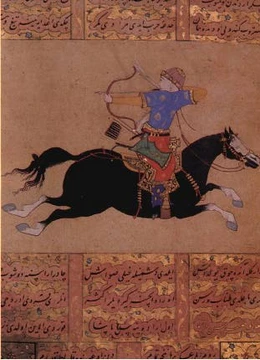
Kabura-ya
Whistling arrows used by samurai for signaling and ritual.

Kabura-ya are a type of Japanese arrow used by the samurai class of feudal Japan. They are notable for producing a whistling sound when shot, created by a specially carved or perforated bulb of deer horn or wood attached to the tip. In English, they are often called 'whistling-bulb arrows', 'messenger arrows', or 'signal arrows'.
- Japanese term meaning
- turnip
- Literal translation
- turnip-shaped arrows
- Materials used for bulb
- deer horn or wood
- Chinese equivalent
- xiangjian (sometimes pronounced and written mingdi)
- Period of use in battle
- particularly around the time of the Heian period
- Example battle
- 1183 battle of Kurikara
Lore & Background
Kabura-ya were arrows used by samurai in feudal Japan, designed to produce a whistling sound when fired. This effect came from a carved bulb of deer horn or wood attached to the tip, shaped like a turnip—the word *kabura* literally means "turnip." In English, they are sometimes called "whistling-bulb arrows," "messenger arrows," or "signal arrows."
During the Heian period, these arrows were shot before battles to warn the enemy. The whistling noise was thought to drive away evil spirits and call on friendly kami for support. Formal archery exchanges could go on for some time; at the 1183 battle of Kurikara, for instance, each side shot fifteen arrows, then thirty, then fifty, then a hundred, before the hundred samurai on each side finally closed for combat. Messages were also tied to the arrows and shot into fortresses or camps. This ritualized exchange likely faded after the Heian period as warfare became less ceremonial.
In Shinto, the sound of a kabura-ya in flight is believed to ward off evil. The arrows are used in rites to purify places like shrine grounds and parks. Other sacred bows used similarly include the hama yumi and azusa yumi. Kabura-ya are also sold at Shinto shrines as good luck charms, especially around New Year’s Day; carrying one is thought to protect against evil, much like a hama ya.
A similar arrow existed in China, called the xiangjian (also written and pronounced mingdi). Until the end of the Warlord Era, bandits there commonly used them to announce their approach.
Reader's Guide
The kabura-ya holds significance as both a practical tool of medieval warfare and a ritual object in Shinto practice. In the Heian period, its use in formal archery exchanges before battle served to alert the enemy and invoke spiritual aid, reflecting the ritualized nature of early samurai combat. The practice of shooting escalating numbers of arrows, as seen at the battle of Kurikara, underscores the ceremonial dimension of these exchanges. Over time, as warfare became less ritualized, the kabura-ya's battlefield role diminished. However, its legacy endures in Shinto, where the whistling sound is believed to ward off evil influences, and the arrows are used in purification rites at shrines and parks. Additionally, kabura-ya are sold as good luck charms, especially around New Year's Day, and carrying one is thought to protect against evil spirits. The similar Chinese xiangjian, used by bandits until the end of the Warlord Era, highlights a cross-cultural parallel in the use of signal arrows.
Did You Know?
- Kabura-ya were used in ritual archery exchanges before formal medieval battles.
- The whistling sound was created by a carved or perforated bulb of deer horn or wood.
- In Shinto, the sound is thought to ward off evil influences and is used in purification rites.
- Messages could be tied to kabura-ya and shot into fortresses or battle camps.
Frequently Asked Questions
What are Kabura-ya?
Kabura-ya are a type of Japanese arrow historically employed by samurai during feudal Japan. The name literally translates to "turnip-shaped arrows," a reference to the distinctive bulb at the tip. In English they are commonly called whistling-bulb arrows, messenger arrows, or signal arrows.
How does the whistling sound on a Kabura-ya actually work?
A small bulb made from deer horn or wood is either specially carved or perforated and attached to the arrow's tip. As the arrow flies, air passing through or around that bulb generates the characteristic whistle.
What purpose did Kabura-ya serve in combat?
Samurai used them primarily as signaling devices on the battlefield and in ritual contexts. They saw particular use around the Heian period, and the 1183 Battle of Kurikara is a well-known example of their deployment in actual fighting.
Is there a Chinese equivalent to Kabura-ya?
Yes. The Chinese counterpart is called xiangjian, though it is sometimes pronounced and written as mingdi.
Why are Kabura-ya significant in the history of Japanese archery?
They represent a unique blend of practical battlefield communication and ceremonial tradition within samurai culture. Their design—pairing a functional projectile with a sound-producing bulb made of deer horn or wood—marks them as one of the more specialized arrow types in Japanese military history.
More in Archery, Part 2 1-24
Spotted an error? Know more?
Reader corrections go straight into our review queue. Suggest an edit · How this site is sourced