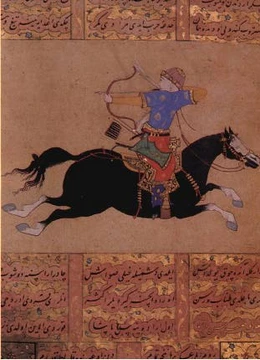
Fire arrow
Gunpowder arrows that evolved from incendiaries to early rockets.

Fire arrows were one of the earliest forms of weaponized gunpowder, used from the 9th century onward. The term derives from the Chinese huǒjiàn (火箭), meaning 'fire arrow,' and originally referred to a bag of incendiary gunpowder attached to an arrow shaft, launched by a bow or crossbow. Later, gunpowder-propelled rockets provided arrows with propulsive force, and the term became synonymous with rockets in Chinese, while in Sanskrit it shifted to mean 'cannon.'
- First reported use
- 904, during the siege of Yuzhang by the Southern Wu of Tang dynasty
- Invention of rocket arrows
- 969, by Yue Yifang and Feng Jisheng
- Earliest compendium mention
- 1044, in the Wujing Zongyao
- Largest recorded production
- 350,000 fire arrows produced in 1083 and sent to two garrisons
- Range
- up to 1,000 ft for rocket-propelled fire arrows
- Key battle
- 1161, Battle of Caishi, where fire arrows were used by general Yu Yunwen
Lore & Background
Fire arrows first appeared in 904 during the siege of Yuzhang, used by the Southern Wu of Tang. By 969, Yue Yifang and Feng Jisheng invented gunpowder-propelled rocket arrows. In 975, the state of Wuyue sent soldiers skilled in fire arrows to the Song, who used them to destroy the fleet of Southern Tang. The Wujing Zongyao (1044) records that in 994, the city of Zitong repelled a Liao army of 100,000 using fire arrows. In 1083, the Song court produced 350,000 fire arrows for two garrisons. During the Jingkang Incident (1126), general Li Gang used a fire arrow machine called the Thunderbolt thrower. By 1127, the Jin used fire arrows made by captured Song artisans. In 1159, the Song navy sank a Jin fleet with fire arrows, and in 1161, general Yu Yunwen used them at the Battle of Caishi. By 1206, 'gunpowder arrows' (huoyaojian) were distinguished from 'fire arrows.' A 1245 military exercise on the Qiantang River likely used rockets. The Mongols employed fire arrows in their campaigns in Japan, and they spread to the Middle East, mentioned by Al Hasan Al Ramma in the late 13th century. In 1374, Joseon began producing gunpowder, and by 1377 made cannons and fire arrows used against wokou pirates; Korean fire arrows were used against Japan in 1592. In 1380, 'wasp nest' rocket arrow launchers were ordered by the Ming, and in 1400, Li Jinglong used rocket arrow launchers. In 1451, the mobile 'Munjong Hwacha' was invented in Joseon. The Japanese version, bo hiya, was a large arrow with a burning waterproof rope element, launched from a mortar-like weapon or wide-bore Tanegashima arquebus; during one sea battle they fell 'like rain.'
Reader's Guide
Fire arrows represent a pivotal step in the development of gunpowder weaponry. Their early form as incendiary arrows attached to a bow or crossbow gave them an advantage over previous incendiaries: gunpowder's built-in oxygen supply made the flames harder to extinguish, similar to Greek fire, but being solid rather than liquid made it easier to store and load. The later shift to rocket propulsion marked the emergence of the solid-propellant rocket, though the dating of this invention is disputed—some sources attribute it to 969, while others argue rockets could not have existed before the 12th century due to unsuitable gunpowder formulas in the Wujing Zongyao. Fire arrows were used across East Asia by the Song, Jin, Mongols, Ming, Joseon, and Japanese pirates, and spread to the Middle East. Their legacy includes the fire lance, the first firearm, and later rocket arrow launchers such as the hwacha. The term 'fire arrow' itself underwent semantic shifts, becoming synonymous with rockets in Chinese and with cannons in Sanskrit.
Did You Know?
- The earliest reported use of fire arrows was in 904 during the siege of Yuzhang.
- The Japanese version, bo hiya, was launched from a mortar-like weapon or a wide-bore Tanegashima arquebus.
- The dating of the gunpowder-propelled fire arrow (rocket) is disputed, with some attributing it to 969 and others arguing it could not have existed before the 12th century.
Birth of a New Arrow
Arrow launched on The CW on October 10, 2012, as the inaugural entry in what would become the Arrowverse, a shared television universe built around DC Comics properties. Developed by Greg Berlanti, Marc Guggenheim, and Andrew Kreisberg, the series reimagined Green Arrow—a costumed crime-fighter originally created by Mort Weisinger and George Papp—for a new generation of viewers. Though the character had appeared on the CW's Smallville between 2006 and 2011, the creative team chose to cast a fresh face and build an entirely new narrative from the ground up. Stephen Amell stepped into the role of Oliver Queen, a billionaire playboy and eldest son of Robert and Moira Queen, who spent five years shipwrecked on the mysterious island of Lian Yu in the North China Sea. Upon returning to Starling City (later rebranded as Star City), he takes up a bow and arrow to wage a secret war against crime and corruption. Production was based in Vancouver, British Columbia, and the show ultimately ran for eight seasons, concluding on January 28, 2020.
Building the Arrow Team
From the very first episode, Oliver Queen's vigilante mission was never a solo endeavor. His closest ally was John Diggle, a former soldier played by David Ramsey, who provided tactical support and ground-level intelligence. Felicity Smoak, portrayed by Emily Bett Rickards, brought her expertise as an IT specialist and skilled hacker to the operation, serving as the team's technological backbone. As the series expanded, the roster grew to include Sara Lance (Caity Lotz), a former assassin who took up the Black Canary mantle; Roy Harper (Colton Haynes), an aspiring vigilante; Oliver's own sister Thea (Willa Holland); and attorney Laurel Lance (Katie Cassidy), who transitioned from the courtroom into the fight. In season five, former police detective Dinah Drake assumed the Black Canary role after Sara's death, while season seven introduced Emiko Queen as a new Green Arrow. The ensemble dynamic shifted further when Oliver's children, William (Ben Lewis) and Mia (Katherine McNamara), became central figures in the later narrative, tying the team's present struggles to a legacy yet to be fully realized.
A Story That Evolved: From Flashbacks to Flash-Forwards
Arrow's narrative architecture underwent a significant transformation over its eight-season run. For the first five seasons, the show wove in flashback episodes that traced Oliver's harrowing survival on Lian Yu—his first year alongside allies like Slade Wilson, his escape from the island, his forced collaboration with Amanda Waller in Hong Kong, his infiltration of the criminal group Shadowspire, and his training under Talia al Ghul after joining the Bratva in Russia. These sequences gave depth to the present-day conflicts, revealing the origins of his feud with Slade and the survival struggles that shaped his vigilantism. Beginning with season seven, the storytelling pivot shifted dramatically: flash-forwards leapt twenty years into the future, centering on adult William as he receives a mysterious message and teams up with his half-sister Mia to defend the city from a cyber attack. This structural change reframed the entire series around legacy, asking how the choices made in the present would ripple into the next generation's world.
Catalyst of a Shared Universe
Arrow's most far-reaching impact may be its role as the genesis point for the Arrowverse. In October 2014, the spin-off series The Flash premiered on The CW, establishing a shared continuity that would eventually encompass multiple related television series and media properties. Characters crossed over between shows—Black Siren, an antagonistic doppelganger of Laurel Lance from Earth-2, first appeared during The Flash's second season before taking a prominent role in Arrow's fifth season. The Arrowverse crossover events further cemented interconnection, as seen when Oliver and Felicity's marriage was celebrated in a multi-series crossover during season six. Critics generally responded positively to the series, and it accumulated numerous awards and nominations throughout its run. By demonstrating that a fresh interpretation of a DC Comics character could sustain eight seasons and spawn an entire interconnected television family, Arrow set a template that reshaped how comic-book adaptations were approached on the small screen.
Frequently Asked Questions
What exactly is a fire arrow?
A fire arrow is an early incendiary weapon in which a pouch of gunpowder was lashed to an arrow shaft and fired from a bow or crossbow. Over time the design evolved so that the gunpowder itself propelled the arrow, making it essentially a primitive rocket.
When did fire arrows first appear in combat?
The earliest recorded use dates to 904, when Southern Wu forces employed them during the siege of Yuzhang under the Tang dynasty. This predates the later rocket-propelled variants by several decades.
Who is credited with developing the rocket-propelled fire arrow?
Yue Yifang and Feng Jisheng are credited with inventing rocket arrows in 969. Their design shifted the gunpowder from a mere incendiary payload to an actual propulsive force behind the arrow.
Which battle is most associated with fire arrows?
The 1161 Battle of Caishi stands out, where General Yu Yunwen deployed fire arrows against the Jin army. It remains one of the best-known large-scale engagements in which the weapon played a decisive role.
How far could a rocket-propelled fire arrow travel?
Rocket-propelled fire arrows could carry their payload up to roughly 1,000 feet. By the 1080s, production had scaled dramatically, with 350,000 units manufactured in a single year for two garrisons.
More in Archery, Part 2 1-24
Spotted an error? Know more?
Reader corrections go straight into our review queue. Suggest an edit · How this site is sourced