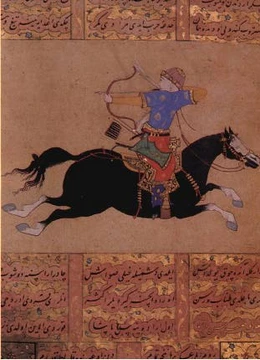
Arbalist (crossbowman)
A crossbowman, also called an arbalist or arbalister.

An arbalist, also spelled arbelist, or historically an arbalister, is a person who shoots a crossbow. The term derives from the arbalest, a European crossbow variant used during the 12th century. Crossbowmen are distinguished from archers by their use of a trigger-released cocking mechanism that allows the weapon to be spanned and cocked ready for use at a later time, affording the wielder unlimited time to aim.
- Alternate spellings
- arbelist, arbalister
- Related weapon
- arbalest (European crossbow variant, 12th century)
- Projectile terms
- bolt, quarrel, vire
- Bow component
- lath or prod
- Frame component
- tiller or stock
Lore & Background
The term arbalist has been used variously over time. Richardson, in his 1839 dictionary, defined arbalist as 'One who casts or shoots from a bow' without specific reference to the crossbow. Hansard (1841) used the word arbalister for a crossbowman, the same usage as Webster and Johnson, who reserved the word arbalist for the crossbow itself. Smith uses arbalist to describe a maker of crossbows. An extensive list of archaic words for medieval crossbowmen is given by Payne-Gallwey.
Crossbows and bows use the same elastic launch principles, but differ in that an archer using a bow must draw-and-shoot in a quick and smooth motion with limited or no time for aiming, while a crossbow's design allows it to be spanned and cocked ready for use at a later time. This allows crossbows to be operated in succession by groups of people, with one person operating a cocked crossbow while others reload and ready them. Crossbows are spanned using techniques and devices such as levers, belt hooks, pulleys, windlasses and cranequins to overcome very high draw weight.
The earliest known crossbows were invented in ancient China in the first millennium BCE. The medieval European crossbow was called by many names, most derived from the word ballista, an ancient Greek torsion siege engine. The Greek crossbow was likely invented independently of the Chinese crossbow.
Reader's Guide
The arbalist, as a crossbowman, represents a significant development in ranged warfare due to the crossbow's design allowing for mechanical spanning and trigger-released cocking. This enabled less trained personnel to effectively use the weapon compared to the extensive practice required for bows like the English longbow or steppe nomad bows. The ability to carry a cocked crossbow and take unlimited time to aim offered tactical advantages, particularly when used in groups where one person could shoot while others reloaded.
However, these advantages were offset by longer reload times, especially for high-draw-weight crossbows requiring complex gear and pulley systems that were awkward and slow on the battlefield. Medieval crossbows were also inefficient, with short shot stroke lengths and slower speeds of steel prods and heavy strings despite massive draw weights. Modern crossbow designs have overcome these shortcomings.
In modern times, firearms have largely supplanted crossbows as weapons of war, but crossbows remain widely used for competitive shooting sports and hunting, and for relatively silent shooting. The term arbalist continues to be used in historical and technical contexts, though its precise meaning has varied among lexicographers.
The Tactical Edge of the Crossbowman
The crossbowman occupied a distinctive niche in the history of ranged combat, one defined by a fundamental design choice that set them apart from traditional archers. Where a bow-wielder had to execute the draw and release in a single fluid motion—leaving little or no window for careful aiming—the crossbowman could span the prod, lock the string in place, and then take as long as needed to line up a shot. This mechanical patience meant the weapon could be carried cocked and ready, and it opened the door to coordinated group tactics: one operator firing while teammates reloaded and cocked the next weapon in the chain. The training curve was also gentler. Unlike the English longbow or the bows of steppe nomads, which demanded considerable physical strength and extensive practice to use accurately in sustained combat, a crossbow could be operated effectively by less experienced personnel. The trade-off was speed: high-draw-weight crossbows required cumbersome gear-and-pulley systems—windlasses, cranequins, belt hooks—to span, making reloads slow on the battlefield. Yet for the individual crossbowman, that extra moment of aim often mattered more than rate of fire.
Names, Roots & the Arbalist's Identity
The person who wielded a crossbow carried a rich and sometimes confusing set of names across centuries and languages. The most common English terms—crossbowman, arbalister, and arbalist—trace back to the arbalest, a European crossbow variant that appeared during the twelfth century. Historical dictionaries reveal how the terminology shifted: Richardson's 1839 entry defined an arbalist simply as one who casts or shoots from a bow, without specifically mentioning the crossbow, while Hansard in 1841 used arbalister for the crossbowman. Webster and Johnson reserved the word arbalist for the weapon itself, and Smith applied it to a crossbow maker. Payne-Gallwey compiled an extensive list of archaic words for medieval crossbowmen, underscoring how deeply the role was embedded in linguistic history. The projectiles themselves also accumulated synonyms—arrow, bolt, quarrel, and the older term vire—while the bow-like assembly was called a prod or lath (a word Peterson traced to a nineteenth-century mistranslation of the sixteenth-century term rodd), and the wooden body was known as a tiller in medieval usage or a stock in modern parlance.
The Lock, the Trigger & the Art of Aiming
At the heart of the crossbowman's craft lay the lock—a release mechanism comprising the string, sears, trigger lever, and housing that held the drawn prod under tension. The earliest known example, the Chinese vertical trigger lock, was an elegant assembly of three cast bronze pieces housed in a hollow bronze enclosure, dropped into a carved slot in the tiller and secured by two bronze rods. The string catch, or nut, took a distinctive J shape: its tall rear spine served double duty as a cocking lever and a primitive rear sight. A flattened C-shaped sear held the nut stationary against the string's tension, while a vertically hanging trigger blade caught the sear via a notch. The bearing surfaces between these three pieces provided a mechanical advantage, letting the operator handle very high draw weights with a comparatively small pull. To fire, the crossbowman held the weapon at eye level by a vertical handle, aimed along the bolt using the sighting spine for elevation—much like a modern rifleman reading iron sights—and pulled the trigger blade to disengage the sear, freeing the nut to pivot forward and release the string.
From Ancient China to the Modern Range
The crossbow's story stretches back to ancient China in the first millennium BCE, where it triggered a major shift in how projectile weaponry shaped warfare, particularly during Qin's unification wars and the later Han campaigns against northern nomads and western states. The medieval European crossbow, by contrast, likely descended from the Greek ballista—a torsion siege engine that shared a visual resemblance but operated on a different design principle—suggesting an independent invention separate from the Chinese lineage. For centuries, crossbowmen filled a critical role on European battlefields, their weapons bearing numerous names derived from the ballista tradition. In the medieval period, however, the design was hampered by short shot-stroke lengths, slow steel prods, and heavy strings that limited bolt velocity despite enormous draw weights. The arrival of firearms eventually displaced both bows and crossbows from the battlefield. Yet the crossbow never disappeared: in modern times it endures in competitive shooting sports, in hunting, and in applications where relatively silent discharge is valued, with contemporary engineering overcoming the inefficiencies that plagued its medieval predecessors.
Frequently Asked Questions
Who is an Arbalist (crossbowman)?
An arbalist is a historical combatant who specializes in firing a crossbow rather than a traditional longbow. The title appears under several alternate spellings, including arbelist and arbalister, all denoting the same role.
What makes an Arbalist different from a standard archer?
The key distinction lies in the weapon's mechanism: a crossbow uses a trigger-locked cocking system, so the shooter can set the weapon and wait without holding tension. This grants the arbalist far more time to take a careful aim compared to an archer who must draw and hold the string simultaneously.
Where does the term 'Arbalist' originate?
The word traces back to the arbalest, a particular European style of crossbow that saw widespread military use during the 12th century. Over time, the name of the weapon became the title for the person who wielded it.
What are the main components of an Arbalist's weapon?
The bow section of the crossbow is called the lath or prod, while the horizontal frame housing the track and trigger is known as the tiller or stock. Together these parts form the complete weapon an arbalist would carry into battle.
What projectiles does an Arbalist fire?
The short, stiff arrows used with a crossbow go by several names, including bolt, quarrel, and vire. These differ from standard arrows in both shape and construction to suit the crossbow's shorter draw length.
More in Archery, Part 2 1-24
Spotted an error? Know more?
Reader corrections go straight into our review queue. Suggest an edit · How this site is sourced