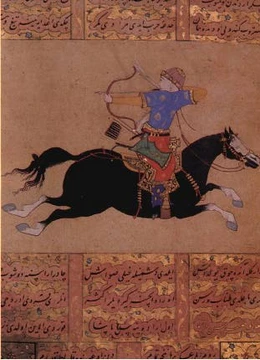
Recurve bow
A recurve bow stores more energy and delivers it efficiently.

A recurve bow is a bow with limbs that curve away from the archer when unstrung. This design stores more energy and delivers it more efficiently than an equivalent straight-limbed bow, giving greater energy and speed to the arrow. A recurve permits a shorter bow for a given arrow energy, making it advantageous in environments where long weapons are cumbersome, such as brush, forest, or horseback.
- Energy absorption
- 18 MJ/m3
- Materials tested
- bovine tendon and pearl glue
- Earliest written record
- Psalm 78:57 (8th century BC)
- Olympic status
- only form of bow permitted in the Olympics until the 2028 Summer Olympics
Lore & Background
Recurve bows made of composite materials were used by many historical groups, including Persians, Parthians, Sarmatians, Scythians, Alans, Dacians, Cumans, Hyksos, Magyars, Huns, Bulgars, Greeks, Turks, Mongols, Koreans, and Chinese. The recurve bow spread to Egypt and much of Asia in the second millennium BC. Perhaps the most ancient written record of recurved bows is Psalm 78:57, dated by most scholars to the eighth century BC. The standard weapon of Roman imperial archers was a composite recurve, and stiffening laths used to form the recurved ends have been found on Roman sites throughout the Empire, as far north as Bar Hill Fort on the Antonine Wall in Scotland. Turkish archers used recurve bows manufactured from laminates of wood glued with animal tissue like horn and sinew. The Mongol armies used recurve bows, allowing massed individuals on horseback to raid from the Pacific to central Europe; these bows were made of a bamboo core, with horn on the belly and sinew on the back, bound with animal glue. During the Middle Ages, composite recurve bows were used in drier European countries because the laminate glue would not moisten and lose adhesive power; the all-wooden straight longbow was normal in wetter areas. Recurve bows depicted in the British Isles may have been composite weapons, wooden bows with ends recurved by heat and force, or artistic licence. Many Indigenous North American bows were recurved, especially West Coast Indian bows. Recurve bows went out of widespread use in warfare with the greater availability of effective firearms at the end of the 19th century. In Ancient China, recurve bows had a long history in battles; during the battle between the Song dynasty and the states of Liao and Jin, their utilization was widely recorded, and during the Ming Dynasty a deeper modification was applied and named the Ming-style recurve bow.
Reader's Guide
The recurve bow's significance lies in its efficient energy storage and delivery, which allowed shorter bows suitable for mounted archers and close terrain. This design enabled the Mongol armies to raid from the Pacific to central Europe, and it was the standard weapon of Roman imperial archers. The recurve bow was the only form of bow permitted in the Olympics until the 2028 Summer Olympics, where a mixed compound bow category was added. Modern recurve bows use advanced technologies and materials such as fibreglass, carbon, wood, carbon foam, aluminium alloy, or magnesium alloy. The modern Olympic-style recurve is a development of the American flatbow, with rectangular-section limbs that taper towards the tips. Most recurves today are take-down bows, allowing limbs to be detached from the riser for transportation and interchangeability. The barebow type lacks a sight, stabilizers, and clicker, and is tuned differently with a negative tiller. The recurve bow's legacy includes its continued use by bowyers, amateurs, and professional archers, and its role as the most widely used bow by European and Asian sporting archers.
Did You Know?
- An unstrung recurve bow can have a confusing shape; many Native American weapons were incorrectly strung backwards and destroyed when attempts were made to shoot them.
- A test of bovine tendon and pearl glue used in traditional Asiatic recurve bows showed energy absorption comparable to carbon fibre composites, spring steel, and butyl rubber.
More in Archery, Part 2 1-24
Spotted an error? Know more?
Reader corrections go straight into our review queue. Suggest an edit · How this site is sourced