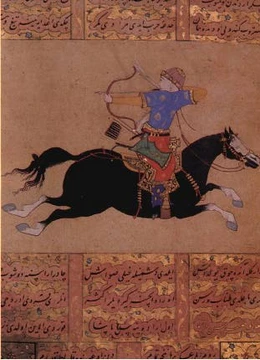
Manchu bow
A heavy composite reflex bow with large siyahs and string bridges.

The Manchu bow is a composite reflex bow that originated in Manchuria and, during the Qing dynasty, came into use across China, Mongolia, and Tibet. Its design likely shares a common origin with the medieval Mongol bow. Key features include very large siyahs (stiff ear sections), a long draw length, prominent string bridges, and the use of large, heavy arrows. While other cultures’ bows often fired lighter arrows over greater distances, the Manchu bow was designed for shorter ranges and could pierce armor. During the Boxer Rebellion, one observer reported that bows with a draw weight of 150 pounds were common. When strung, these bows measured roughly 196 centimeters from tip to tip.
Because it was so widely used outside Manchuria, the bow is also frequently called a Chinese bow or Mongol bow. By the 17th century, its widespread adoption—along with the growing presence of firearms—had almost entirely replaced other bow types within the Qing Empire. The Manchu military favored the bow over firearms and continued using it until the late 19th century. Archers traditionally drew the bow with a cylindrical thumb ring, usually made of bone.
The earliest inhabitants of Manchuria likely used other bow types as well, possibly including a mulberry longbow for hunting in wet weather, which could damage the glues used in composite construction.
The exact origin of the Manchu bow design is unknown. It was first recorded in the 17th century but probably existed unrecorded for some time between the fall of the Jin dynasty and the rise of the Later Jin. The earliest known description of something resembling a Manchu bow appears in the 1638 work *Wubei yaolue* (Essentials of Military Affairs) by Cheng Ziyi, where it is called the *dashao gong* (big ear bow). This bow was used by the Nine Garrisons of the Ming dynasty.
In construction, the Manchu bow follows the basic layout of other Asian composite reflex bows. Its frame was made from wood or a mix of wood and bamboo. Strips of horn were glued to the compressing side of the working limbs using a durable, collagen-based glue made from fish bladders. The bow has long, rigid ears that help the archer bend its thicker, wider limbs. Distinct string bridges, made of wood, bone, or antler, catch the string after release.
- Draw weight
- 150 lb not uncommon
- Length when strung
- around 196 cm from tip to tip
- Primary users
- Manchuria, China, Mongolia, Tibet
- Period of use
- 17th century to late 19th century
- Thumb ring material
- bone
Lore & Background
The origin of the Manchu bow design is unknown. It was first recorded in the 17th century but had probably existed for some time between the fall of the Jin dynasty and the rise of the Later Jin. The first description of something resembling a Manchu bow appeared in the Wubei yaolue (Essentials of Military Affairs) by Cheng Ziyi in 1638, where it was called the dashao gong (big ear bow) and was used by the Nine Garrisons of the Ming dynasty. The Manchu bow follows the same basic layout as other Asian composite reflex bows, formed using frames of wood or a mixture of wood and bamboo, with strips of horn glued to the compressing side of the working limbs using a collagen-based glue made from fish bladders. The bow has long, rigid ears and distinct string bridges made of wood, bone, or antler that catch the string upon release, creating a two-stage draw and release process. Because of its greater weight in the extremities, the Manchu bow does not snap back as quickly as shorter-eared designs, and the long ears are more susceptible to twisting damage and require more maintenance.
Reader's Guide
The Manchu bow's significance lies in its widespread adoption across the Qing Empire, where it almost completely displaced all other types of bows during the 17th century, alongside the increasing proliferation of firearms. The Manchu military preferred bows over firearms and continued using them until the late 19th century. Its design, characterized by very large siyahs and string bridges, allowed it to fire heavy arrows capable of penetrating armor at shorter distances, contrasting with other cultures' bows that fired lighter arrows over longer distances. The bow was traditionally drawn using a cylindrical thumb ring made of bone. The early inhabitants of Manchuria likely used other types of bow as well, including a type of mulberry longbow for hunting in wet weather conditions that could negatively affect the glues used for composite bow construction. The Manchu bow is also often identified as a Chinese bow or Mongol bow due to its extensive usage outside Manchuria.
Did You Know?
- The Manchu bow is characterized by very large siyahs, long draw length, and prominent string bridges.
- One observer of the Boxer Rebellion noted that bows of 150 lb were not uncommon.
- The Manchu bow was traditionally thumb drawn using a cylindrical thumb ring made of bone.
- The first description of something resembling a Manchu bow was in the Wubei yaolue in 1638, called the dashao gong (big ear bow).
More in Archery, Part 2 1-24
Spotted an error? Know more?
Reader corrections go straight into our review queue. Suggest an edit · How this site is sourced