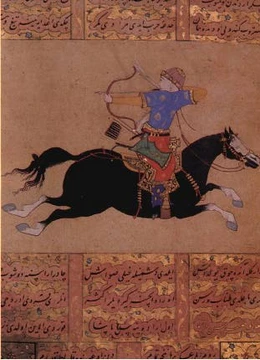
Hama yumi
Sacred Japanese bow used to vanquish demons and purify spaces.

The hama yumi is a sacred Japanese bow (yumi) that originated in 1103 A.D. It is considered one of the oldest and most sacred Japanese weapons, and the first Emperor Jimmu is always depicted carrying a bow. The hama yumi is also known as the 'Evil-Destroying Bow,' and its counterpart arrow is called a hama ya, or 'Evil-Destroying Arrow.'
- Date of origin
- 1103 A.D.
- Type
- Sacred bow (yumi)
- Alternate name
- Evil-Destroying Bow
- Associated arrow
- Hama ya (Evil-Destroying Arrow)
- First emperor depicted with bow
- Emperor Jimmu
- Key historical figure
- Minamoto no Yorimasa
Lore & Background
According to legend, in 1103 A.D. the Imperial Palace was taken over by an evil demon, causing the Emperor to fall ill with great anxiety and suffering. The Imperial High Priests tried and failed to destroy the demon and dispel its influence. Finally, the archer Minamoto no Yorimasa was summoned to the Imperial Palace. With a steady hand and a virtuous heart, he vanquished the demon with his first arrow, and his bow was declared a hama yumi, an 'Evil-Destroying Bow,' and the first arrow a hama ya, an 'Evil-Destroying Arrow.'
Since then, hama yumi have been used in Buddhist and Shinto rituals of purification, such as Shihōbarai (the Purification/Sweep of the Four Directions). In Japan, it is believed that merely the twanging of its bowstring will frighten away ghosts, evil spirits, and negative influences from a house. A miko will carry a hama yumi and a set of hama ya as part of their religious regalia, while in Feudal Japan they were used literally in defense of a shrine or temple.
Hama-yumi replicas are scale versions of the sacred Japanese bow, coated with urushi, wrapped in fine rattan, and accented in gold leaf. They are displayed in a stand along with two arrows tipped with yanone (traditional warrior tips); one arrow represents male and the other female, yin and yang (vermilion signifying male energy (yang), and black representing female energy (yin)).
Reader's Guide
The hama yumi holds enduring significance in Japanese culture as a symbol of spiritual protection and purification. Its legacy began with the legendary feat of Minamoto no Yorimasa, who used the bow to slay a demon that had taken over the Imperial Palace and caused the Emperor to fall ill. This event established the bow as an 'Evil-Destroying Bow' and the arrow as an 'Evil-Destroying Arrow,' and they have been used ever since in Buddhist and Shinto purification rituals like Shihōbarai. The belief that the mere twang of its bowstring can frighten away ghosts and evil spirits underscores its apotropaic power.
Today, decorative hama ya arrows are sold at shrines as engimono (good-luck charms), and smaller replicas are placed in shrines and people's homes. It is believed that even a single hama ya blessed by a Shinto priest carries great spiritual power, offering protection against evil, purification, and the ability to attract vast good fortune. Hama ya and hama yumi are often given as gifts to celebrate the first New Year of a male baby's life. The replicas, coated in urushi and wrapped in rattan with gold leaf accents, are displayed with two arrows representing male and female energies, reflecting the balance of yin and yang. The hama yumi thus remains a potent symbol of spiritual defense and good fortune in both religious and domestic settings.
Did You Know?
- Minamoto no Yorimasa vanquished a demon with the first arrow from this bow in 1103 A.D.
- The twanging of a hama yumi's bowstring is believed to frighten away ghosts and evil spirits.
- Hama ya arrows are sold at shrines as good-luck charms called engimono.
More in Archery, Part 2 1-24
Spotted an error? Know more?
Reader corrections go straight into our review queue. Suggest an edit · How this site is sourced