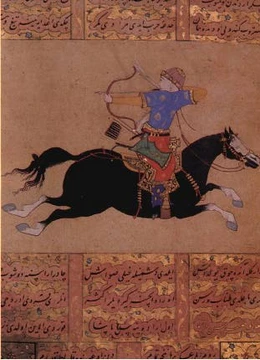
Gakgung
A horn-based composite reflex bow standardized centuries ago in Korea.

The gakgung, often called the Korean bow, is a composite reflex bow built with water buffalo horn. It was standardized centuries ago from earlier, varied versions of similar weapons. Because Koreans have used it for so long, it is also known as Guk Gung, meaning "national bow." This bow is drawn with the thumb, so a thumb ring is commonly worn. Korean thumb rings differ from Manchu, Mongol, or Turkic styles, coming in two types: male and female. The male ring has a small protrusion that catches the bowstring, working like a release aid. The female ring simply covers the front joint of the thumb to prevent blisters, which can easily form from repeatedly pulling heavy bows with only the thumb.
Gungsul, also romanized as goong sool, means "techniques of the bow" or "skill with the bow," and is another term for Korean traditional archery. However, goong sool is not the preferred expression. Koreans more often use gungdo, meaning "way of the bow."
The reflex bow was the most important weapon for Koreans in wars against Chinese dynasties and nomadic peoples, with records dating from the 1st century BC. Legend holds that Go Jumong, the first king and founder of Goguryeo, was a master archer who could catch five flies with one arrow. Bak Hyeokgeose, the first king of Silla, was also said to be a skilled archer. The ancient Chinese called the peoples of the east—including the Shandong Peninsula, Huai River basin, Jianghuai, Manchuria, the Korean Peninsula, the Japanese archipelago, and eastern Siberia—Dongyi, a name combining the characters for "large" and "bow." However, the Chinese used this term broadly for any foreign tribes in the east associated with large bows.
Yi Sŏng-gye, the founding king of Joseon, was known as a master archer. In a battle against Japanese pirates, he and Yi Bangsil killed the young samurai commander Agibaldo with two arrows in succession: the first knocked off his helmet, and the second entered his mouth. In a letter to General Ch'oe Yŏng, Sŏng-gye listed as one of five reasons not to invade Ming China that during the monsoon season, the glue holding the composite bow weakens, reducing its effectiveness.
With the founding of the Joseon dynasty, the composite bow remained the mainstay of the military. Archery was the primary martial event tested in the military portion of the national service exam, held annually from 1392 to 1894.
- Draw weight
- most are above 20 kilograms (approximately 44 pounds)
- Maximum range
- up to 350 m
- Standard target distance
- 120 bo (about 145 m)
- Materials
- bamboo core, sinew backing, oak handle, water buffalo horn belly, mulberry or black locust siyahs, birch bark backing, isinglass glue
- Cultural designation
- designated an important Intangible Cultural Property in 1971
Lore & Background
The reflex bow was the most important weapon for Koreans in wars with Chinese dynasties and nomadic peoples, recorded from the 1st century BC. Legend says the first king and founder of Goguryeo, Go Jumong, was a master of archery, able to catch five flies with one arrow. Bak Hyeokgeose, the first king of Silla, was also said to be a skilled archer. The ancient Chinese gave the people of the East the name Dongyi, combining the characters for 'large' and 'bow', though the term was widely applied to any foreign tribes in the east associated with large bows.
Yi Sŏng-gye, the founding king of Joseon, was known as a master archer. In a battle against Japanese pirates, he killed the young samurai commander Agibaldo with two successive arrows, one knocking off his helmet and the second entering his mouth. In a letter to General Ch'oe Yŏng, Sŏng-gye listed as one of five reasons not to invade Ming China that during the monsoon season the glue holding the composite bow weakens, reducing its effectiveness.
The founding of the Joseon dynasty saw the retention of the composite bow as the mainstay of the military. Archery was the main martial event tested during the military portion of the national service exam held annually from 1392 to 1894. Under Joseon, archery reached its zenith, resulting in the invention of pyeonjeon, which saw great service against the Japanese in 1592 and against the Manchus in the early 1600s. Until the Imjin wars, archery was the main long-range weapon system; during those wars, the tactical superiority of the matchlock-ignited arquebus became apparent, but the gakgung—referred to as the 'half bow' by the Japanese—halted the Japanese at the Battle of Haengju and at the Battle of Ulsan. Although Joseon adopted the arquebus during the Imjin War, the gakgung retained its position of importance in the military until the reforms of 1894.
Reader's Guide
The gakgung is a highly reflexed version of the classic Eurasian composite bow. Its core is bamboo, sinew-backed to prevent breaking and add pulling strength, with oak at the handle. On the belly is water buffalo horn, which significantly increases power by pushing the limbs. The siyahs are made of mulberry or black locust and V-spliced onto the bamboo. The glue is made from isinglass. Over the sinew backing is a special birch bark imported from Northeast China, soaked in sea water for about one year and applied using diluted rubber cement. No sights or other modern attachments are used.
In 1899, visiting Prince Heinrich of Prussia expressed astonishment at a traditional archery demonstration and suggested making the art into a national sport. Emperor Gojong decreed 'let people enjoy archery to develop their physical strength' and established an archery club. In the subsequent standardization, the nature of the bow and arrow was standardized, as was the range of the targets. Korean traditional archery now uses one specific type of composite bow, bamboo arrows, and a standard target at 120 bo (about 145 m). Korean archery as a sport developed under the Japanese Occupation, with its textbook 'Joseon eui Goongdo' published in 1920.
Tradition says a noted general of the Joseon Dynasty settled in Yecheon about 300 years ago and handed down his expertise. Today, bowyers from Yecheon and its environs produce approximately 70% of Korea's traditional horn composite bows. The city has produced numerous Olympic medalists and world champion archers and hosts the Jinho International Archery Field. The art of constructing traditional Korean bows was designated an important Intangible Cultural Property in 1971.
Did You Know?
- The gakgung is also called the 'half bow' by the Japanese.
- Korean thumb rings come in two styles: male (with a protrusion for the bowstring) and female (protecting the thumb joint from blisters).
- The bow's birch bark backing is imported from Northeast China and soaked in sea water for about one year.
- A sukgung (a kind of crossbow) can shoot up to 400 m, while a gakgung can shoot up to 350 m.
More in Archery, Part 2 1-24
Spotted an error? Know more?
Reader corrections go straight into our review queue. Suggest an edit · How this site is sourced