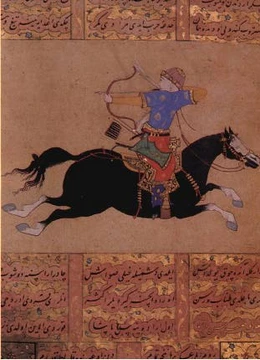
Composite bow
A laminated bow combining horn, sinew, and wood for power and compactness.

A composite bow is a bow made from many different materials, typically including horn, antler, bamboo, wood, or sinew laminated together with glue. Its notable advantage is the combination of small size with high power, making it especially convenient for mounted archery and flight archery.
- Earliest evidence
- Bronze Age civilizations in Anatolia or Mesopotamia
- Spread to egypt
- ancient Egypt
- Spread to east asia
- Indo-Iranian Andronovo culture and Srubnaya culture
- Key military users
- classical Greece, Roman Empire, Han dynasty, Ottoman Empire
- Decline began
- early modern period, supplanted by guns
- Surviving traditions
- Korea and China
Lore & Background
The composite bow likely originated in the Bronze Age, though it is unclear whether it has a single origin or developed independently in different regions. The earliest composite bows containing horn are reliably traced to the Near East, probably Syria, Anatolia, or Mesopotamia, and then spread to Egypt, culminating in the angular bow. Several composite bows were found in the tomb of Tutankhamun. The Indo-Iranian Andronovo culture and the Srubnaya culture spread the composite bow to East Asia.
The Scythian bow, ideally suited to mounted archery, evolved from the angular bow and became the dominant composite bow shape in Europe and Asia until the 1st century AD. The mounted archer became the archetypal warrior of the steppes, using the composite bow for protecting herds, steppe warfare, and incursions into settled lands. Classic tactics included skirmishing and the Parthian shot, shooting backwards over the horse's rear. Infantry archers of classical Greece and the Roman Empire also used composite bows, and the Han dynasty utilized composite crossbows.
Construction involves a wooden core for shape and stability, a thin layer of horn glued to the belly for compression strength, and sinew soaked in animal glue laid in layers on the back for tensile strength. Materials such as water buffalo horn, antelope horn, and deer sinew are traditional. The bow is finished with leather or waterproof bark to protect against moisture. Composite bows are time-consuming to make, requiring months of drying, and are sensitive to moisture.
Reader's Guide
Composite bows were a significant military weapon across Europe and Asia for hundreds of years, particularly after the development of the Scythian bow suited for mounted archery. They enabled the horse-archer tactics that dominated steppe warfare and influenced military engagements from classical Greece to the Ottoman Empire. The Ottoman Empire relied on archers with composite bows as a main component of their forces until 1571, when the Battle of Lepanto resulted in the loss of most such troops. Composite bows began to be supplanted by guns in the early modern period, but survived in some areas for leisure purposes, such as early modern Turkish bows specialized for long-distance archery. The tradition continues in Korea and China, and has been revived elsewhere with modern replicas incorporating natural and synthetic materials. While composite construction offers no advantage for most non-mounted archery purposes, it is superior for horsemen and flight archery, where well-designed composite bows of high draw-weight achieve higher arrow velocity.
Did You Know?
- Composite bows can be made from any combination of horn, antler, bamboo, wood, or sinew.
- The Scythian bow was the first composite bow ideally suited for mounted archery.
- Water buffalo horn is very suitable for the belly of a composite bow.
- The Strategikon advised Byzantine cavalry to keep composite bows in leather cases to keep them dry.
More in Archery, Part 2 1-24
Spotted an error? Know more?
Reader corrections go straight into our review queue. Suggest an edit · How this site is sourced