Bow shape
Bow shape is the side-view product of material stresses and design.

In archery, a bow’s shape is generally understood from a side view. It results from how a bowyer balances material stresses, and the design of the limbs accounts for the materials used, the desired performance, and the bow’s purpose. While many shapes exist, they largely fit into three categories: straight, recurve, and compound. Straight and recurve bows are regarded as traditional types.
A straight limb keeps the same effective length as the bow is drawn—the string runs directly to the nock when the bow is strung. The materials must handle the stresses, store energy, and release it efficiently. Many traditional self bows are roughly straight in side profile. The English longbows used at battles like Crécy and Agincourt were straight-limbed bows.
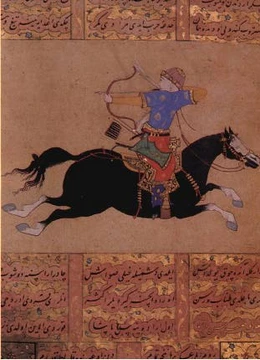
A recurve bow has tips that curve away from the archer when strung. The key difference is that the string touches part of the limb when the bow is strung. Recurve bows made from composite materials were used by groups such as the Persians, Parthians, Scythians, Hyksos, Magyars, Bulgars, Huns, Turks, Mongols, and Chinese.
When a limb is straight, its effective length stays constant during the draw. With a recurve, the string contacts the limb before reaching the nock, so the effective limb length is shorter at the start of the draw. As the bow is drawn, the recurve unwinds, lengthening the limb and improving the archer’s mechanical advantage. Meanwhile, stresses build in the limb materials: the belly (closest to the archer) compresses, the back (farthest) stretches, and the line between them experiences shear. The materials must endure these forces, store energy, and release it quickly. The energy stored depends on the stresses and the limb’s shape from unstrung to strung (pre-stressed) and then to full draw as the recurve unwinds. These principles of changing mechanical advantage were understood in antiquity.
For straight bows, mechanical advantage is greatest at the start of the draw, and the limbs are only pre-stressed to the strung position, so draw weight is lowest then. But draw weight increases rapidly as mechanical advantage drops and stresses build, causing the weight to “stack.” On release, the arrow receives maximum force that quickly decreases.
- Main categories
- straight, recurve, compound
- Traditional categories
- straight, recurve
- Recurve bow definition
- string touches a section of the limb when the bow is strung
- Reflex bow shape when unstrung
- C-shaped, entire length curves forward from the belly
- Decurve bow definition
- arms curved or curled at the ends to turn towards the archer
- Deflex bow definition
- arms curved or curled at the base to turn towards the archer when unstrung
Lore & Background
The shape of a bow is determined by the bowyer's design, which accounts for construction materials, performance requirements, and intended use. A straight limb bow has an effective length that remains the same as the bow is drawn, with the string going directly to the nock in the strung position. Many traditional self bows are made approximately straight in side-view profile. Longbows as used by English archers in the Middle Ages at battles such as Crecy and Agincourt were straight limb bows, usually made of yew and with heavy draw weights.
A recurve bow has tips that curve away from the archer when the bow is strung, and the string touches a section of the limb. Recurve bows store more energy and deliver it more efficiently than an equivalent straight-limbed bow, permitting a shorter bow for a given arrow energy. This form was often preferred by archers in environments where long weapons could be cumbersome, such as in brush and forest terrain, or while on horseback. Recurve bows made out of composite materials were used by the Persians, Parthians, Scythians, Hyksos, Magyars, Bulgars, Huns, Turks, Mongols, and Chinese.
A reflex bow has curved or curled arms that turn away from the archer throughout their length, forming a C-shape when unstrung. This allows a significantly shorter bow to have a high draw weight and long draw length, making it ideal for horseback use. Highly reflexed composite bows are still used in Korea and were common in Turkish and Indian traditional archery. A decurve bow has arms curved at the ends to turn towards the archer, reducing strain but also energy stored. A deflex bow has arms curved at the base to turn towards the archer when unstrung, also reducing strain and energy stored.
Reader's Guide
The significance of bow shape lies in its direct impact on performance, energy storage, and mechanical advantage. Straight bows, while simple and traditional, exhibit rapid stacking of draw weight, meaning the force increases quickly as the bow is drawn. Recurve bows, by contrast, use the unwinding of the recurve to increase effective limb length during the draw, improving mechanical advantage and storing more energy efficiently. This made recurve bows the classic weapon of horse archers across Asia and Europe, as their shorter profile was ideal for mounted use. Reflex bows, with their extreme curves, put materials under greater stress, enabling a short bow to match or exceed the power of longer bows, but requiring high-quality materials and workmanship. The compound bow, a modern invention, uses a levering system of cables and pulleys to bend stiffer limbs, offering greater energy efficiency. The choice of shape—straight, recurve, reflex, decurve, deflex, or compound—thus reflects a balance between material capabilities, intended use (such as hunting, warfare, or sport), and the archer's environment, from open battlefields to dense forests or horseback.
Did You Know?
- A recurve bow is defined by the string touching a section of the limb when the bow is strung.
- Reflex bows curve forward from the belly along their entire length when unstrung, resembling a 'C'.
- Decurve bows have arms that turn towards the archer, reducing strain but also arrow speed.
- Many Native American recurve bows were incorrectly strung backwards and destroyed when attempts were made to shoot them.
More in Archery, Part 2 1-24
Spotted an error? Know more?
Reader corrections go straight into our review queue. Suggest an edit · How this site is sourced