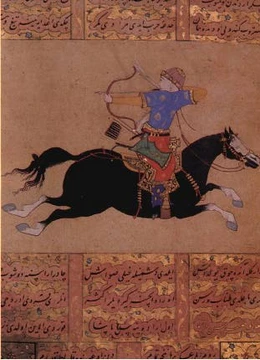
Bow and arrow
A prehistoric ranged weapon system still used for hunting and sport.

The bow and arrow is a ranged weapon system made up of a flexible, elastic launching device called a bow and long, shafted projectiles known as arrows. Long before written history, humans used bows and arrows for hunting and fighting, and this practice was widespread among many prehistoric groups. From ancient times through the early modern period, they served as key weapons in warfare, but they became increasingly outdated as more powerful and accurate firearms were developed. Today, bows and arrows are mainly used for hunting and sport.
The skill of using a bow to shoot arrows is called archery. A person who shoots arrows is a bowman or archer. A bowyer makes bows, a fletcher makes arrows, and an arrowsmith manufactures metal arrowheads.
A bow is built as a semi-rigid but elastic arc, with a high-tensile bowstring connecting the ends of its two limbs. An arrow has a pointed tip, a long shaft, stabilizing fins called fletching near the back, and a narrow notch, or nock, at the very end to fit onto the bowstring. To load an arrow, the archer places it across the middle of the bow with the string in the nock. To shoot, the archer holds the bow at its center with one hand and pulls back, or draws, the arrow and string with the other hand, usually the dominant one. This bends the two limbs backward, acting like a pair of cantilever springs to store elastic energy. While holding the draw, the archer aims, either intuitively or by sighting along the arrow. Releasing the draw lets the stored energy in the limbs convert into kinetic energy, which travels through the bowstring to the arrow, propelling it forward at high speed. The distance a bow can shoot is called its cast. A container for extra arrows, used for quick reloading, is a quiver.
When not in use, bows are usually kept unstrung, meaning one or both ends of the string are detached. This removes all residual tension, helping to prevent the bow from losing strength or elasticity over time. Many bow designs also allow the bow to straighten out more completely, reducing the space needed for storage. Putting the string back into ready-to-use position is called stringing the bow.
The oldest known evidence of arrows comes from layers 20–21 in Obi-Rakhmat Grotto, Uzbekistan, dating to about 80,000 years ago.
- Oldest known arrow evidence
- Obi-Rakhmat Grotto, Uzbekistan, circa 80,000 years ago
- Earliest definite bow remains in europe
- Mannheim-Vogelstang, Germany, 17,500–18,000 years ago
- Oldest extant bows
- Holmegaard bows from Denmark, dated to 9,000 BCE
- Earliest evidence of stone tipped arrows
- Nataruk, Kenya, circa 10,000 years ago
Lore & Background
The oldest known evidence of arrows comes from layers 20–21 in Obi-Rakhmat Grotto, Uzbekistan, some 80,000 years ago, where micro-points of the right size for arrowheads were found. In Sibudu Cave, South Africa, likely arrowheads have been found dating from approximately 72,000–60,000 years ago. Probable arrowheads from Fa Hien Cave, Sri Lanka have been dated to 48,000 years ago, with evidence suggesting bow-and-arrow hunting focused on monkeys and smaller animals. Small stone points from Mandrin Cave in Southern France, used some 54,000 years ago, have damage indicating use as projectile weapons, and some are too small for any practical use other than as arrowheads. After the end of the last glacial period, some 12,000 years ago, the use of the bow seems to have spread to every inhabited region except for Australasia and most of Oceania. The earliest definite remains of bow and arrow from Europe are possible fragments from Germany found at Mannheim-Vogelstang dated 17,500–18,000 years ago, and at Stellmoor dated 11,000 years ago. The oldest extant bows in one piece are the elm Holmegaard bows from Denmark, dated to 9,000 BCE. The bow was an important weapon for both hunting and warfare from prehistoric times until the widespread use of gunpowder weapons in the 16th century. The skill of Nubian archers was renowned in ancient Egypt, and the bow was the national weapon of Persian kings. The English longbow was England's principal ranged weapon until the end of the Middle Ages, and Genghis Khan's Mongol hordes used short bows. Organised warfare with bows ended in the early to mid-17th century in Western Europe but persisted into the 19th century in Eastern cultures.
Reader's Guide
The bow and arrow's significance spans from prehistoric hunting to modern sport and specialized military use. Its development as a weapon of war was central to many ancient and medieval societies, from the Nubian archers of Egypt to the English longbowmen and Mongol horsemen. The transition to firearms in the early modern period gradually ended its military dominance in Western Europe by the mid-17th century, though it continued in Eastern cultures and tribal warfare into the 19th and even 21st centuries, as documented in a 2009 clash in Kenya. The British upper class revived archery as a sport in the late 18th century, with the Toxophilite Society formed in London in 1781. Bows and arrows have also been used by modern special forces for survival and clandestine operations. The basic design—a semi-rigid elastic arc with a high-tensile bowstring—has remained consistent, though materials and construction have evolved. The bow's cast, or distance it can shoot, and its draw weight, which expresses its power, are key performance metrics. The practice of keeping bows unstrung when not in use to preserve their strength and elasticity reflects the careful maintenance required for these weapons.
Did You Know?
- The bow was the national weapon of Persian kings, and images of them carrying it appear on Persian coins.
- In 2009, a tribal clash in Kenya between Kisii and Kalenjin people involving bows and arrows resulted in four deaths.
More in Archery, Part 2 1-24
Spotted an error? Know more?
Reader corrections go straight into our review queue. Suggest an edit · How this site is sourced