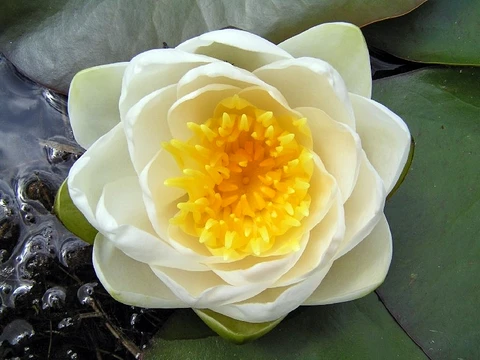
Utricularia
Last updated
Utricularia, commonly called bladderworts, is a genus of carnivorous plants with about 233 species.[1] They capture small organisms using bladder-like traps that operate by suction.[2][3]
Scientific classification
- CladeTracheophytes
- CladeAngiosperms
- CladeEudicots
- CladeAsterids
- OrderLamiales
- FamilyLentibulariaceae
- GenusUtricularia
Named by L.
Sources: Wikipedia taxobox: Utricularia (CC BY-SA 4.0)
Biology and range
Utricularia occur on every continent except Antarctica.[1] About 80% of species are terrestrial, living in waterlogged soils.[2] Aquatic species have larger bladders that can catch water fleas, mosquito larvae, and young tadpoles.[2] Flowers are the only part of the plant that emerges above the soil or water.[2]
Some species are epiphytic, growing on trees in rainforests.[4] Temperate perennials die back each winter and require a cold dormancy period.[2] Minute prey like protozoa and rotifers living in waterlogged soil are consumed by the small traps of terrestrial species.[2] Bladder dimensions vary from 0.02 cm up to 1.2 cm.[2]
Unlike most flowering plants, Utricularia has no root system, and its vegetative parts are not distinctly divided into roots, leaves, and stems.[5] South America contains the highest number of Utricularia species, with Australia having the second-highest count.[1]
What the specialist sources record
The GBIF Backbone Taxonomy lists Utricularia L. as an accepted genus in the family Lentibulariaceae.[6] GBIF holds 373,293 occurrence records for this taxon as of 17 October 2026.[6] Lloyd demonstrated that the trap can ingest larger prey bit by bit through suction alone.[7] A 2009 study found that Utricularia bladders often host mutualistic microbial communities that aid digestion.[8]
Research from 2006 and 2010 suggests that adaptive changes in cytochrome C oxidase have enhanced the genus' trapping efficiency.[9][10] Experiments conducted by F. E. Lloyd in 1942 demonstrated that the trap operates through a purely mechanical process, without any need for plant irritability.[7]
References
- Wikipedia, "Utricularia" (CC BY-SA 4.0), which cites: Salmon, Bruce (2001). Carnivorous Plants of New Zealand. Ecosphere Publications. (original not read by us) en.wikipedia.org
- Wikipedia, "Utricularia" (CC BY-SA 4.0), which cites: Taylor, Peter. (1989). The genus Utricularia - a taxonomic monograph. Kew Bulletin Additional Series XIV: London. (original not read by us) en.wikipedia.org
- Wikipedia, "Utricularia" (CC BY-SA 4.0), which cites: D'Amato, Peter. 1998. The Savage Garden: Cultivating Carnivorous Plants. Ten Speed Press: Berkeley, California.; Lloyd, F.E. 1942. The Carnivorous Plants. The Ronald Press Company: New York. (original not read by us) en.wikipedia.org
- Wikipedia, "Utricularia" (CC BY-SA 4.0), which cites: D'Amato, Peter. 1998. The Savage Garden: Cultivating Carnivorous Plants. Ten Speed Press: Berkeley, California. (original not read by us) en.wikipedia.org
- Wikipedia, "Utricularia" (CC BY-SA 4.0), which cites: Rutishauser, "Developmental Genetics and Morphological Evolution of Flowering Plants, Especially Bladderworts (Utricularia): Fuzzy Arberian Morphology Complements Classical Morphology", Annals of Botany, 2001, p. 1173–12; Hedrich, "On the Origin of Carnivory: Molecular Physiology and Evolution of Plants on an Animal Diet", Annual Review of Plant Biology, 17 June 2021, p. 133–153; Adlassnig, "The Roots of Carnivorous Plants", Plant and Soil, 1 July 2005, p. 127–140; Miranda, "A Historical Perspective of Bladderworts (Utricularia): Traps, Car en.wikipedia.org
- GBIF Backbone Taxonomy and occurrence index, Utricularia (taxon key 3172398). CC BY 4.0 (backbone); counts are facts. gbif.org
- Wikipedia, "Utricularia" (CC BY-SA 4.0), which cites: Lloyd, F.E. 1942. The Carnivorous Plants. The Ronald Press Company: New York. (original not read by us) en.wikipedia.org
- Wikipedia, "Utricularia" (CC BY-SA 4.0), which cites: Sirová, "Microbial community development in the traps of aquatic Utricularia species", Aquatic Botany, 2009, p. 129–136 (original not read by us) en.wikipedia.org
- Wikipedia, "Utricularia" (CC BY-SA 4.0), which cites: Albert, "The carnivorous bladderwort (Utricularia, Lentibulariaceae): a system inflates", Journal of Experimental Botany, 2010, p. 5–9; Laakkonen, "A new model for the evolution of carnivory in the bladderwort plant (utricularia): adaptive changes in cytochrome C oxidase (COX) provide respiratory power", Plant Biology, 2006, p. 758–764 (original not read by us) en.wikipedia.org
- Wikipedia, "Utricularia" (CC BY-SA 4.0), which cites: Laakkonen, "A new model for the evolution of carnivory in the bladderwort plant (utricularia): adaptive changes in cytochrome C oxidase (COX) provide respiratory power", Plant Biology, 2006, p. 758–764 (original not read by us) en.wikipedia.org
Each numbered sentence above was checked against the source it cites before publication. Sentences citing Wikipedia adapt text from the English Wikipedia article Utricularia (contributors), used under CC BY-SA 4.0; this entry is available under the same licence. Other sources were used for facts only; no text or images are copied from them.
More in Aquatic & Wetland Plants
Sources
Compiled from Wikipedia and the sources listed below. Text from Wikipedia is available under CC BY-SA 4.0; this entry is adapted from it.
- Wikipedia: Utricularia (CC BY-SA 4.0).
- Word definitions: the Codexery glossary, each quoted from its Wikipedia article.
Spotted an error? Know more?
Reader corrections go straight into our review queue. Suggest an edit · How this site is sourced