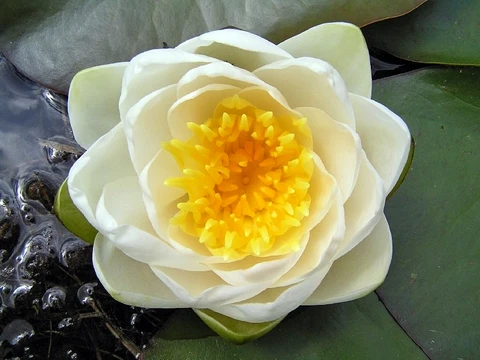
Nymphaea nouchali var. caerulea
A sacred water lily of ancient Egypt, known for its psychoactive alkaloids and symbolic association with the sun and rebirth.
Last updated
The blue lotus, also known as the blue water lily, is a variety of the species Nymphaea nouchali, and is formally classified as Nymphaea nouchali var. caerulea (or simply Nymphaea caerulea). This aquatic herb thrives in freshwater lakes, pools, and rivers, with a natural range covering most of eastern Africa and parts of southern Arabia; it has since been introduced elsewhere as an ornamental. Its roots can survive in oxygen-depleted mud and nutrient-poor conditions, allowing it to dominate deeper waters in such environments. The plant’s underwater rhizomes are safe to eat.
Religion and art
In ancient Egyptian culture, the blue lotus held deep symbolic meaning, representing the sun and rebirth, and has been discovered in pharaohs’ tombs. It may have been used for aphrodisiac and religious purposes, including rituals such as Hathor’s Festival of Drunkenness.
The plant contains the psychoactive alkaloids nuciferine and apomorphine, which affect serotonin, dopamine, and adrenergic systems. Modern recreational use—typically through drinking infusions or vaping—has been linked to toxicity, causing sedation and perceptual disturbances. A recent study from UC Berkeley confirmed that authentic Nymphaea caerulea is chemically distinct from many products sold online, which often contain far less nuciferine and are actually misidentified water lilies.
Publication
First described by Marie Jules César Savigny in 1798, the plant was later reclassified as a variety of Nymphaea nouchali by Bernard Verdcourt in 1989. Although it is still most commonly referred to as a variety, recent phylogenetic studies have raised questions about this taxonomy. When treated as Nymphaea nouchali var. caerulea, it is considered synonymous with Nymphaea capensis. When treated as Nymphaea caerulea, it is now rare due to habitat loss caused by the Aswan Dam.
Vegetative characteristics
This perennial aquatic herb has a tuberous rhizome, with small tubers that can develop into short vertical rhizomes. A single plant can spread over about one meter. Its leaves are peltate, with long petioles and leaf blades measuring 8–35 cm by 7.5–42 cm. The leaves are polymorphic, changing shape and texture depending on whether they are underwater or floating.
The blades have a papery texture and may be smooth or densely hairy. Their shape is incised-cordate and round or slightly elliptical, with a pointed or tail-like tip. The two lobes may overlap slightly or be somewhat apart. The upper leaf surface is smooth, while the underside has prominently raised veins that are green, or occasionally reddish or reddish-purple.
There are eight to eleven primary lateral veins on each side of the midrib, and six to eight pairs of secondary veins. The primary veins form closed, elongated areas that extend more than two-thirds of the way to the leaf edge. The leaf margin is entire near the tip or somewhat irregularly wavy-lobed throughout. The petioles are thick, blackish-green, and spongy, continuing to lengthen as the plant ages, pushing older leaves toward the plant’s edges.
Generative characteristics
Flowers can be blue, white, mauve, or pinkish, but usually have pale bluish-white to sky-blue or mauve petals that smoothly shift to pale yellow at the center. They are 8–12 cm in diameter. There are four sepals, colored green and sometimes purple at the margins, measuring 4–10 cm by 1.5–3.5 cm.
The 14–20 petals are oblong, with blunt or slightly pointed tips; the outermost petals are as long as the sepals. The stamens are densely packed and very numerous—100 to 200 or more—with the outermost ones bearing long appendages. There are 14–24 carpels with very short styles. Carpellary appendages, called osmophores, attract pollinators by visual appeal and by emitting a food-mimicking odor, without offering any reward.
Flower buds rise to the surface over two to three days, opening in mid-morning and closing near dusk; this opening and closing is controlled by the sepals, as cutting them off prevents closure. Flowers and buds do not rise above the water in the morning or submerge at night. Each flower lasts about four days, closing each night before withering.
The fruit is a berry, 2.2 by 3.2 cm, flattened and round. Seeds are ellipsoid, 1.2 mm long, smooth, and have a fleshy, bell-shaped aril.
The plant’s psychoactive effects come mainly from the aporphine alkaloids nuciferine and apomorphine. Nuciferine acts as an antagonist at the serotonin 5-HT2A receptor, a partial agonist at dopamine D2 and D5 receptors and serotonin 5-HT6 receptor, and an inhibitor of the dopamine transporter. Its degradation product, atherosperminine, is also linked to dopamine receptor agonism. Apomorphine is a non-selective dopamine receptor agonist and serotonin receptor modulator, with partial agonist activity at the serotonin 5-HT1A receptor and antagonist activity at the serotonin 5-HT2A receptor; it also acts as an alpha-adrenergic receptor antagonist.
Scientific classification
- CladeTracheophytes
- CladeAngiosperms
- OrderNymphaeales
- FamilyNymphaeaceae
- GenusNymphaea
- GenusNymphaea
- SpeciesNymphaea nouchali
Named by (Savigny) Verdc., 1989
Close relatives
Other species of Nymphaea with a Codexery entry.
- Nymphaea lotus Nymphaea lotus
- Nymphaea thermarum Nymphaea thermarum
Sources: Wikipedia taxobox: Nymphaea nouchali var. caerulea (CC BY-SA 4.0) · order, family and genus agree with WoRMS AphiaID 1600203 (CC BY 4.0)
Conservation status
Least Concern (LC)
- LC▲ this species
- NT
- VU
- EN
- CR
- EW
- EX
Source: IUCN Red List assessment · GBIF copy of the Red List category
Where the nymphaea nouchali var. caerulea has been recorded
Each dot is a place where the species has been observed and reported (5,561 records, half-degree grid) — not a modelled range. 343 inland records left out (institution coordinates).
Map: drawn by Codexery. Data: GBIF occurrence search (records CC0 / CC BY) · Natural Earth basemap (public domain) · place coordinates: Wikipedia (CC BY-SA 4.0)
Lore & Background
It features prominently in Egyptian mythology and art, symbolizing the sun and rebirth and has been found in pharaohs' tombs. It may have been used for aphrodisiac and religious purposes, including in rituals like Hathor's Festival of Drunkenness.
The plant contains the psychoactive alkaloids nuciferine and apomorphine, which interact with the serotonin, dopamine, and adrenergic systems. Modern recreational use, primarily through drinking infusions or vaping, has been associated with toxicity, causing symptoms like sedation and perceptual disturbances. Recent research by UC Berkeley confirmed that the authentic Nymphaea caerulea is chemically distinct from many products sold online, which contain significantly less of the alkaloid nuciferine and are misidentified water lilies.
Taxonomic History and the Problem of Classification
The taxonomic identity of this water lily has been a source of persistent confusion among botanists. caerulea, N. ovalifolia, N. colorata, and N. petersiana—into N. nouchali as new varieties. Two additional varieties, var. mutandaensis and var. However, this sweeping circumscription has drawn sharp criticism as highly unnatural, particularly because N. petersiana was later revealed to belong to the subgenus Lotos, making it entirely unrelated to the true N. nouchali, which sits within subgenus Brachyceras. Earlier still, the name N. nouchali was erroneously applied to Nymphaea pubescens, compounding the taxonomic muddle. The blue-flowered variant, N. nouchali var. caerulea, is generally treated as part of this species complex and is widely recognised as the so-called blue Egyptian lotus.
Reader's Guide
This is an aquatic (euhydrophyte) herb with a tuberous rhizome. It is a perennial. One plant can spread over an area of about 1 metre. The peltate leaves have long petioles and leaf blades 8–35 cm by 7.5–42 cm.
The leaves are polymorphic. The flowers can be blue, white, mauve or pinkish, usually with pale bluish-white to sky-blue or mauve petals, smoothly changing to a pale yellow in the centre, and are 8–12 cm in diameter. There are four sepals, 14–20 petals, and 100–200 or more stamens. The fruit are berries, 2.2 by 3.2 cm, flattened-round.
Seeds are ellipsoid, 1.2 mm long. The chromosome count is n = 14. The genome size is 567.24 Mb.
More in Aquatic & Wetland Plants
Sources
Compiled from Wikipedia and the sources listed below. Text from Wikipedia is available under CC BY-SA 4.0; this entry is adapted from it.
- Wikipedia: Nymphaea nouchali var. caerulea (CC BY-SA 4.0).
- Classification: the source article's taxobox; order, family and genus checked against WoRMS, the World Register of Marine Species (CC BY 4.0).
- Conservation status: IUCN Red List assessment.
- Occurrence records: GBIF (CC0 / CC BY). Basemap: Natural Earth (public domain).
- Word definitions: the Codexery glossary, each quoted from its Wikipedia article.
Spotted an error? Know more?
Reader corrections go straight into our review queue. Suggest an edit · How this site is sourced