Nymphaeaceae
Last updated
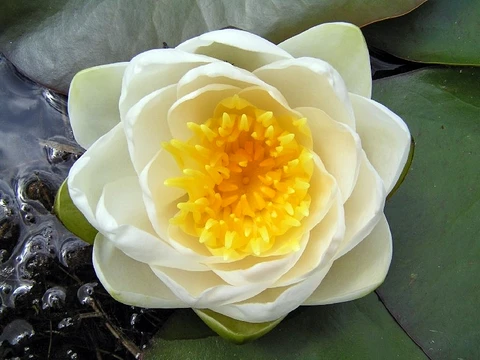
Nymphaeaceae is a family of aquatic perennial herbs that grow from thick horizontal rhizomes, as described by the Go Botany account.[1] Water lilies are a well-studied group because their large flowers were initially thought to represent the floral pattern of the earliest flowering plants.[2] Rooted in aquatic substrates, water lilies produce foliage and blooms that either rest on the water's surface or are held above it, with the family comprising five genera and roughly 70 documented species.[3]
Scientific classification
- CladeTracheophytes
- CladeAngiosperms
- OrderNymphaeales
- FamilyNymphaeaceae
Named by Salisb.
Sources: Wikipedia taxobox: Nymphaeaceae (CC BY-SA 4.0)
Quick Facts
- Common name
- Water lilies
- Number of species
- About 70
Facts from the source article.
Biology and range
Leaves arise directly from the rhizome and are alternate, floating, submersed, or emersed, with stipules present or absent.[4] The Flora of North America account notes that Nymphaeaceae are insect-pollinated, often by beetles.[4] Some species are protogynous and primarily cross-pollinated, but self-fertilization is possible because male and female stages overlap on the second day.[5] Each flower is solitary, contains both male and female parts, exhibits radial symmetry, and is borne on an elongated pedicel, typically floating or held above the water.[5]
The fruit takes the form of a nut aggregate, a berry, or a spongy, fleshy capsule that opens irregularly.[6] Seeds commonly possess an aril and have little to no endosperm.[6] The Mexican waterlily, whose natural range is the Gulf Coast of North America, has been introduced across the continent and has naturalized, becoming invasive in locations like California's San Joaquin Valley.[7] This species colonizes slow-moving waterways and resists eradication; management strategies include mechanical removal of top growth and application of herbicides such as glyphosate and fluridone.[7]
What the specialist sources record
The Go Botany account states that species formerly placed in a separate family, Cabombaceae, are now included in Nymphaeaceae.[1] The Flora of North America notes that Nymphaeaceae have often been treated to include Cabombaceae and Nelumbonaceae, but these are now generally segregated.[4] The Maya elite associated themselves with water lilies because the plants were a visual sign of water cleanliness.[8] According to a 1977 study, the Maya incorporated water lily imagery onto stelae, large-scale buildings, wall paintings, and into their hieroglyphic script.[9]
In certain Maya ritual depictions, a liquid is shown emerging not from bloodletting but directly from water lily blossoms positioned on the heads of specific deities.[10] Because Nymphaeaceae contain opiate alkaloids, it is thought the Maya consumed these plants to induce altered states of consciousness.[10]
References
- "Family: Nymphaeaceae (water-lily family): Go Botany", gobotany.nativeplanttrust.org. facts only, no text reused. gobotany.nativeplanttrust.org
- Wikipedia, "Nymphaeaceae" (CC BY-SA 4.0), which cites: Phylogeny, Classification and Floral Evolution of Water Lilies (Nymphaeaceae; Nymphaeales): A Synthesis of Non-molecular, rbcL, matK, and 18S rDNA Data, Donald (original not read by us) en.wikipedia.org
- Wikipedia, "Nymphaeaceae" (CC BY-SA 4.0), which cites: "Nymphaeaceae Salisb. Ann. Bot. (König & Sims) 2: 70. 1805. (Jun 1805)", World Flora Online, 2022; "The number of known plants species in the world and its annual increase", Phytotaxa, 2016, p. 201–217 (original not read by us) en.wikipedia.org
- Nymphaeaceae in Flora of North America @ efloras.org. (n.d.). Retrieved September 5, 2024, from http://www.efloras.org/florataxon.aspx?flora_id=1&taxon_id=10618. facts only, no text reused. efloras.org
- Wikipedia, "Nymphaeaceae" (CC BY-SA 4.0), which cites: Ito, "Studies in the floral morphology and anatomy of nymphaeales", The Botanical Magazine Tokyo, 1986, p. 169–184; Supaphon, "Isolation and antimicrobial activities of fungi derived from Nymphaea lotus and Nymphaea stellata", Mycoscience, 2018, p. 415–423; Ervik, "Breeding system and pollination of Nuphar luteum (L.) Smith (Nymphaeaceae) in Norway", Flora, 1995, p. 109–113; Wiersema, "Reproductive Biology of Nymphaea (Nymphaeaceae)", Annals of the Missouri Botanical Garden, 1988, p. 795–804 (original not read by us) en.wikipedia.org
- Wikipedia, "Nymphaeaceae" (CC BY-SA 4.0), which cites: "Family: Nymphaeaceae (water-lily family): Go Botany", gobotany.nativeplanttrust.org (we also read that source) en.wikipedia.org
- Wikipedia, "Nymphaeaceae" (CC BY-SA 4.0), which cites: "Nyphaea genus", www.cdfa.ca.gov (original not read by us) en.wikipedia.org
- Wikipedia, "Nymphaeaceae" (CC BY-SA 4.0), which cites: Lucero, "Climate Change and Classic Maya Water Management", Water, 1 April 2011, p. 479–94 (original not read by us) en.wikipedia.org
- Wikipedia, "Nymphaeaceae" (CC BY-SA 4.0), which cites: Puleston, "Social Process in Maya Prehistory: Studies in Honor of Sir Eric Thompson", Academic Press, 1977, p. 449–467 (we also read that source) en.wikipedia.org
- Wikipedia, "Nymphaeaceae" (CC BY-SA 4.0), which cites: McDonald, "Water Lily and Cosmic Serpent: Equivalent Conduits of the Maya Spirit Realm", Journal of Ethnobiology, 2012, p. 74–107; McDonald, "Water Lily and Cosmic Serpent: Equivalent Conduits of the Maya Spirit Realm", Journal of Ethnobiology, 2012, p. 74–107; Lucero, "The collapse of the Classic Maya: A case for the role of water control", American Anthropologist, September 2002, p. 814–826 (original not read by us) en.wikipedia.org
Each numbered sentence above was checked against the source it cites before publication. Sentences citing Wikipedia adapt text from the English Wikipedia article Nymphaeaceae (contributors), used under CC BY-SA 4.0; this entry is available under the same licence. Other sources were used for facts only; no text or images are copied from them.
More in Aquatic & Wetland Plants
Sources
Compiled from Wikipedia and the sources listed below. Text from Wikipedia is available under CC BY-SA 4.0; this entry is adapted from it.
- Wikipedia: Nymphaeaceae (CC BY-SA 4.0).
Spotted an error? Know more?
Reader corrections go straight into our review queue. Suggest an edit · How this site is sourced