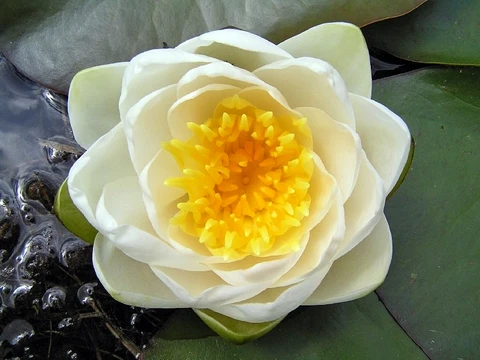
Nelumbo nucifera
Sacred lotus: a thermoregulating aquatic perennial with edible seeds and deep cultural symbolism.
Last updated
Nelumbo nucifera—known in Sanskrit as Padma or Kamala, and commonly called the sacred lotus, pink lotus, Indian lotus, or simply lotus—is one of only two living species in the aquatic plant family Nelumbonaceae. People sometimes refer to it as a water lily, but that name is more accurately used for plants in the family Nymphaeaceae. This lotus belongs to the order Proteales.
Description
The plant thrives in the floodplains of slow-moving rivers and delta areas. Each year, a stand of lotus drops hundreds of thousands of seeds to the pond bottom. Some sprout right away, but most are eaten by wildlife. The seeds that survive can stay dormant for a very long time as the pond silt fills in and dries out.
When floods come, the sediments break open, the dormant seeds rehydrate, and a new lotus colony begins. Cultivation requires nutrient-rich, loamy, often flooded soil, warm temperatures, and specific planting depths; propagation happens through rhizomes, seeds, or tissue culture. Harvesting—by hand or machine—takes place over several months, depending on climate and variety, and yields stolons, flowers, seeds, and rhizomes.
The lotus is the national flower of India and an unofficial national symbol of Vietnam. Its large leaves and flowers can regulate their own temperature, and it produces seeds that can stay viable for many years. The oldest recorded lotus germination came from seeds 1,300 years old, recovered from a dry lakebed in northeastern China. Because of this, the Chinese regard the plant as a symbol of longevity.
Its native range is very wide, stretching from East Asia (north to the Amur region) through northern Indochina and central and northern India (up to 1,400 meters in the southern Himalayas). Russian populations are sometimes called Nelumbo komarovii, with isolated spots at the Caspian Sea. Today, the species also grows in southern India, Sri Lanka, nearly all of Southeast Asia, New Guinea, and northern and eastern Australia—though this is likely due to human transport.
It has been cultivated for its edible seeds for about 3,000 years and is commonly grown in water gardens. The lotus is a highly symbolic and versatile plant, used in religious offerings (especially in Hinduism and Buddhism) and in diverse culinary traditions across Asia. Its flowers, seeds, and rhizomes are valued for spiritual, cultural, and nutritional purposes. It holds deep significance in Hinduism, Buddhism, Jainism, Ismailism, and Chinese culture, symbolizing purity, enlightenment, spiritual awakening, and divine beauty, and appears widely in art, architecture, and literature.
The leaves contain the flavonol miquelianin and alkaloids such as coclaurine and norcoclaurine, while the whole plant has bioactive compounds including nuciferine and neferine. These substances have been studied for possible pharmacological effects, and the plant is used in traditional medicine and marketed as a functional food in various cultures.
Etymology
The scientific name Nelumbo nucifera comes from the Sinhalese word nelambu or nelum (meaning “lotus”) and the Latin nucifera (“nut-bearing”), so the full name means “nut-bearing nelumbo,” referring to the plant’s edible, nut-like seeds.
Classification
The lotus is often confused with true water lilies of the genus Nymphaea, especially N. caerulea, the “blue lotus.” Some older classification systems, like the Bentham & Hooker system (still widely used in the Indian subcontinent), refer to the lotus by its old synonym Nymphaea nelumbo. All modern plant taxonomy agrees that the species belongs in the genus Nelumbo, but systems disagree on which family it should be in, or whether it deserves its own unique family and order.
Under the APG IV system, N. nucifera, N. lutea, and their extinct relatives are placed in Proteales with protea flowers, based on genetic comparisons. Older systems, such as the Cronquist system, put it in Nymphaeles due to anatomical similarities. According to APG IV, the lotus’s closest relatives include sycamores (Platanaceae).
Botany
The lotus roots grow in pond or river bottom soil, while the leaves float on the water’s surface or rise well above it. The leaf stalks (petioles) can reach up to 200 cm long, letting the plant grow in water that deep.
The peltate leaf blade (lamina) can be 80–100 cm across. Leaves are spaced up to 2 meters apart along the rhizome, which can grow as much as 20 meters in a single year. The internodes are not cylindrical but swollen in the middle.
Flowers usually appear on thick stems rising several centimeters above the leaves. They are showy and can grow up to 35 cm in diameter. Some cultivated varieties have an extraordinary number of petals.
For instance, the Chinese variety qian ban lian (“thousand petals lotus”) can have between 3,000 and 4,000 petals in one blossom, and the Japanese variety ohmi myoren (“strange lotus”) can have between 2,000 and 5,000 petals—the highest number recorded for any plant species. Lotus flowers regulate their temperature to a narrow range of 30–35 °C, even when air temperatures drop to 10 °C. Researchers think this may attract cold-blooded insect pollinators. Nelumbo nucifera is not closely related to true water lilies.
Scientific classification
- CladeTracheophytes
- CladeAngiosperms
- CladeEudicots
- OrderProteales
- FamilyNelumbonaceae
- GenusNelumbo
- SpeciesNelumbo nucifera
Named by Gaertn.
Sources: Wikipedia taxobox: Nelumbo nucifera (CC BY-SA 4.0) · order, family and genus agree with WoRMS AphiaID 1600092 (CC BY 4.0)
Where the nelumbo nucifera has been recorded
Each dot is a place where the species has been observed and reported (8,241 records, half-degree grid) — not a modelled range. 368 inland records left out (institution coordinates). 1 isolated far-off record not drawn.
Map: drawn by Codexery. Data: GBIF occurrence search (records CC0 / CC BY) · Natural Earth basemap (public domain) · place coordinates: Wikipedia (CC BY-SA 4.0)
Quick Facts
- Species
- nucifera
Facts from the source article.
Lore & Background
It is the national flower of India and unofficially of Vietnam. It holds deep cultural, spiritual, and religious significance across Hinduism, Buddhism, Jainism, Ismailism, and Chinese culture, symbolizing purity, enlightenment, spiritual awakening, and divine beauty, and is widely depicted in art, architecture, and literature.
It has a very long history (3,000 years) of being cultivated for its edible seeds and is commonly cultivated in water gardens. It is a highly symbolic and versatile plant used in religious offerings (especially in Hinduism and Buddhism) and diverse culinary traditions across Asia, with its flowers, seeds, and rhizomes valued for spiritual, cultural, and nutritional purposes. The Chinese regard the plant as a symbol of longevity.
Botanical Architecture & Growth
The sacred lotus is an aquatic perennial engineered for life in slow-moving rivers, flood plains, and delta soils. Its roots anchor in the pond or river bottom while its leaves either float on the surface or rise well above the waterline. The petioles—those long leaf stalks—can stretch up to 200 centimetres, enabling the plant to thrive in water of that depth.
That rhizome itself is a marvel of expansion, capable of growing up to 20 metres in a single growing season, with its internodes swollen rather than cylindrical. The plant is cultivated in nutrient-rich, loamy, often flooded soils and requires warm temperatures. Propagation can occur through rhizomes, seeds, or tissue culture, and harvesting of stolons, flowers, seeds, and rhizomes spans several months depending on climate and variety.
Thermal Biology & Seed Longevity
One of the most remarkable physiological traits of Nelumbo nucifera is its capacity to regulate its own flower temperature. Even when ambient air falls to 10 °C, the blossom sustains an internal range of 30 to 35 °C. Researchers believe this thermogenic strategy exists to attract cold-blooded insect pollinators, and notably the lotus is not closely related to other known heat-producing plants.
Equally extraordinary is the seed's dormancy potential. A single fertilized flower yields a fruit holding 10 to 30 ovoid seeds, each 1 to 2.5 cm wide with a brownish coat. Stands of lotus shed hundreds of thousands of seeds annually; most are consumed by wildlife, but survivors can lie dormant in pond silt for extensive periods until flood conditions fracture the sediment and rehydrate them, launching a new colony.
Cultural & Spiritual Significance
Across Hinduism, Buddhism, Jainism, Ismailism, and Chinese culture, the sacred lotus carries profound symbolic weight, representing purity, enlightenment, spiritual awakening, and divine beauty. It is the national flower of India and holds unofficial national-flower status in Vietnam. The plant features prominently in religious offerings, art, architecture, and literature throughout Asia.
Its Sanskrit names—Padma and Kamala—both translate simply to "lotus," underscoring its centrality in the Indic linguistic tradition. In China, the plant is regarded as a symbol of longevity, a perception rooted in the extraordinary viability of its seeds. The lotus also features in diverse culinary traditions across Asia, with flowers, seeds, and rhizomes valued for both spiritual and nutritional purposes.
Taxonomic Identity & Classification
The sacred lotus occupies a peculiar position in plant taxonomy, one that has generated persistent confusion and disagreement among classification systems. It is one of only two extant species in the family Nelumbonaceae, yet it is frequently mistaken for true water lilies of the genus Nymphaea, particularly N. caerulea, the "blue lotus." Older systems such as Bentham and Hooker, still widely referenced in the Indian subcontinent, listed the lotus under its synonym Nymphaea nelumbo. Modern taxonomy unanimously places the species in the genus Nelumbo, but systems diverge on higher classification.
The APG IV system, relying on genetic comparisons, assigns N. nucifera, N. lutea, and their extinct relatives to the order Proteales—grouping them with protea flowers—and identifies sycamores (Platanaceae) as the closest relatives. The older Cronquist system, by contrast, placed the lotus in Nymphaeales based on anatomical similarities. Russian populations have occasionally been referred to as Nelumbo komarovii, with isolated occurrences near the Caspian Sea.
Reader's Guide
Lotus plants are adapted to grow in the flood plains of slow-moving rivers and delta areas. They are cultivated in nutrient-rich, loamy, and often flooded soils, requiring warm temperatures and specific planting depths, with propagation via rhizomes, seeds, or tissue culture. The sacred lotus grows in water about 2.5 m to 30 cm deep.
Cultivation
In colder climates, a deeper water level protects the tubers more effectively. The sacred lotus germinates at temperatures above 13 °C. Most varieties are not naturally cold-hardy, but may readily adapt to living outdoors year-round in USDA hardiness zones 6 through 11 (with some growers having success in zones as low as 4 or 5). In the growing season (from April to September in the northern hemisphere), the average daytime temperature needed is 23 to 27 °C. In regions with low light levels in winter, the sacred lotus has a period of dormancy. The tubers are not cold-resistant if removed from water and exposed to the air; but when kept underwater in soil, the energy-rich tubers can overwinter temperatures below 0 °C. If the plants are taken out of the water for wintertime storage (mostly in exceptionally cold climates), the tubers and roots must be stored in a stable, frost-free location, such as a garage, preferably in a cardboard box or container filled completely with vermiculite or perlite.
Planting
Care must be taken to fully insulate the tubers. The first step of cultivation is to plough the dry field. One round of manure is applied after ten days, before flooding the field.
To support a quick initial growth, the water level is relatively low and increases when plants grow. Then a maximum of approximately 4,000 /ha with grid spacing of 1.2x2 m are used to plant directly into the mud 10–15 cm below the soil surface. The stolon is ready to harvest two to three months after planting. It must be harvested before flowering.
Harvest
Harvesting the stolon is done by manual labor. For this step, the field is not drained. The stolon is pulled out of the water by pulling and shaking.
More in Aquatic & Wetland Plants
Sources
Compiled from Wikipedia and the sources listed below. Text from Wikipedia is available under CC BY-SA 4.0; this entry is adapted from it.
- Wikipedia: Nelumbo nucifera (CC BY-SA 4.0).
- Classification: the source article's taxobox; order, family and genus checked against WoRMS, the World Register of Marine Species (CC BY 4.0).
- Occurrence records: GBIF (CC0 / CC BY). Basemap: Natural Earth (public domain).
- Word definitions: the Codexery glossary, each quoted from its Wikipedia article.
Spotted an error? Know more?
Reader corrections go straight into our review queue. Suggest an edit · How this site is sourced